


Shipping looks simple from a distance. An order comes in, a label prints, a box leaves the building, and the customer gets a tracking email. The problem is that growth turns every small weakness into a daily fire drill, especially once volume, channels, and warehouses start multiplying.
That’s the moment an enterprise shipping system stops being a “nice upgrade” and starts looking like operational insurance. Your team needs consistent decisions, reliable performance at peak, and clean data flow to every system that depends on shipping. This article breaks down the signs you’ve outgrown basic tools, what enterprise-grade shipping should solve, and how to roll it out without derailing daily fulfillment.
“The post-purchase experience deserves a seat at the executive table because it affects both brand equity and margin. A better return process can reduce service volume while increasing customer confidence. Clearer shipping communication can lower inbound tickets while improving trust. Faster resolution can protect repeat purchases. Cleaner workflows can reduce stress on teams and make the business easier to scale.” Read Article on Forbes


| Category | Product | Best For | Key Features |
|---|---|---|---|
| CRM | ReadyCloud CRM | Teams needing complete customer visibility | Unified customer profiles, activity timelines, multichannel data synchronization |
| Shipping | ReadyShipper X | High-volume fulfillment across multiple carriers | Batch label printing, real-time rate comparison, automation rules |
| Returns | ReadyReturns | Enterprise-grade return automation | Branded return portals, RMA workflows, analytics, exchange options |
| Task Management | ReadyCloud Tasks | Cross-team ecommerce and operations workflows | Project tracking, task assignments, accountability and visibility |
| App Integration | ReadyCloud App Store | Connecting platforms, marketplaces, and carriers | Shopify, BigCommerce, WooCommerce, Amazon, eBay, and more |




What “Enterprise” Shipping Means In Practice
In an enterprise environment, shipping isn’t a station. It’s a network of decisions, data, and accountability that touches almost every part of the business. Customer promises, warehouse labor, carrier performance, inventory accuracy, and post-purchase support are all tied to events that occur between pick and carrier pickup.
“Enterprise” shipping also isn’t about adding complexity for the sake of it. It’s about replacing human memory and tribal knowledge with rules and workflows that scale across teams, shifts, and facilities. The goal is repeatability. If a process only works when an experienced person is on shift, it isn’t ready for growth.
At a practical level, enterprise shipping means your tools can keep up with volume while still maintaining consistent decisions. It also means your shipping operation can support the business as it expands into new channels, locations, and service levels without disrupting your current flow
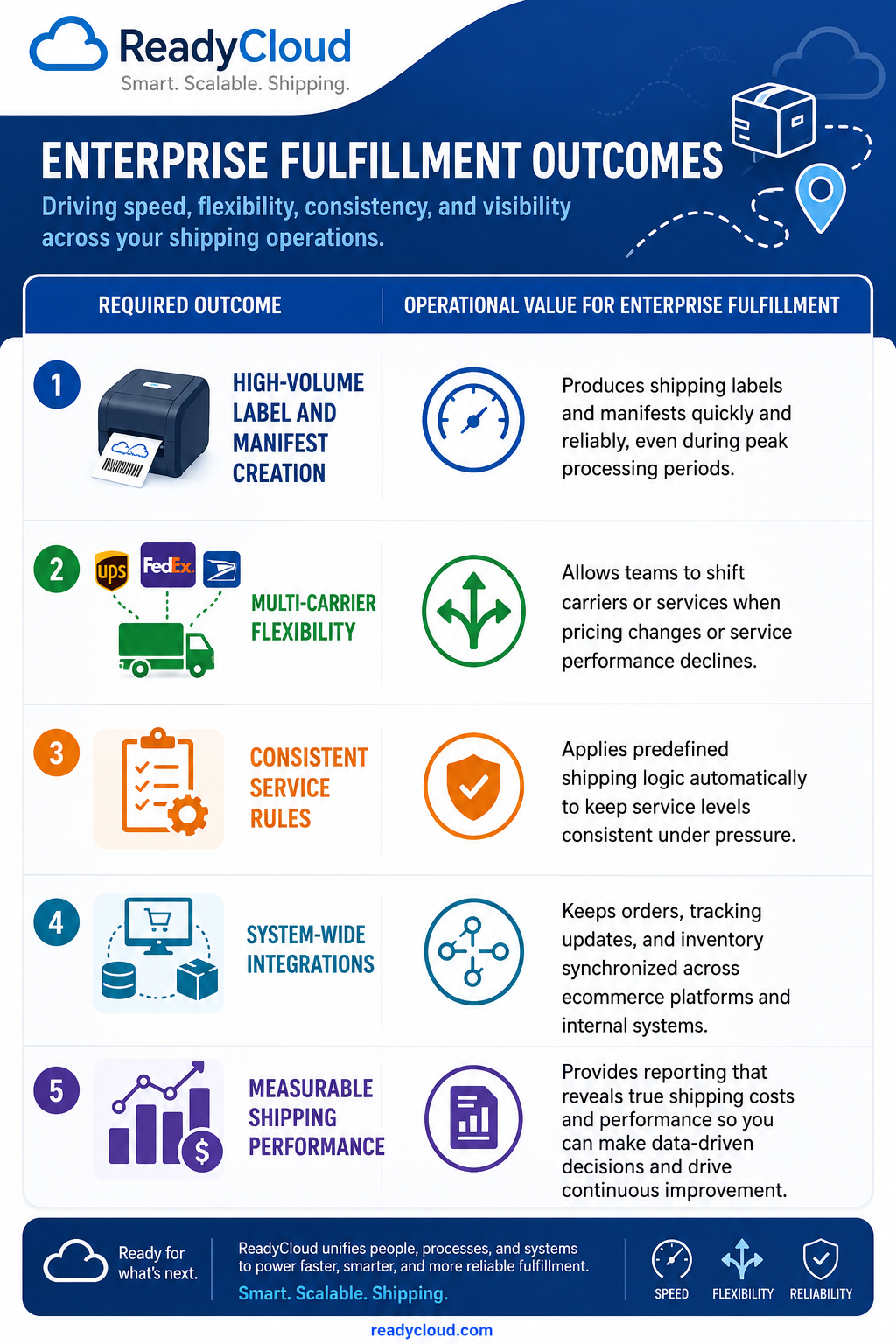
Here are the outcomes enterprise teams typically need from shipping, in plain terms:
| Required Outcome | Operational Value for Enterprise Fulfillment |
|---|---|
| High-Volume Label and Manifest Creation | Produces shipping labels and manifests quickly and reliably, even during peak processing periods. |
| Multi-Carrier Flexibility | Allows teams to shift carriers or services when pricing changes or service performance declines. |
| Consistent Service Rules | Applies predefined shipping logic automatically to keep service levels consistent under pressure. |
| System-Wide Integrations | Keeps orders, tracking updates, and inventory synchronized across ecommerce platforms and internal systems. |
| Measurable Shipping Performance | Provides reporting that reveals true shipping costs and performance trends, enabling data-driven improvements. |
If you’re chasing spreadsheets, fixing exceptions manually, or spending half your day reconciling data between tools, that’s not a team problem. It’s a system problem.

The Growth Tipping Points That Signal You’ve Outgrown Basic Tools
Most companies don’t wake up and decide they need enterprise shipping. They feel it first. It shows up as “minor issues” that keep repeating until leadership starts asking why shipping costs are rising while delivery performance is slipping.
One common tipping point is throughput. If your team is working harder but shipping less, the bottleneck is often label creation, batch printing, or manual steps that weren’t a big deal at lower volume. Peak season then becomes a stress test you fail in public.
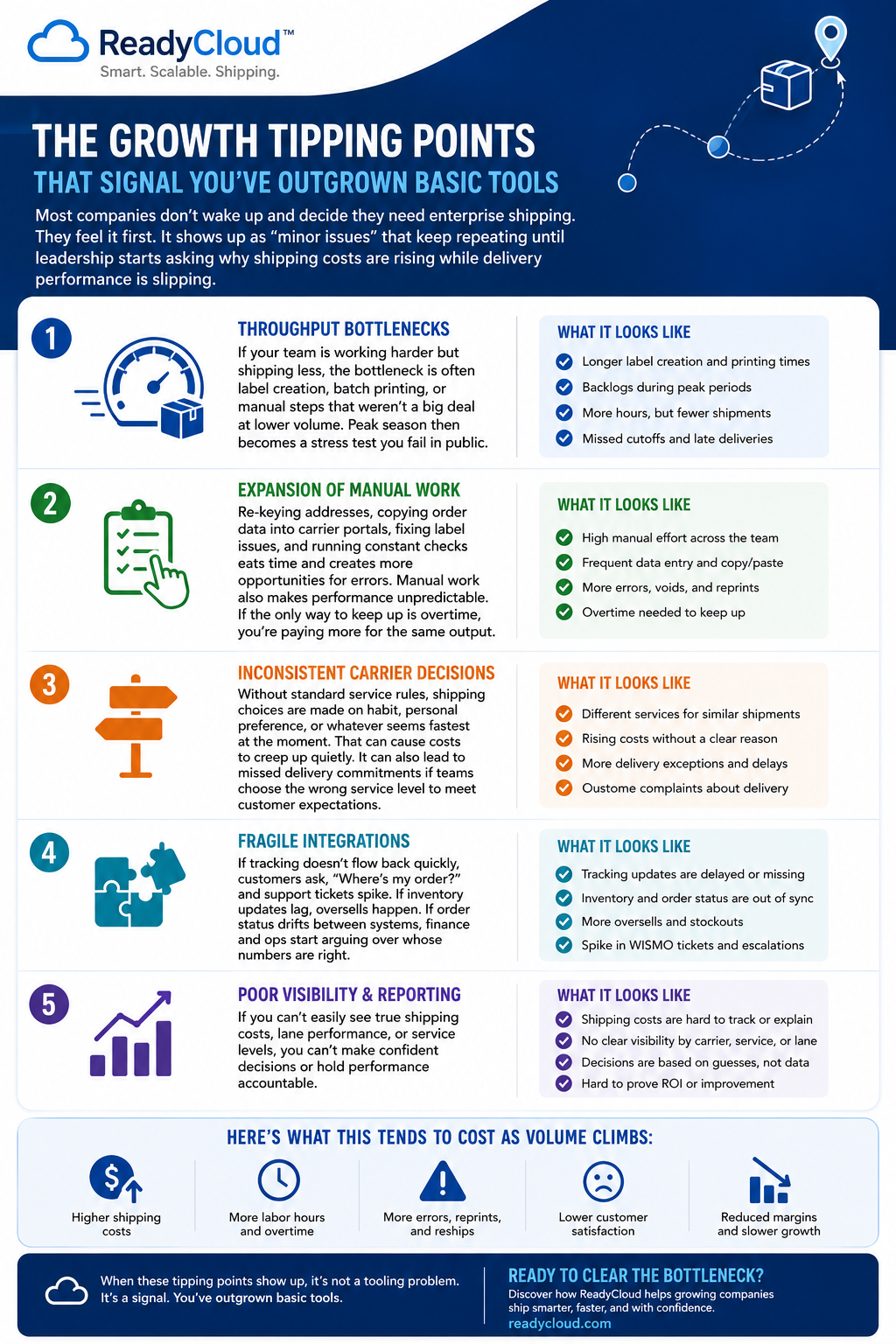
Inconsistent carrier decisions are another classic sign. Without standard service rules, shipping choices are made on habit, personal preference, or whatever seems fastest at the moment. That can cause costs to creep up quietly. It can also lead to missed delivery commitments if teams choose the wrong service level to meet customer expectations.
Fragile integrations also surface quickly as you scale. If tracking doesn’t flow back quickly, customers ask, “Where’s my order?” and support tickets spike. If inventory updates lag, oversells happen. If order status drifts between systems, finance and ops start arguing over whose numbers are right.
Here’s what this tends to cost as volume climbs:
| Cost Pressure | Business Impact as Order Volume Increases |
|---|---|
| Labor Creep | Temporary fulfillment help becomes permanent headcount as manual workflows cannot keep pace with growing order volume. |
| Shipping Exceptions and Reships | Address errors, misroutes, and delivery failures increase, driving higher claim volume and replacement shipments. |
| Customer Support Load | Tracking gaps generate more order status inquiries, increasing support workload and operational costs. |
| Customer Trust Erosion | Delivery inconsistencies and poor post-purchase communication reduce repeat purchases and long-term loyalty. |
If these issues sound familiar, the core problem usually isn’t effort. It’s that the tools were built for a smaller version of your business.
“Cloud-based solutions are tethered to the uptime of the service provider, whereas hybrid-cloud solutions mean you can keep shipping packages even if your SaaS provider is experiencing a disruption of service.” – Read Article on Forbes


What You Gain With An Enterprise Shipping System
Enterprise-grade shipping changes the day-to-day in a few important ways. First, it reduces decision load. The best systems don’t ask your team to “think harder” for every label. They encode decisions into rules, so the default path is usually the right one.
Fulfillment speed improves because manual steps shrink and batch processes stabilize. That doesn’t just help on your busiest days. It helps every day you’re fighting cutoffs, late pickups, or labor shortages. Better systems also reduce the number of stop-the-line exceptions that disrupt the entire workflow.

Error rates drop because the system can catch problems earlier. Addressing issues, incorrect service selections, and labeling inconsistencies are all easier to prevent than to clean up after the carrier has the package. Prevention also reduces those hidden costs like reships, refunds, and lost time chasing down where a package went wrong.
Customer experience improves as a side effect of operational reliability. Customers don’t care how hard your team worked to find the right label. They care that tracking makes sense, delivery matches the promise, and problems are rare.
A strong enterprise approach often includes:
| Enterprise Practice | Operational Benefit |
|---|---|
| Address Validation | Verifies addresses before shipment, reducing carrier surcharges, delivery delays, and returns to sender. |
| Service-Level Shipping Rules | Aligns storefront delivery promises with actual carrier services to maintain consistent delivery expectations. |
| Standardized Labeling and Scanning | Ensures consistent packing, scanning, and shipment handling across multiple warehouses or fulfillment locations. |
| Automated Workflow Steps | Keeps fulfillment moving during peak periods by removing manual bottlenecks and repetitive tasks. |
The best part is visibility. Instead of guessing why shipping costs rose last month, you can see it. Instead of debating which warehouse is struggling, you can measure it. That’s how shipping becomes a managed system instead of a constant scramble.
Key Signals You’ve Outgrown Basic Tools
Most companies don’t wake up and decide they need enterprise shipping. They feel it first. It shows up as “minor issues” that keep repeating until leadership starts asking why shipping costs are rising while delivery performance is slipping.
One common tipping point is throughput. If your team is working harder but shipping less, the bottleneck is often label creation, batch printing, or manual steps that weren’t a big deal at lower volume. Peak season then becomes a stress test you fail in public.
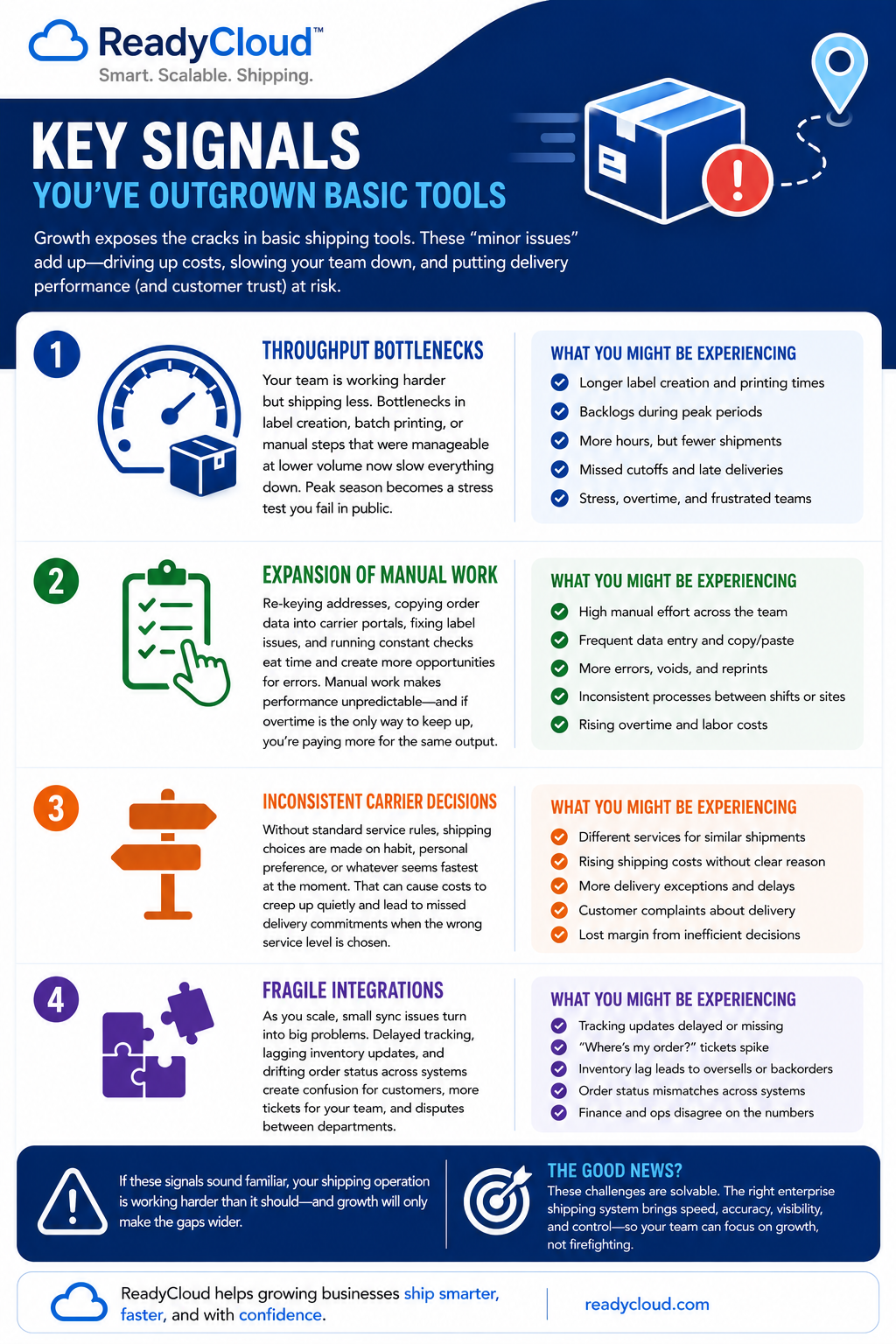
Another tipping point is the expansion of manual work. Re-keying addresses, copying order data into carrier portals, fixing label issues, and running constant checks eats time and create more opportunities for errors. Manual work also makes performance unpredictable. If the only way to keep up is overtime, you’re paying more for the same output.
Inconsistent carrier decisions are another classic sign. Without standard service rules, shipping choices are made on habit, personal preference, or whatever seems fastest at the moment. That can cause costs to creep up quietly. It can also lead to missed delivery commitments if teams choose the wrong service level to meet customer expectations.
Fragile integrations also surface quickly as you scale. If tracking doesn’t flow back quickly, customers ask, “Where’s my order?” and support tickets spike. If inventory updates lag, oversells happen. If order status drifts between systems, finance and ops start arguing over whose numbers are right.
The Non-Negotiables: Capabilities Enterprise Teams Should Demand
Enterprise shipping software is marketed with long feature lists, but evaluation should start with a shorter question: will this reduce exceptions, standardize decision-making, and remain stable at your peak volume? If the answer is unclear, the feature list doesn’t matter.
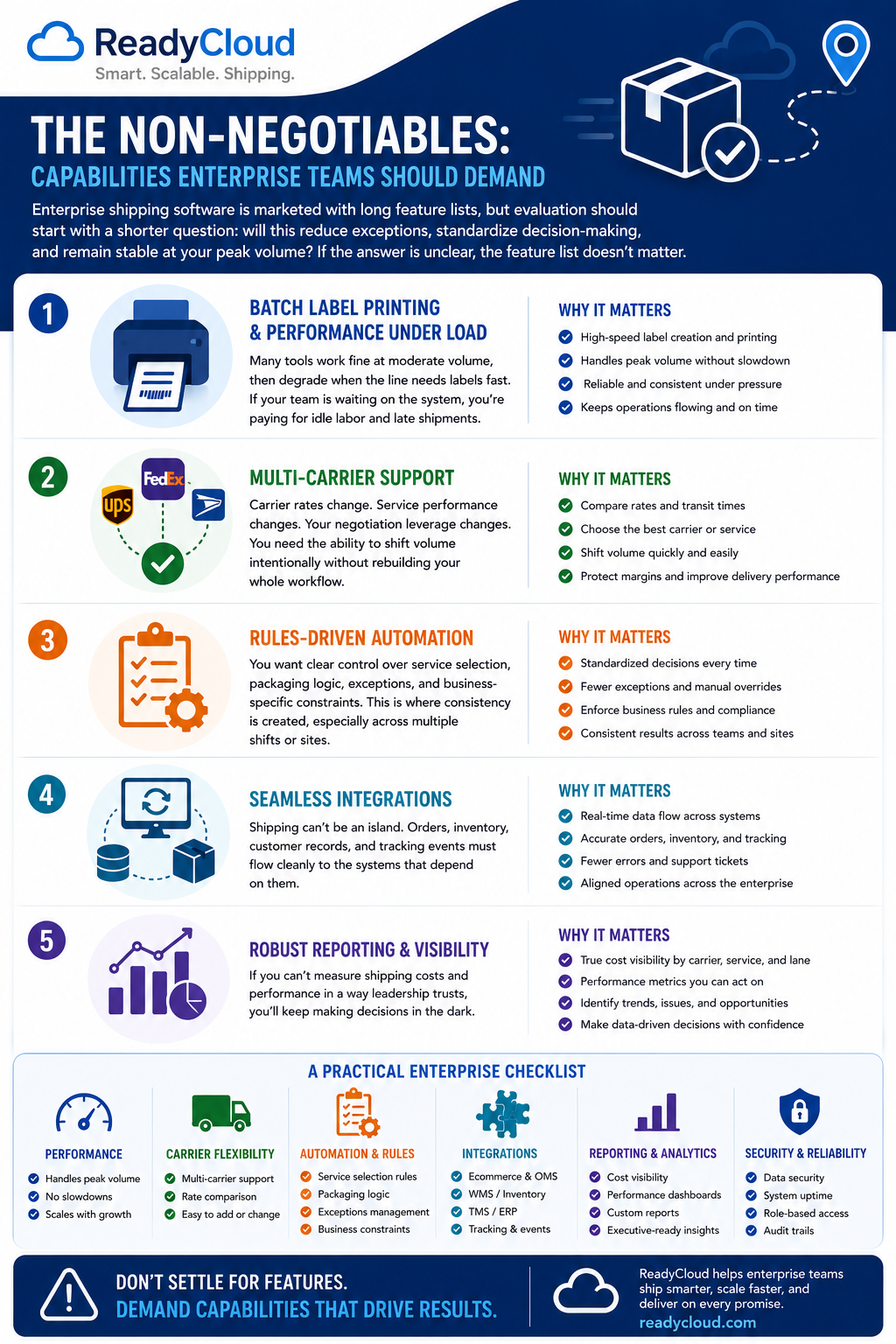
Batch label printing and performance under load are one of the biggest deal-breakers. Many tools work fine at moderate volume, then degrade when the line needs labels fast. If your team is waiting on the system, you’re paying for idle labor and late shipments.
Multi-carrier support is another must-have. Carrier rates change. Service performance changes. Your negotiation leverage changes. You need the ability to shift volume intentionally without rebuilding your whole workflow.
Rules-driven automation should be treated as required, not optional. You want clear control over service selection, packaging logic, exceptions, and business-specific constraints. This is where consistency is created, especially across multiple shifts or sites.
Integrations are also critical. Shipping can’t be an island. Orders, inventory, customer records, and tracking events must flow cleanly to the systems that depend on them. Reporting is the other half of this. If you can’t measure shipping costs and performance in a way leadership trusts, you’ll keep making decisions in the dark.
A practical enterprise checklist looks like this:
| Capability | What It Ensures in Enterprise Operations |
|---|---|
| High-Volume Label Creation and Batch Processing | Supports consistent fulfillment throughput even during peak demand without workflow slowdowns. |
| Multi-Carrier Rate Comparison | Provides flexible shipping options with configurable decision rules based on cost, speed, or service level. |
| Automation for Service and Packaging Decisions | Applies consistent logic for carrier selection, packaging, and exception handling without manual intervention. |
| Reliable Integrations | Keeps order, tracking, and inventory data synchronized across all connected platforms and systems. |
| Operational Analytics and Reporting | Delivers measurable insights into performance, shipping costs, and operational issues to guide improvements. |
If you’re sorting “nice-to-have” items, treat cosmetic preferences and minor workflow tweaks as secondary. Focus on decisions, automation, integrations, and reporting first. Those are the levers that change outcomes.
“In a perfect world, you’d have the solution you needed in just a few clicks. In reality, not all software accommodates the specific needs of the individual retailer. When creating a balanced shipping strategy for your online business, it’s imperative that you ensure the feature sets you need are in place, so you can fulfill faster and go home early.” – Read Article on Forbes
Shipping execution may feel like an ops-only concern, yet it’s also customer experience and brand perception. Clean fulfillment makes your post-purchase communication more believable, because customers can see proof in the tracking timeline. That’s the foundation that makes proactive messaging work.
“Post-purchase is a crucial part of the customer journey, but it often doesn’t get the attention it deserves, especially at the enterprise level. What’s interesting is how many growing e-commerce brands are outshining larger retailers when it comes to what happens after the “buy” button is clicked.” – Read Article on Forbes
Integrations Matter More Than A Long Feature List
In most growing operations, the worst shipping pain doesn’t happen inside the shipping tool. It happens between tools. That’s where drift is created, and drift is what turns a normal day into cleanup work.
Order drift can occur when orders appear in one system but not another, or when order details aren’t cleanly synchronized. Tracking drift occurs when labels are created but the tracking events don’t reach customer-facing systems quickly enough. Inventory drift occurs when deductions are made late or inconsistently, leading to oversells, cancellations, or mispicks.
These gaps create labor. Someone has to reconcile the mismatch. Someone has to manually update statuses. Someone has to answer customer emails that should’ve been prevented with accurate tracking and communication.
A healthy enterprise shipping flow usually looks like this:
| Workflow Stage | What Happens Operationally |
|---|---|
| Order Placement | A customer completes a purchase in a sales channel such as an ecommerce storefront or marketplace. |
| Order Data Synchronization | Order information automatically syncs into fulfillment systems, ensuring accurate processing without manual entry. |
| Label Creation and Service Selection | Shipping software generates labels and selects carriers according to predefined service rules. |
| Tracking and Customer Updates | Shipment status and tracking information are returned to customer-facing touchpoints such as storefronts and notifications. |
| Operational Reporting | Shipping and fulfillment data are consolidated into reports that reveal performance trends and true shipping costs. |
If your business relies on spreadsheets or manual checks to keep this flow intact, that’s a sign the stack isn’t doing its job. Shipping and receiving tools should reduce data translation work, not create more of it.
A useful way to assess integration readiness is to run a quick internal audit:
- Identify where your team rekeys information or copies data between tools.
- Track which exceptions are most common and where they originate.
- Map where tracking delays occur and how that affects support volume.
- Prioritize fixing data drift before you add new channels or facilities.
Integrations aren’t exciting, but they’re often the difference between scaling smoothly and scaling painfully.
“Many retailers are simply not equipped to manage what’s coming. But some are. These are the brands already investing in technology, training and process optimization to turn what used to be a logistical nightmare into a competitive edge.” – Read Article on Forbes
Shipping And Post-Purchase: Why Returns Belong In The Same Conversation
Shipping doesn’t end when the box leaves your dock. From the customer’s perspective, the experience is still in motion until the product is in hand and expectations are met. That’s why shipping strategy and post-purchase experience should be discussed together.
Tracking clarity reduces “where is my order” pressure on support. It also helps customers trust your timelines. If your tracking and status updates are inconsistent, you’ll see it in ticket volume and reship rates. Even if the carrier performs well, confusion incurs costs.
“Modern consumers expect transparency. They don’t want to chase tracking links across different carriers or dig through their inbox to figure out when a package is supposed to arrive. They want real-time updates and branded communication that feels consistent with the rest of their shopping experience.
Brands that offer detailed order tracking, SMS updates or branded tracking pages are already ahead of the curve. These shipping intelligence touchpoints show customers that the brand is still involved … even after the sale is complete.” Read Article on Forbes
Returns are the other side of the same operational coin. As businesses scale, returns become more complex, not less. More SKUs, more channels, and more policies create more edge cases. If shipping and returns data live in separate worlds, reporting gets messy, and the customer experience can feel disconnected.
An enterprise returns management approach treats shipping and returns as connected workflows with shared data. That doesn’t mean you need one giant tool that does everything. It does mean you should plan for visibility and consistency across forward and reverse logistics.
Key alignment points include:
- Shared data between shipping events, order history, and customer records.
- Consistent policies across channels so customers aren’t surprised.
- Unified reporting so you can see the full cost of fulfillment and returns.
If your returns process is mature, shipping decisions often improve too. You start spotting patterns, such as which service levels lead to more damage, which warehouses produce more exceptions, and which product categories cause repeat issues. That’s where operational learning turns into profit protection.
Implementation Plan: How To Roll Out Without Disrupting Operations
Enterprise shipping projects fail when teams try to replace everything at once without protecting daily throughput. The best implementations are phased. They focus on stabilizing core workflows first, then expanding once the process is proven.
Start with a baseline. You want real metrics before you change tools so you can measure improvement and avoid “it feels better” decision-making. Track throughput, error rates, cost per shipment, exception categories, and support volume tied to shipping questions. If you have multiple warehouses, track these by location.
Next, standardize decision rules. Define service-level logic, cutoff handling, packaging assumptions, and how exceptions should be routed. Rules create consistency, so this work is worth doing carefully. A tool can only automate what you’ve defined.
Integrations should be validated early. Confirm which systems must stay in sync and what “good data” looks like for each. Pay special attention to tracking flow and order status updates, since those affect customer experience and support workload.
Then run a controlled pilot. Choose a lane where you can test real volume without risking the entire operation. That might be one warehouse, one brand, or a specific carrier mix. Use the pilot to pressure-test batch volumes, label formats, and exception handling.
A rollout risk-reduction checklist helps keep the team steady:
- Keep the fallback process limited during the early cutover period.
- Validate label formats and carrier compliance before go-live.
- Test peak-like batch volumes, not just quiet-day scenarios.
Finally, scale with governance. Decide who owns rule updates, who reviews reporting, and how improvements get prioritized. Enterprise shipping is never “set it and forget it.” It’s a system you manage, measure, and refine.

“The post-purchase experience shapes your brand just as much as what draws a customer to it before they buy. Branding or advertising begin to shape customer confidence, but the experience that follows checkout influences loyalty more.” Read Article on Fast Company

Get A Shipping Stack That Holds Up Under Pressure
If shipping feels like the part of your business that’s always one surprise away from chaos, it’s worth stepping back and asking a simple question: Is your shipping setup built for the volume you have today, or the volume you’re trying to reach next?
ReadyCloud is built for growing operations that need shipping to stay reliable as complexity rises. That means automation that reduces manual decision-making, multi-carrier flexibility that supports cost control, and integrations that keep orders, tracking, and operations data aligned across the stack. You don’t need more tools that add steps. You need a system that removes friction and gives your team a repeatable process they can trust.
If you’re evaluating a change, come prepared with a few details so the conversation stays practical:
- Average monthly order volume and your peak season spike.
- Your current carrier mix and where service selection breaks down.
- The systems that must integrate cleanly, including ERP, WMS, 3PL, and support tools.
ReadyCloud can help you map out what an enterprise-ready shipping workflow via ReadyShipper X should look like in your environment, so the next growth phase feels controlled rather than chaotic. Ready to get started? Let’s Chat.
The Future of Ecommerce is Now
Staying ahead in the ecommerce industry means embracing innovation and anticipating changes before they arrive. The ecommerce trends shaping 2025 provide valuable insights into what’s next, but the future also brings exciting new possibilities. Businesses that adapt quickly and leverage the right tools will thrive in this dynamic landscape.
Ready for 2026? ReadyCloud Has You Covered!
Success in 2026 starts with the right tools, and ReadyCloud’s suite of solutions is designed to propel your ecommerce business to new heights. With ReadyCloud, you’ll have all your data centralized in one place, offering insights that drive smarter decisions. Take your marketing to the next level with Action Alerts, delivering growth-focused, automated campaigns that keep your customers engaged.
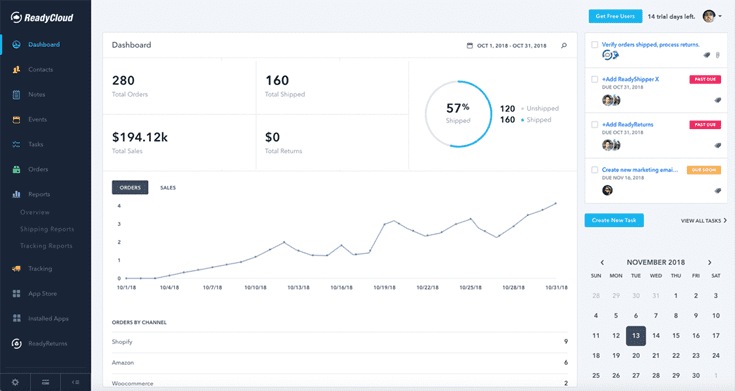

Shipping is easier than ever with ReadyShipper X, a multicarrier solution that simplifies your fulfillment process while saving time and money.

And when it comes to returns, ReadyReturns streamlines the entire process with an automated solution that boosts customer satisfaction and loyalty.
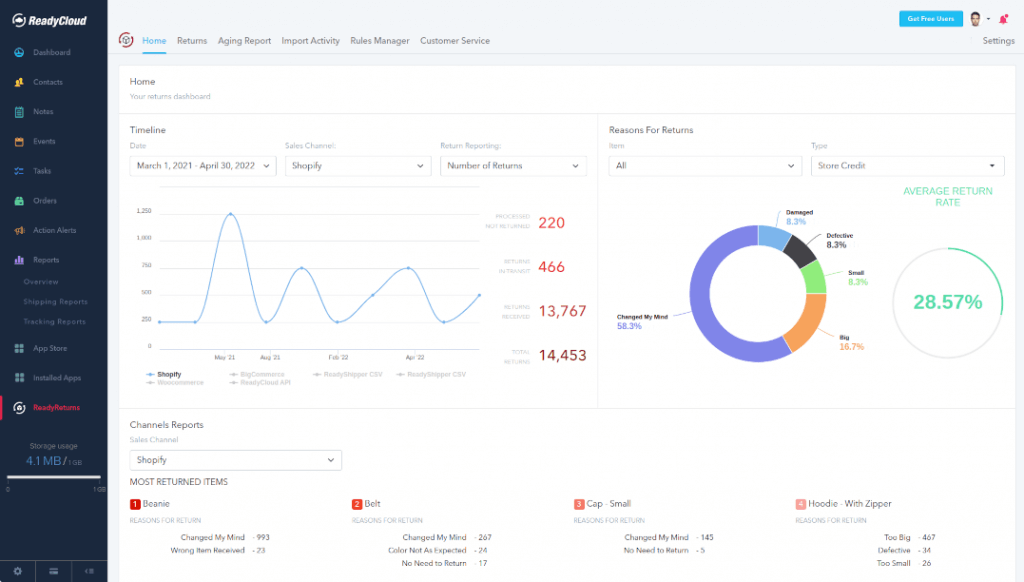

ReadyCloud is more than just a suite of systems—it’s your ticket to thriving in 2026 and beyond!
Start your journey to success today! Learn more and get started here.
Or contact our Sales Department at: 877-818-7447 ext. 1.
Frequently Asked Questions About Enterprise Shipping Systems
Enterprise Shipping System Vs Parcel Shipping Software: What’s The Difference?
An enterprise shipping system is typically built for scale and governance, not just label creation. It focuses on consistent decision-making through rules, stable performance at high volume, and integration depth across the rest of your stack. Parcel shipping software can work well for smaller teams that just need to print labels, but it may struggle once automation, reporting, and multi-location consistency become daily needs. For enterprise teams, the difference shows up in fewer exceptions, better data flow, and more predictable outcomes.
What Features Should An Enterprise Shipping Platform Include?
Look for stable high-volume label creation, multi-carrier support, and rules-driven automation that standardizes service selection. Strong integrations matter just as much as features, since shipping data must remain consistent across systems such as ERP, WMS, and customer communication tools. Reporting should help you answer operational questions, including cost per shipment, exceptions by category, and performance trends over time. A platform that can’t connect cleanly or report clearly will create more work than it removes.
How Do Enterprise Teams Reduce Shipping Costs Without Slowing Delivery?
Cost reduction usually comes from consistency, not shortcuts. Rules-based service selection helps ensure you’re not paying premium rates when a lower-cost option still meets the delivery promise. Rate comparison at the point of label creation can also prevent costly “habit decisions” that accumulate across thousands of shipments. The best approach ties cost controls to customer commitments, so savings don’t create new support problems.
What Is Rate Shopping In Enterprise Shipping?
Rate shopping means comparing carrier options and service levels in real time, then selecting the best match based on your rules. Those rules might factor in cost, transit time, delivery promise, package details, and cutoff timing. The real value lies in consistency, as it prevents different shifts or locations from making conflicting decisions. Over time, consistent selection makes it easier to negotiate with carriers and manage shipping spend predictably.
How Important Are Integrations With ERP, WMS, Or 3PL Tools?
Integrations are often the make-or-break factor in a shipping rollout. If orders, inventory, and tracking don’t stay aligned, teams end up doing reconciliation work that grows with volume. Clean integrations reduce re-keying, prevent order drift, and speed up tracking updates that customers rely on. They also improve reporting, since leadership can trust the numbers when systems aren’t fighting each other.
How Do You Know You’ve Outgrown Basic Shipping Tools?
You’ll usually see throughput slow down even as the team works harder. Manual steps expand, and exceptions become the norm rather than the exception. Carrier selection becomes inconsistent, leading to higher costs and missed delivery commitments. Tracking gaps also increases support tickets, as customers and internal teams can’t clearly see what’s happening.
How Long Does It Take To Implement Enterprise Shipping Software?
Implementation timelines depend on integration complexity, rule definition, and how much you’re changing at once. A phased approach tends to work best, starting with baselining your current metrics, validating integrations, and then piloting in a controlled lane. Training and an exception playbook are just as important as the technical setup, since consistency is the goal. Once the pilot is stable, scaling across warehouses or brands becomes far less risky.
Can Enterprise Shipping Software Improve Customer Experience?
Yes, mostly through reliability. Fewer label errors and clearer tracking reduce surprises and keep customers informed. Consistent service selection increases the likelihood that delivery matches the customer’s expectations, reducing complaints and support escalations. Over time, smoother shipping operations tend to reduce reships and refunds that can quietly damage retention.
Should Shipping And Returns Be Managed In The Same Platform?
Shipping and returns benefit from shared data and consistent policies, even if they aren’t handled in a single tool. If shipping and returns live in separate systems with limited visibility, reporting becomes fragmented, and customers can feel the disconnect. Connected workflows make it easier to identify where issues originate, such as damage patterns or service-level problems. In enterprise operations, alignment between forward and reverse logistics often leads to clearer decision-making and better cost control.