


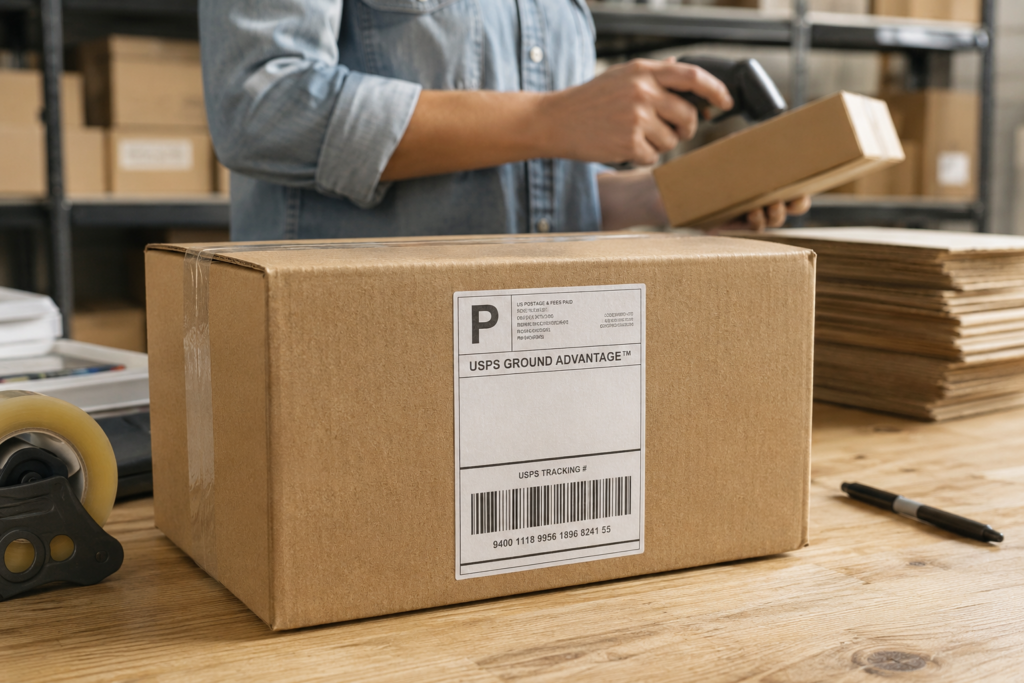
Shipping a small package doesn’t always mean paying a small shipping bill. For ecommerce brands selling books, candles, beauty products, auto parts, hardware, accessories, and other compact goods, package weight can drive up shipping costs even when the box itself occupies very little space.
That’s where USPS Ground Advantage Cubic enters the picture. This commercial USPS pricing option is designed for qualifying compact packages. Instead of basing the shipping rate primarily on actual package weight, cubic pricing considers the parcel’s volume and the distance it travels. For merchants shipping dense products, that can create another rate option worth comparing.
Ground Advantage Cubic also offers the service features associated with USPS Ground Advantage, including tracking, insurance, and a 2–5 business-day delivery standard.
For ecommerce teams, the challenge is simple: knowing when a package qualifies, how the cubic calculation works, and whether the service fits the delivery promise made to the customer.
Here’s what you need to know and why the shipping system you’re using matters more than ever.
“The post-purchase experience deserves a seat at the executive table because it affects both brand equity and margin. A better return process can reduce service volume while increasing customer confidence. Clearer shipping communication can lower inbound tickets while improving trust. Faster resolution can protect repeat purchases. Cleaner workflows can reduce stress on teams and make the business easier to scale.” Read Article on Forbes



USPS Ground Advantage Cubic Explained
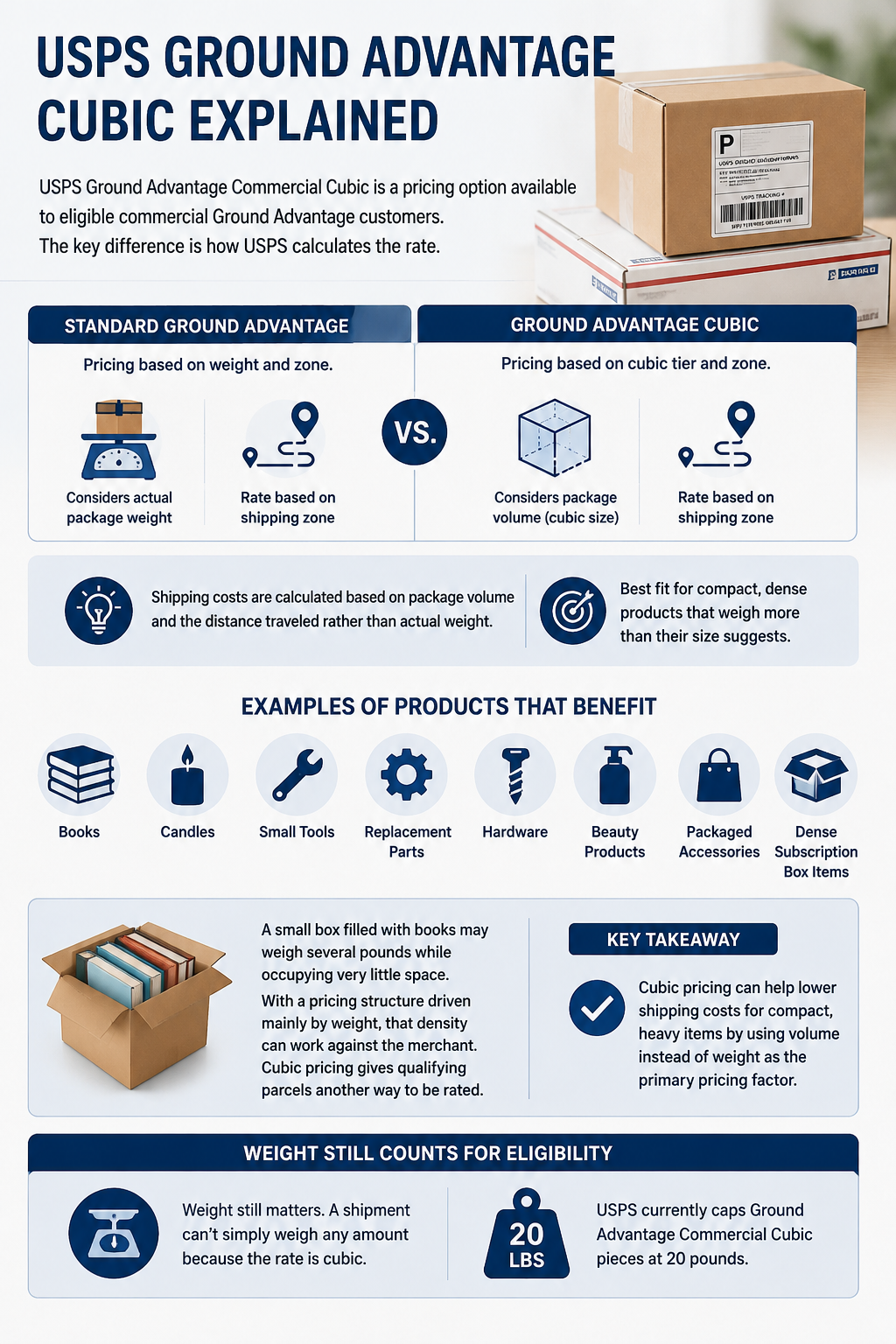
USPS Ground Advantage Commercial Cubic is a pricing option available to eligible commercial Ground Advantage customers.
The key difference is how USPS calculates the rate.
Standard Ground Advantage pricing generally considers package weight and shipping zone. Cubic pricing instead uses the package’s cubic tier and destination zone for qualifying shipments. Shipping costs are calculated based on package volume and the distance traveled rather than actual weight.
That makes the service especially interesting for compact products that carry more weight than their physical size might suggest.
Think about an online retailer shipping:
- Books
- Candles
- Small tools
- Replacement parts
- Hardware
- Beauty products
- Packaged accessories
- Dense subscription box items
A small box filled with books may weigh several pounds while occupying very little space. With a pricing structure driven mainly by weight, that density can work against the merchant. Cubic pricing gives qualifying parcels another way to be rated.
Weight still counts for eligibility. A shipment can’t simply weigh any amount because the rate is cubic. USPS currently caps Ground Advantage Commercial Cubic pieces at 20 pounds.


“Growing e-commerce brands have set a new standard. They’re demonstrating that, with the right strategy in place, the post-purchase experience can be elevated. And customers are noticing it. For the larger retailers in the pond, this represents a monumental shift that swings from traditional customer acquisition to long-term retention.” Read Article on Forbes


How USPS Ground Advantage Cubic Pricing Works
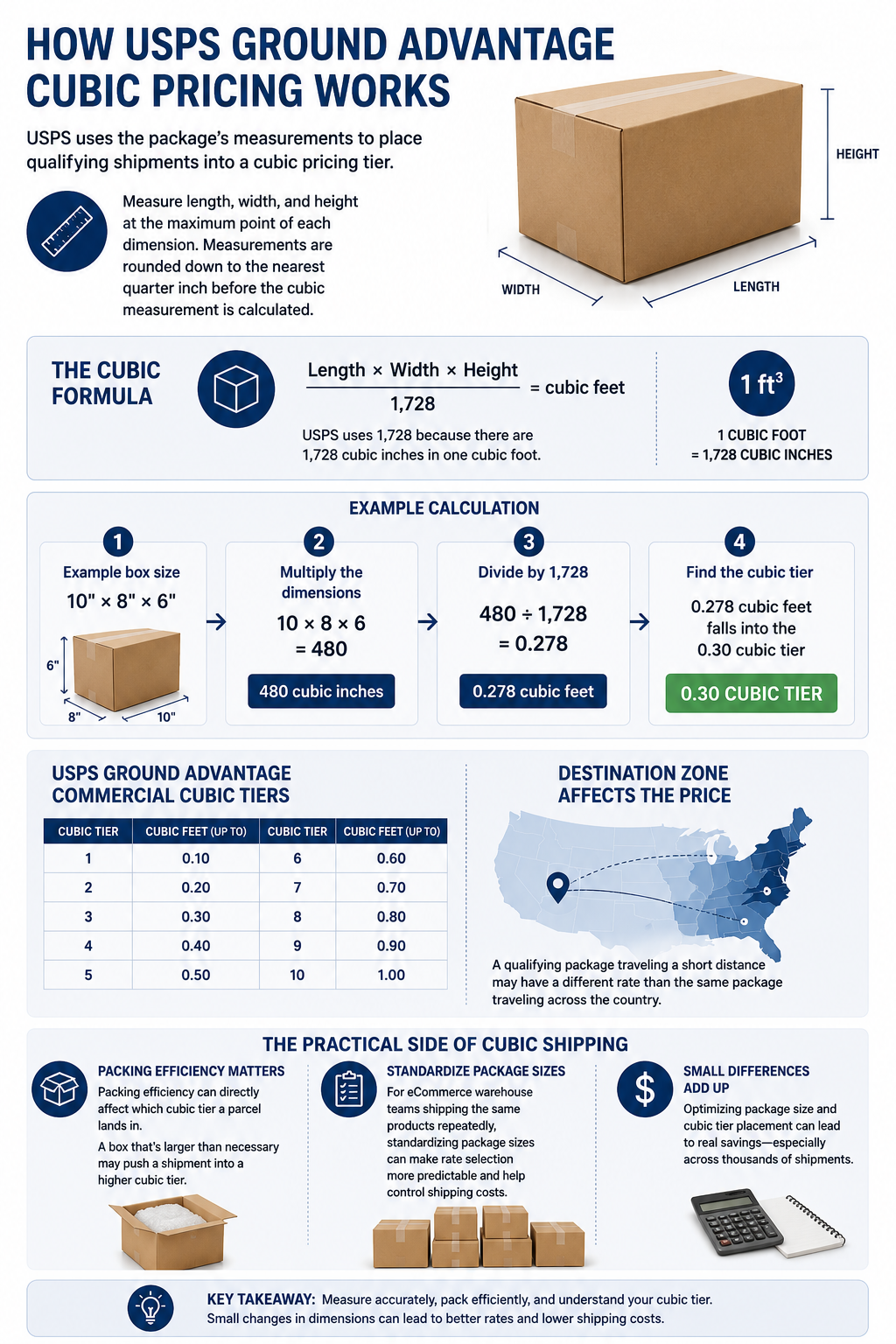
USPS uses the package’s measurements to place qualifying shipments into a cubic pricing tier.
For rectangular and nonrectangular parcels, USPS instructs shippers to measure the length, width, and height at the maximum point of each dimension. Measurements are rounded down to the nearest quarter inch before the cubic measurement is calculated.
The basic formula is:
Length × Width × Height ÷ 1,728 = cubic feet
USPS uses 1,728 because there are 1,728 cubic inches in one cubic foot.
For example, imagine an ecommerce order packed in a box measuring:
10″ × 8″ × 6″
Multiply the dimensions:
10 × 8 × 6 = 480 cubic inches
Then divide by 1,728:
480 ÷ 1,728 = 0.278 cubic feet
That shipment falls into the 0.30 cubic tier.
USPS currently has 10 Ground Advantage Commercial Cubic tiers:
- 0.10 cubic foot
- 0.20 cubic foot
- 0.30 cubic foot
- 0.40 cubic foot
- 0.50 cubic foot
- 0.60 cubic foot
- 0.70 cubic foot
- 0.80 cubic foot
- 0.90 cubic foot
- 1.00 cubic foot
The destination zone also affects the final shipping price. A qualifying package traveling a short distance may have a different rate than the same package traveling across the country.
That’s the practical side of cubic shipping. Packing efficiency can directly affect which tier a parcel lands in.
A box that’s larger than necessary may push a shipment into a higher cubic tier. For ecommerce warehouse teams shipping the same products repeatedly, standardizing package sizes can make rate selection more predictable.
“The post-purchase experience shapes your brand just as much as what draws a customer to it before they buy. Branding or advertising begin to shape customer confidence, but the experience that follows checkout influences loyalty more.” Read Article on Fast Company

What Packages Qualify for Ground Advantage Cubic?
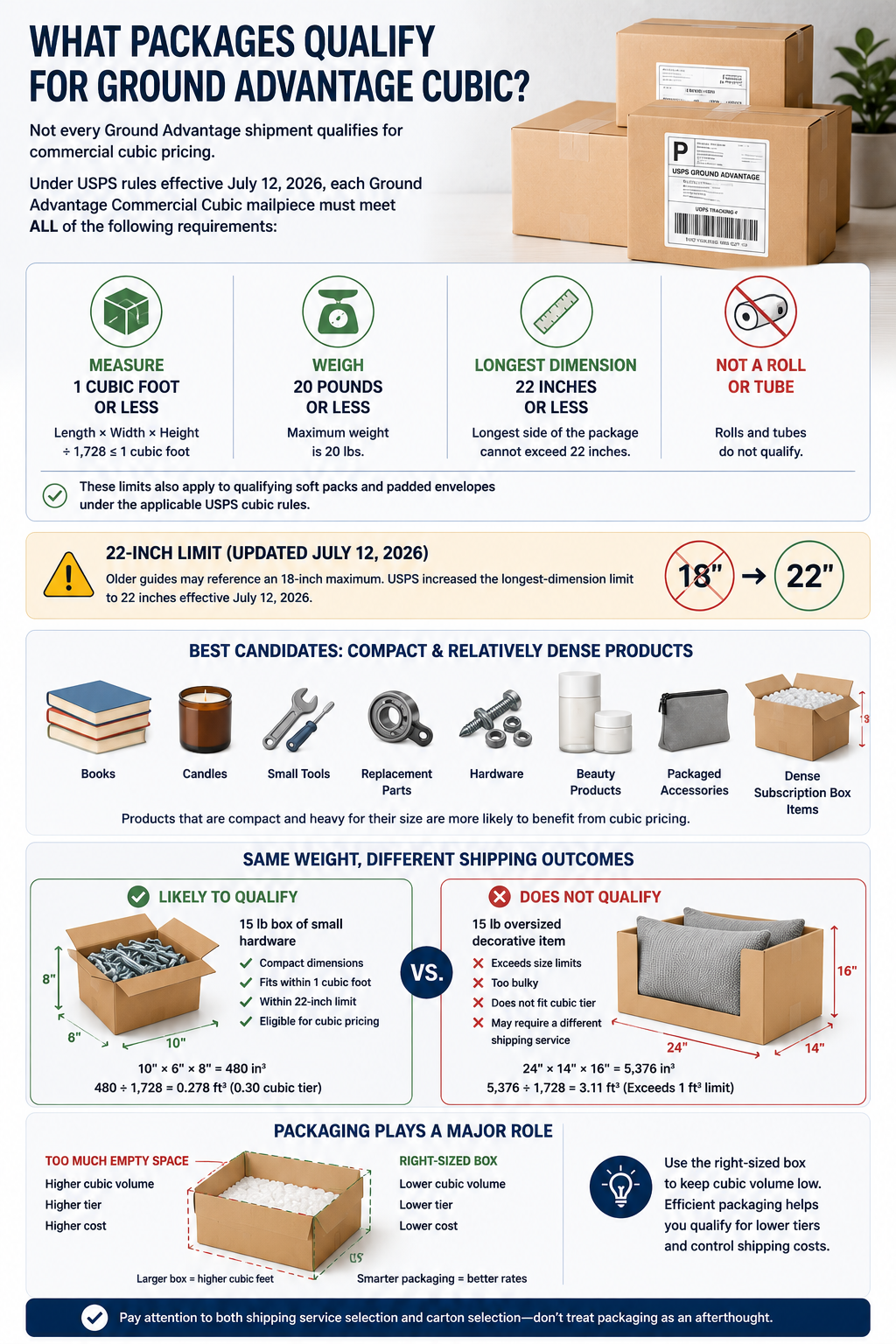
Not every Ground Advantage shipment qualifies for commercial cubic pricing.
Under USPS rules effective July 12, 2026, each Ground Advantage Commercial Cubic mailpiece must:
- Measure 1 cubic foot or less
- Weigh 20 pounds or less
- Have a longest dimension of 22 inches or less
- Not be a roll or tube
These limits also apply to qualifying soft packs and padded envelopes under the applicable USPS cubic rules.
The 22-inch limit is especially useful for checking whether you’ve read older Ground Advantage Cubic guides. Previous material may still reference an 18-inch maximum, but USPS increased the longest-dimension limit to 22 inches in July 2026.
For online retailers using enterprise shipping systems, the best candidates are often products that are physically compact and relatively dense.
A 15-pound box of small hardware, for example, has a very different shipping profile from a 15-pound oversized decorative item. The first may fit neatly within a cubic tier. The second may not qualify at all.
Packaging plays a large role here. Using a box with unnecessary empty space can raise cubic volume and change the pricing tier. Growing ecommerce brands should pay attention to both shipping service selection and carton selection rather than treating packaging as an afterthought.
“What often gets missed along the way, though, is that growth doesn’t always equate to profitability. For example, a company may be scaling rapidly, winning over new customers and showing strong performance. But it’s leaking margin in the operational layer because there are small friction points within their logistics flow. Those minor bottlenecks might be in shipping, returns, customer support, or internal handoffs, and they all add up when repeated at scale.” Read Article on Fast Company
Does USPS Ground Advantage Have Insurance?
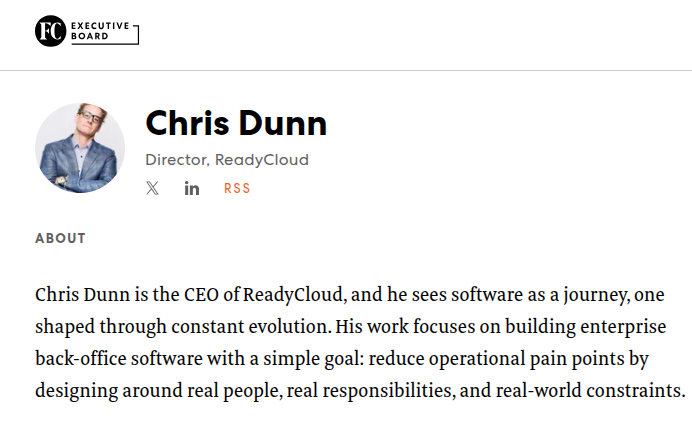
Yes. USPS Ground Advantage includes up to $100 of insurance coverage for merchandise, including qualifying outbound and return shipments.
USPS also allows shippers to purchase additional insurance coverage for merchandise up to $5,000. Tracking is included with Ground Advantage as well.
That insurance applies to the underlying Ground Advantage service, so merchants using the commercial cubic pricing option still receive its features.
For ecommerce businesses, including insurance can reduce some of the financial exposure associated with packages that are lost or damaged in transit.
That doesn’t mean $100 is enough for every order. A merchant selling lower-cost accessories may find the included amount covers most shipments. A retailer sending higher-value merchandise may need to consider additional coverage based on the order’s value.
The bigger issue is making consistent insurance decisions. If warehouse employees have to remember which orders need additional coverage each time they print a label, mistakes become more likely as order volume rises. Shipping rules and automation can help teams apply the right process based on order value, service, or other shipment details.
Is USPS Ground Advantage Fast?
USPS lists a 2–5 business-day delivery standard for Ground Advantage. Tracking is included.
That makes Ground Advantage a practical option for many standard ecommerce deliveries, but it isn’t the same as choosing a premium expedited service.
USPS also states that actual delivery time depends on the origin, destination, and drop-off time. Shipments to certain destinations, as well as packages containing hazardous materials or live animals, may take longer. Ground Advantage delivery isn’t guaranteed.
For online retailers, speed isn’t optional, but speed also has to be viewed in context. A shopper choosing free or economical delivery may be comfortable with a 2–5 business-day carrier window. A shopper paying for expedited delivery has a different expectation.
The carrier transit window is only one part of the equation, too. If an ecommerce brand takes 3 days to pick, pack, and hand off an order, a 2–5 business-day shipping service can become a much longer customer experience.
That’s where many retailers get stuck. They focus on the carrier’s delivery estimate while ignoring warehouse processing time. Fast fulfillment keeps shoppers coming back. The strongest shipping process connects order processing, carrier selection, label creation, and customer communication so the shopper knows what is happening after checkout.

“In a perfect world, you’d have the solution you needed in just a few clicks. In reality, not all software accommodates the specific needs of the individual retailer. When creating a balanced shipping strategy for your online business, it’s imperative that you ensure the feature sets you need are in place, so you can fulfill faster and go home early.” – Read Article on Forbes
Ground Advantage Cubic vs. Standard Ground Advantage
Ground Advantage Cubic and standard Ground Advantage use the same core Ground Advantage service, but the pricing rules differ.
| Feature | Ground Advantage Cubic | Standard Ground Advantage |
|---|---|---|
| Pricing basis | Cubic tier and zone | Primarily weight and zone |
| Best fit | Compact, dense parcels | Broad range of package sizes |
| Cubic eligibility | 1 cubic foot or less | Not required |
| Weight | 20-pound cubic maximum | Ground Advantage supports packages up to 70 pounds |
| Delivery standard | 2–5 business days | 2–5 business days |
| Tracking | ✓ Included | ✓ Included |
| Insurance | $100 included | $100 included |
USPS Ground Advantage itself supports packages weighing up to 70 pounds, while the Commercial Cubic pricing option is limited to packages weighing no more than 20 pounds.
The key point is that cubic pricing changes how an eligible package is rated. It doesn’t create a separate faster Ground Advantage delivery network. That also means merchants don’t need to look at cubic pricing as a replacement for every Ground Advantage shipment.
Some orders may price well under cubic rates. Others may be a better fit for conventional Ground Advantage pricing, Priority Mail, or another carrier entirely. The better approach is to compare services based on the actual package and customer promise.
“Many retailers are simply not equipped to manage what’s coming. But some are. These are the brands already investing in technology, training and process optimization to turn what used to be a logistical nightmare into a competitive edge.” – Read Article on Forbes
When Ground Advantage Cubic Makes Sense for Ecommerce Brands
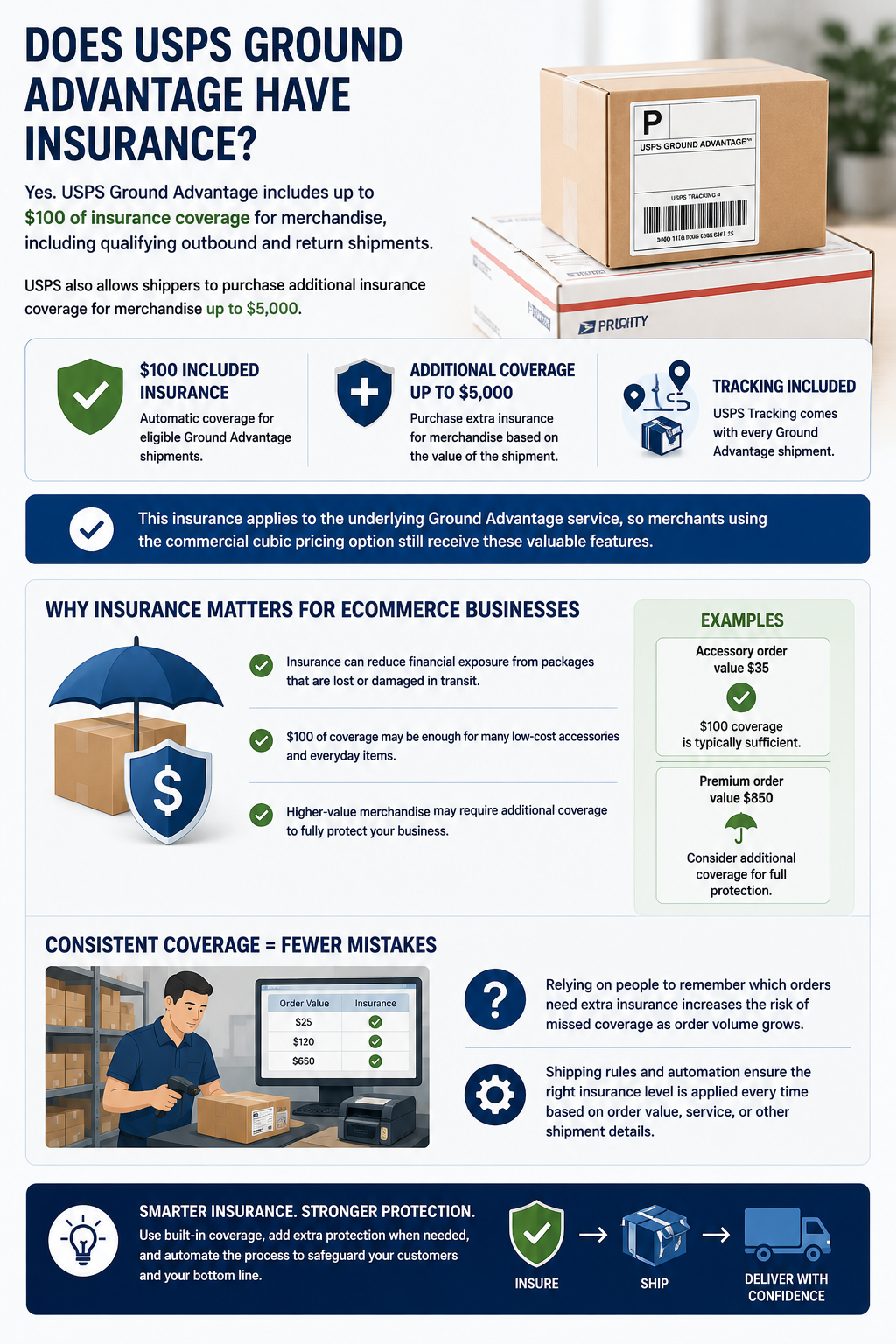
Ground Advantage Cubic can be a strong candidate when your shipping profile regularly includes small, dense parcels.
Consider it if:
- Many packages weigh less than 20 pounds
- Your cartons remain below the cubic size limit
- Your products are compact relative to their weight
- A 2–5 business day service standard fits the customer’s delivery expectation
- You want more commercial USPS rate options to compare
- Your warehouse ships enough orders that manual rate checking is becoming inefficient
It may be less attractive if your products are lightweight but physically large, your cartons exceed the cubic limits, or shoppers routinely require expedited delivery.
Product mix also makes a difference. A cosmetics retailer might have hundreds of orders that fit into small boxes with similar measurements. Cubic pricing could become relevant across a large percentage of those shipments.
A home décor retailer may have far more variation. Some products could qualify, while others would quickly exceed the size limits.
The answer isn’t more manual work. Shipping and receiving software should help teams evaluate the available carrier and service options without turning every order into a separate research project. For busy ecommerce teams, simplicity counts.
“Modern consumers expect transparency. They don’t want to chase tracking links across different carriers or dig through their inbox to figure out when a package is supposed to arrive. They want real-time updates and branded communication that feels consistent with the rest of their shopping experience.
Brands that offer detailed order tracking, SMS updates or branded tracking pages are already ahead of the curve. These shipping intelligence touchpoints show customers that the brand is still involved … even after the sale is complete.” Read Article on Forbes
Packaging Can Affect Your Cubic Shipping Costs
Cubic pricing creates another reason to look closely at packaging. If two boxes can safely hold the same order, the smaller box may place the shipment into a lower cubic tier.
That can make carton selection an operational decision rather than just a packing decision. Consider an ecommerce company shipping a product in a box that’s much larger than the item itself.
Extra void fill takes time, increases material use, and increases package volume. A better-sized carton may reduce the cubic volume while still providing the product with the protection it needs in transit. For growing ecommerce brands, small differences become significant across thousands of shipments.
The goal is simple: use packaging that protects the order without paying to ship unnecessary space. This also makes accurate package data more valuable. If dimensions are incomplete or inconsistent inside the shipping process, rate comparisons can become less useful. Connected ecommerce data helps teams move faster because the shipping decision starts with better information about the order and package.

“Companies looking to scale successfully should focus on building operations strong enough to handle growth so they can seamlessly process more orders.” Read Article on Fast Company
How ReadyShipper X Supports USPS Cubic Shipping
Knowing a cubic rate exists is one thing. Applying the right shipping choice across a busy warehouse is another.
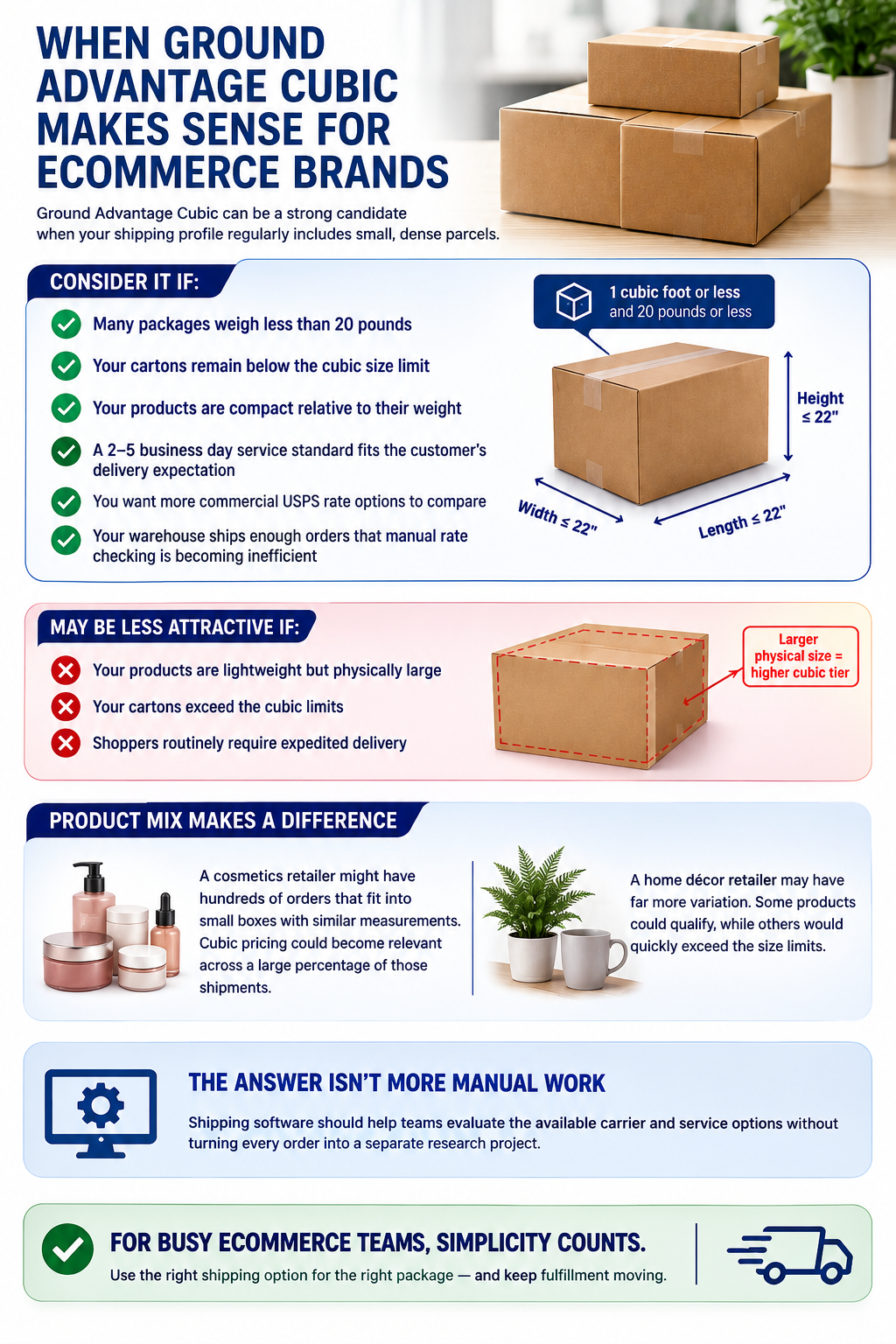
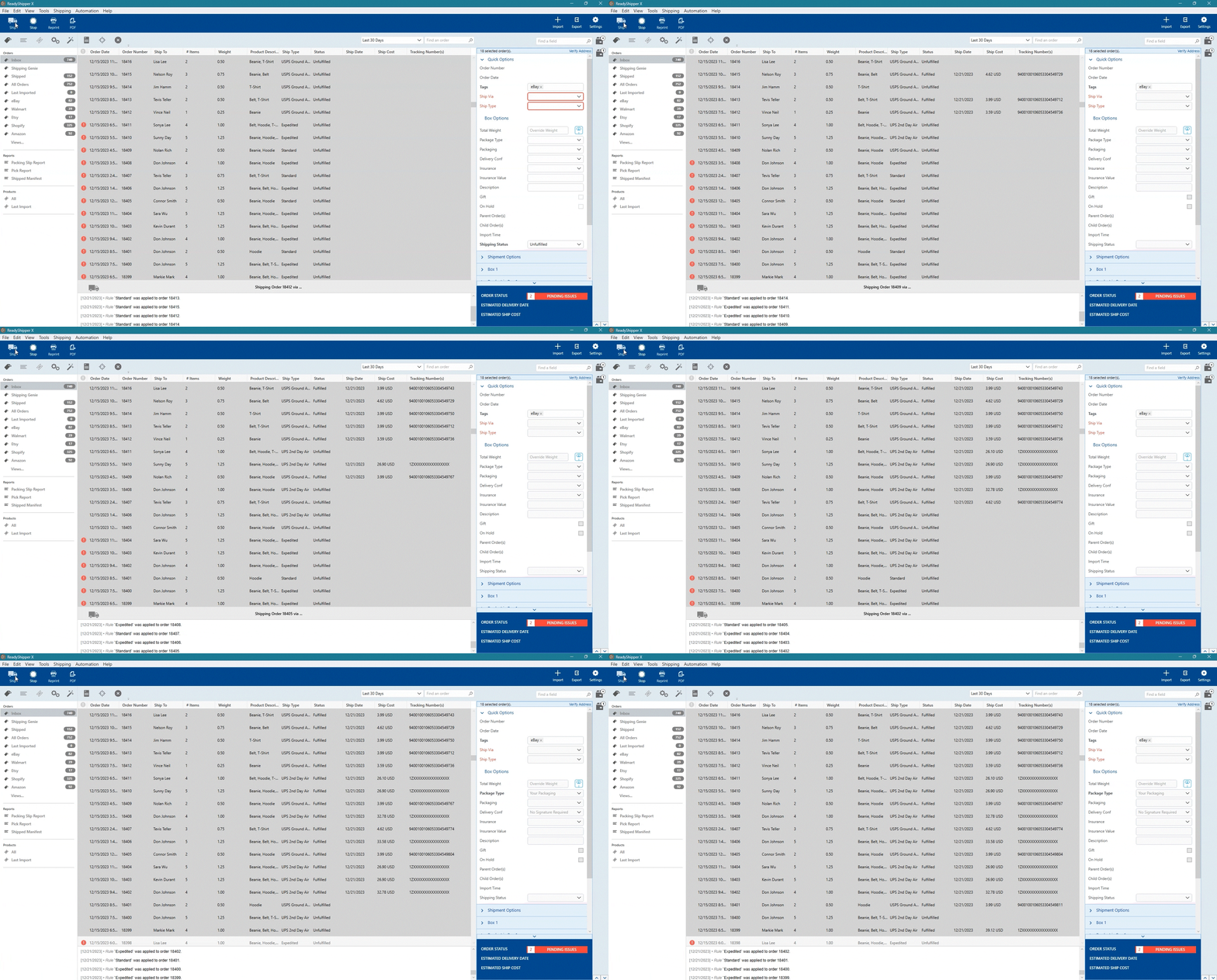
ReadyShipper X supports USPS Direct Cubic shipments, allowing users to ship with USPS Cubic rates inside ReadyShipper. The update describes cubic pricing as being based on package volume and shipping distance rather than actual package weight.
That’s where ReadyShipper X fits into the larger ecommerce shipping process. ReadyShipper X helps ecommerce teams print labels faster, work with multiple carriers, apply shipping rules, and manage higher-volume fulfillment from one shipping workflow.
Instead of relying on one service for every package, retailers can make shipping decisions based on factors such as:
- Package dimensions
- Package weight
- Destination
- Carrier
- Service level
- Delivery expectations
- Order value
- Shipping rules
For an order that qualifies for USPS Cubic pricing, having that option available inside the shipping process gives the warehouse another service to consider. For an order that doesn’t qualify, the team can look at other available carrier and service choices.
Shipping software should help teams do more with less manual effort. That becomes increasingly valuable as daily shipment counts rise and the number of possible carrier choices grows.
ReadyCloud also connects shipping to the larger post-purchase experience. The customer experience doesn’t stop at checkout. Delivery speed, tracking communication, returns, and future engagement all shape whether a shopper buys again.
“Shipping, delivery updates, returns, refunds, exchanges and support tickets all shape whether a customer feels confident buying again. For enterprise e-commerce companies, the post-purchase experience can no longer be treated as a back-office function. It is becoming one of the next major battlegrounds for customer retention.” Read Article on Forbes
The Future of Ecommerce is Now
Staying ahead in the ecommerce industry means embracing innovation and anticipating changes before they arrive. The ecommerce trends shaping 2025 provide valuable insights into what’s next, but the future also brings exciting new possibilities. Businesses that adapt quickly and leverage the right tools will thrive in this dynamic landscape.
Ready for 2026? ReadyCloud Has You Covered!
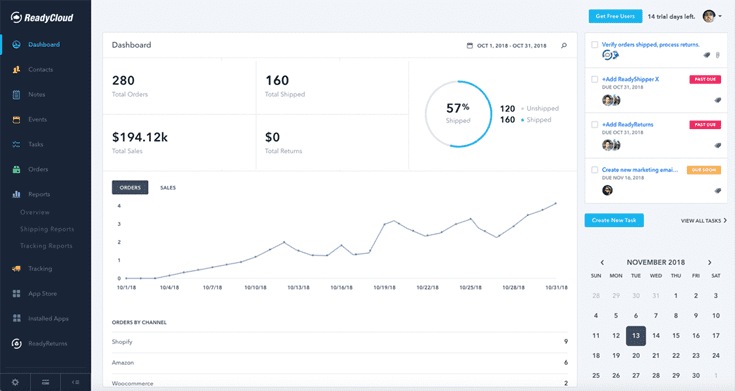
Success in 2026 starts with the right tools, and ReadyCloud’s suite of solutions is designed to propel your ecommerce business to new heights. With ReadyCloud, you’ll have all your data centralized in one place, offering insights that drive smarter decisions. Take your marketing to the next level with Action Alerts, delivering growth-focused, automated campaigns that keep your customers engaged.

ReadyCloud Has You Covered!
Success in ecommerce starts with the right tools, and ReadyCloud’s suite of solutions is designed to propel your ecommerce business to new heights. With ReadyCloud, you’ll have all your data centralized in one place, offering insights that drive smarter decisions. Take your marketing to the next level with Action Alerts, delivering growth-focused, automated campaigns that keep your customers engaged.
Shipping is easier than ever with ReadyShipper X, a multicarrier solution that simplifies your fulfillment process while saving time and money.

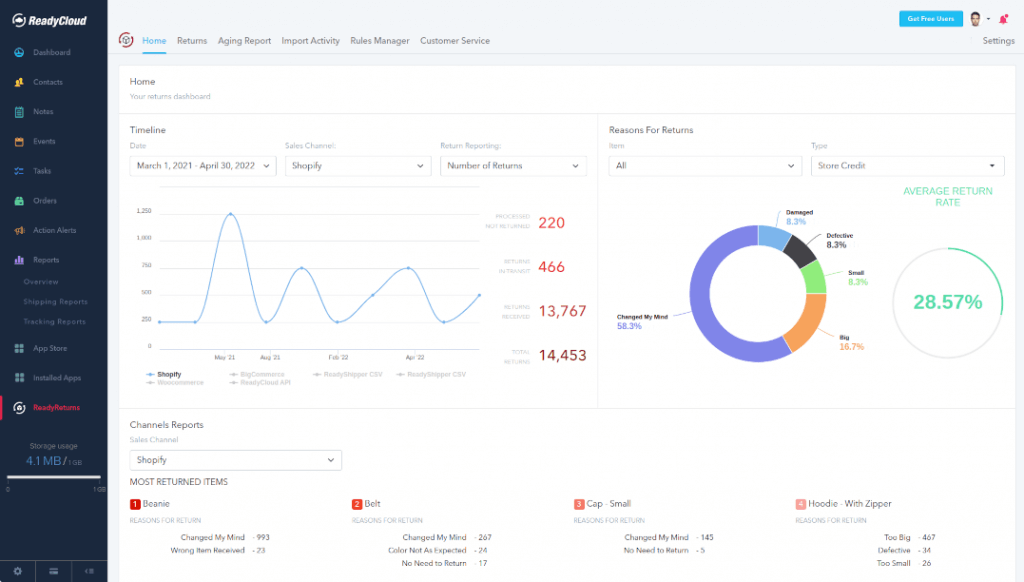
And when it comes to returns, ReadyReturns streamlines the entire process with an automated solution that boosts customer satisfaction and loyalty.

ReadyCloud is more than just a suite of systems—it’s your ticket to thriving in 2026 and beyond!
Start your journey to success today! Learn more and get started here.
Or contact our Sales Department at: 877-818-7447 ext. 1.
Frequently Asked Questions About Online Shopping And Same-Day Delivery
What Is Considered Same-Day Delivery?
Same-day delivery means the order is placed and received within the same calendar day. Retailers usually restrict the service to eligible products, approved locations, and orders received before a cutoff time. DeliveryApp reports that many programs set cutoff times around 1 p.m. or 2 p.m. Orders placed later may move to a next-day or within-24-hours service instead.
How Does Same-Day Delivery Affect Online Shopping?
Same-day service gives customers online convenience without requiring them to wait several days for the product. It can support urgent purchases and make categories once tied to in-store shopping more practical online. DeliveryApp found that 49% of shoppers would be more likely to shop online if same-day service were available. The effect is strongest when pricing, tracking, and delivery reliability meet the customer’s expectations.
Are Customers Willing To Pay For Same-Day Delivery?
Many customers will pay for speed when the purchase feels urgent or valuable. Roadie found that 65% of respondents were satisfied the last time they paid extra for delivery within 24 hours. DeliveryApp also reported that up to half of shoppers across four European markets would pay as much as 10% of the order value for same-day service. Willingness drops when the delivery fee feels excessive compared with the product price.
Does Faster Delivery Increase Ecommerce Sales?
Research cited by DeliveryApp found that 77% of participating industry leaders saw net new sales rise after implementing same-day delivery. Another 66% reported higher conversion rates, while nearly 80% saw more repeat purchases. These results show strong potential, but they don’t guarantee the same outcome for every retailer. Product demand, service coverage, fees, inventory placement, and dependable execution all affect performance.
How Do Retailers Provide Same-Day Delivery?
Retailers usually place inventory near customers through regional warehouses, stores, micro-fulfillment facilities, or third-party logistics partners. Order-routing systems determine which location should fulfill the purchase. Local couriers or regional carriers then complete the final trip. Accurate inventory, automated shipping rules, tracking, and customer notifications help keep the promise realistic.
What Products Are Best Suited For Same-Day Delivery?
Products tied to urgency are often strong candidates. Examples include groceries, household essentials, replacement electronics, gifts, office supplies, clothing, medical necessities, tools, and repair parts. Local availability, size, handling requirements, and margin also affect whether the service is practical. A low-margin item stored hundreds of miles away isn’t a good same-day candidate.
Is Same-Day Delivery Available In Rural Areas?
Same-day coverage is more common in urban and suburban markets because retailers can complete more deliveries within a smaller radius. Rural routes often involve longer distances and fewer orders, which raises the cost per stop. Some rural customers may receive expedited, next-day, or scheduled regional service instead. Availability depends on inventory location, carrier coverage, order volume, and the retailer’s service rules.
What Is The Biggest Challenge With Same-Day Delivery?
The central challenge is balancing speed with cost and reliability. Last-mile delivery can represent as much as 50% of total transportation costs, so poorly planned service can erase the financial gain from added sales. Retailers also need accurate inventory, trained fulfillment teams, courier capacity, realistic cutoff times, and dependable tracking. A fast promise only helps the brand when the order arrives correctly and on time.