


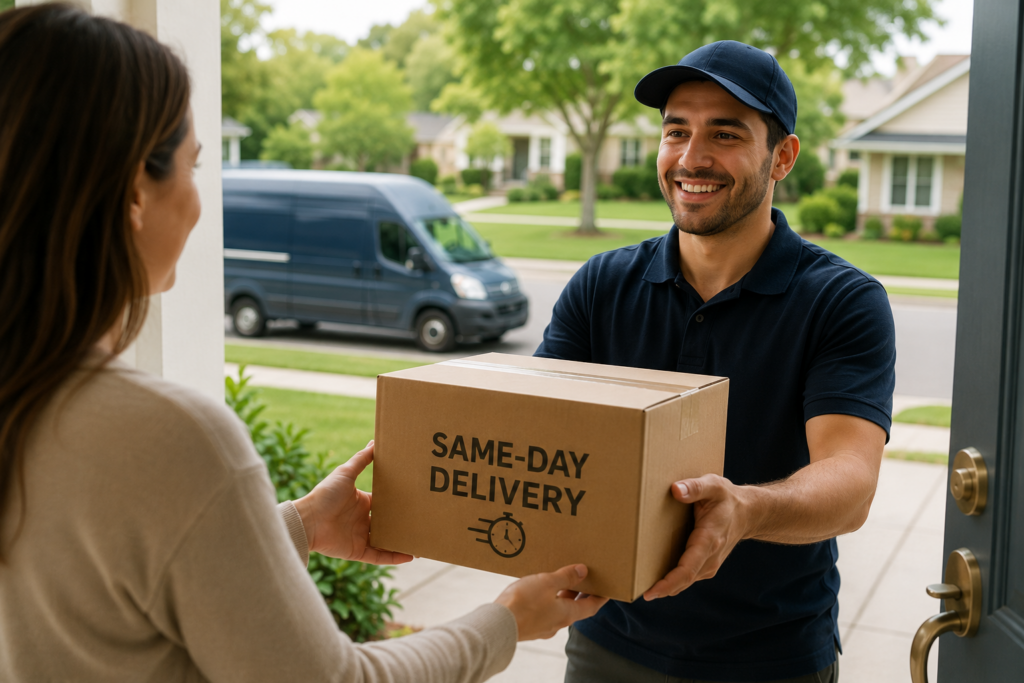
Online shopping didn’t simply give customers another place to buy. It reset their sense of how quickly a purchase should move from checkout to doorstep. Shoppers can compare products in seconds, place an order from almost anywhere, and watch each stage of fulfillment from a phone. Delivery is no longer hidden behind the sale. It’s part of the sale.
The numbers show how far expectations have moved. DeliveryApp reports that 80% of consumers expect same-day delivery to appear as an option at checkout, while 96% now interpret “fast delivery” as same-day service. The same report projects the same-day delivery market to reach £21 billion by 2027 in the EU, reflecting a wider shift toward immediate commerce rather than traditional multiday fulfillment.
That doesn’t mean every shopper expects every order within hours. It means customers want control over their delivery options. One buyer may wait several days to avoid a shipping charge, while another will pay more because an item is needed before the day ends. Retailers gaining ground are those that serve both customers without making either fight through a confusing checkout experience.
Current ecommerce delivery statistics reveal a market where delivery speed and accuracy are vital for building trust and confidence, alongside product selection. The checkout button may close the sale, but the delivery promise often determines whether the customer reaches it.
“Growing e-commerce brands have set a new standard. They’re demonstrating that, with the right strategy in place, the post-purchase experience can be elevated. And customers are noticing it. For the larger retailers in the pond, this represents a monumental shift that swings from traditional customer acquisition to long-term retention.” Read Article on Forbes



Delivery Now Influences The Buying Decision
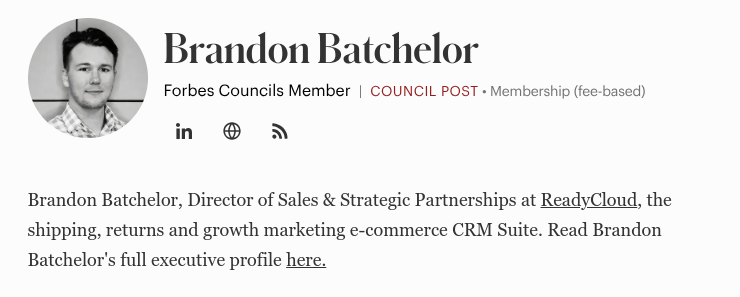
A recent Roadie survey of 1,000 ecommerce shoppers found that 58% considered free delivery the most important part of the delivery experience. Free service carries serious weight, but customers don’t accept poor execution simply because shipping costs nothing. In the same survey, 47% named damaged items as a trust breaker, 45% pointed to orders that never arrived, and 38% cited high delivery costs.
Cart abandonment data makes the commercial impact even clearer. Baymard Institute research shows that 39% of online shoppers abandon a purchase because delivery costs are too high. An additional 21% leave because the delivery timeline is too slow. Retailers with strong products and attractive pricing can still lose sales during checkout if delivery choices don’t meet customers’ needs.
Speed can also pull shoppers toward a particular seller. The same report also found that 32% of respondents had bought from a retailer specifically because it offered the fastest delivery. At the same time, 67% were willing to wait more than two days if delivery was free. These figures aren’t contradictory. They show that shoppers make different choices according to the order in front of them.
A delivery menu that reflects different moments-such as urgent needs or routine purchases-can make customers feel their specific situations are understood and respected.
Free shipping can influence the basket itself, with research finding that 34% of shoppers purchase additional items to receive free-delivery benefits, while 29% enroll in loyalty programs for the same reason. Delivery incentives can raise order value and encourage membership, but only when the economics make sense for the retailer.
A good checkout experience should give buyers clear choices instead of forcing everyone into one model:
- Free or economy delivery should provide an affordable option with an honest arrival estimate.
- Standard delivery should offer a practical balance between speed and price.
- Expedited or same-day service should serve urgent purchases at a clearly stated premium.
- Scheduled delivery should help customers receive expensive, oversized, or time-sensitive products.
The best option isn’t always the fastest. It’s the one that matches what the buyer needs and arrives as promised.


Same-Day Delivery Is Closing The Online And In-Store Gap
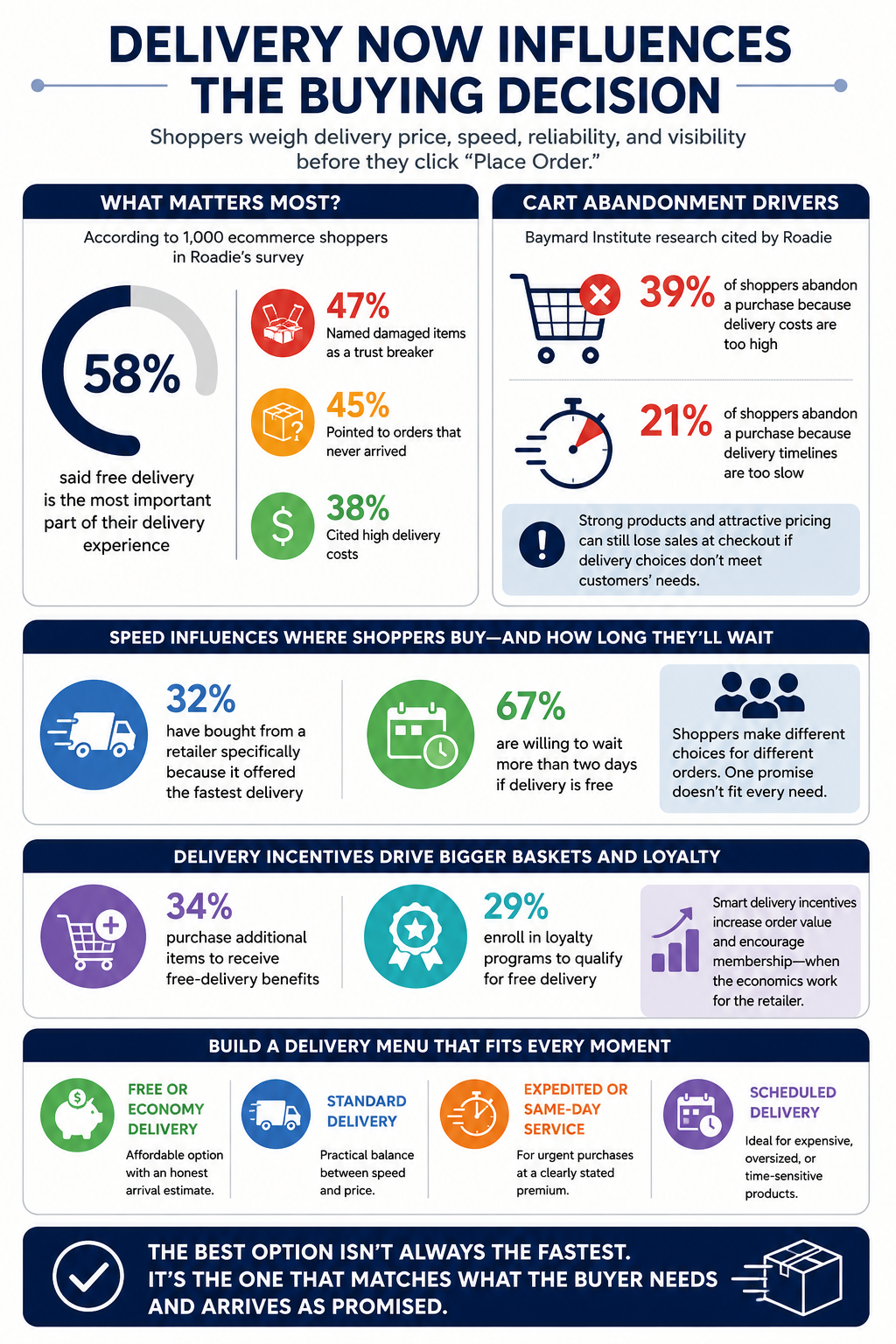
Traditional retail held one major advantage over ecommerce for years: immediacy. A shopper could enter a store, make a purchase, and leave with the product. Online shopping offered wider selection and greater convenience, but it usually required patience.
Same-day delivery weakens that old tradeoff. A buyer can place an order from home, work, or a mobile device and receive it within hours or even pick it up at the store later. This service is a combination of ecommerce convenience and the instant gratification associated with physical stores. That combination is changing the kinds of products people are willing to purchase online.
The demand reaches beyond groceries and restaurant orders. Fast local fulfillment can support electronics accessories, clothing, gifts, tools, household goods, medical necessities, replacement parts, office supplies, and other purchases tied to an immediate need. Of note are rapid networks that could expand online demand in categories such as tools and do-it-yourself products, where shoppers often need the item for use that day.
Consumer interest is already substantial. Data from these reports also finds that 49% of shoppers would be more likely to shop online if same-day service were available. In categories such as grocery and food delivery, 40% said they would abandon their carts if same-day service weren’t offered. Those figures show how quickly a premium convenience can become a baseline expectation within certain product categories.
Retailers are responding. Up to 65% planned to offer same-day delivery within two years, according to recent findings. That investment isn’t limited to the largest marketplaces. Regional sellers, established retail chains, and digitally native brands can participate through local inventory, third-party logistics providers, courier networks, and stores that double as fulfillment points.
“Cloud-based solutions are tethered to the uptime of the service provider, whereas hybrid-cloud solutions mean you can keep shipping packages even if your SaaS provider is experiencing a disruption of service.” – Read Article on Forbes
Supply Chains Are Getting Shorter And More Regional
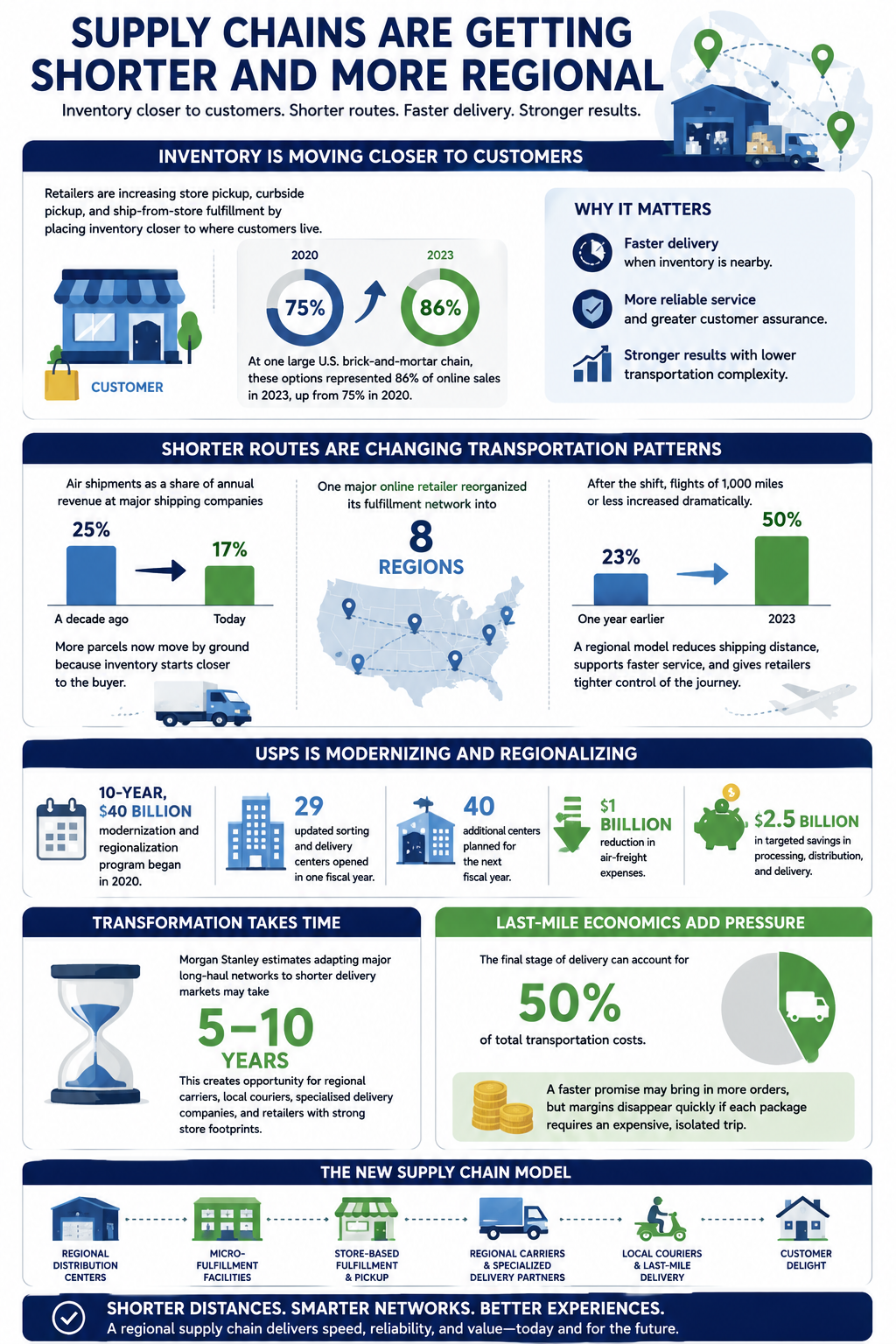
Fast fulfillment depends on inventory being close enough to the customer to meet expectations. This approach helps customers feel assured that their delivery will be timely and dependable.
Morgan Stanley reports that retailers are placing more inventory near customer markets and increasing their use of store pickup, curbside pickup, and ship-from-store fulfillment. At one large U.S. brick-and-mortar chain, those options represented 86% of online sales in 2023, up from 75% in 2020.
Shorter routes are also changing transportation patterns. Air shipments accounted for 17% of annual revenue at some of the largest shipping companies, down from 25% a decade earlier. More parcels can now move regionally by ground because the merchandise begins its journey closer to the buyer.
One major online retailer reorganized its fulfillment network into eight regions. Following that shift, half of its flights in 2023 covered 1,000 miles or less, compared with 23% one year earlier. A regional model can reduce shipping distance, support faster service, and give the retailer tighter control over more of the delivery journey.
The U.S. Postal Service has been adjusting as well. Morgan Stanley notes that USPS began a 10-year, $40 billion modernization and regionalization program in 2020. It opened 29 updated sorting and delivery centers during one fiscal year and planned 40 more for the next. USPS also cut air-freight expenses by $1 billion and targeted another $2.5 billion in processing, distribution, and delivery savings.
Established parcel networks can’t rebuild overnight. Morgan Stanley estimates that adapting major long-haul networks to shorter delivery markets may take five to 10 years. That lengthy adjustment creates room for regional carriers, local couriers, specialized delivery companies, and retailers with strong store footprints.
Last-mile economics adds pressure to every decision. Advanced Logistics states that the final stage of delivery can account for as much as 50% of total transportation costs. A faster promise may bring in more orders, but the margin disappears quickly if each package requires an expensive, isolated trip.
The emerging network looks less like one straight line from a national warehouse and more like a connected map of regional facilities, local stores, micro-fulfillment sites, carriers, and couriers.
Stores Are Becoming Local Fulfillment Centers
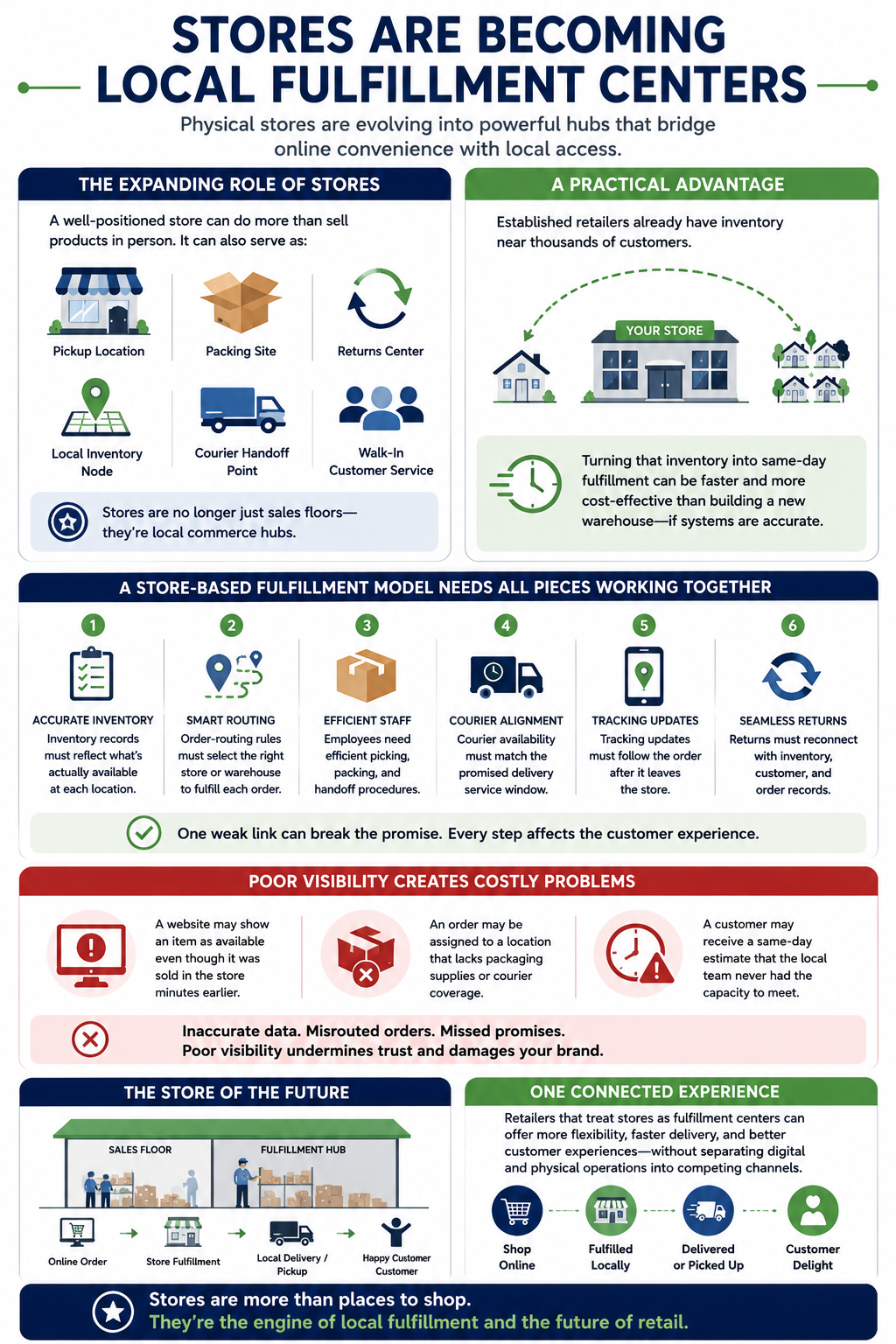
Physical stores aren’t disappearing from commerce. Their role is expanding. A well-positioned store can serve walk-in customers while also functioning as a pickup location, packing site, returns center, local inventory node, and courier handoff point.
This gives established retailers a practical advantage. Their inventory may already sit within a short drive of thousands of customers. Turning that inventory into a same-day option can be faster than building a new warehouse, but only if the underlying systems are accurate.
A store-based fulfillment model needs several pieces working together:
- Inventory records must reflect what’s actually available at each location.
- Order-routing rules must select the right store or warehouse.
- Employees need efficient picking, packing, and handoff procedures.
- Courier availability must match the promised service window.
- Tracking updates must follow the order after it leaves the store.
- Returns must reconnect with inventory, customer, and order records.
Poor visibility can undermine the entire model. A website may show an item as available even though it was sold in the store minutes earlier. An order may be assigned to a location that lacks packaging supplies or courier coverage. A customer may receive a same-day estimate that the local team never had the capacity to meet.
The store of the future isn’t only a sales floor. It’s a local commerce hub. Retailers that treat it that way can support more flexible fulfillment without separating digital and physical operations into competing channels.
Reliability And Visibility Still Beat Empty Speed Promises
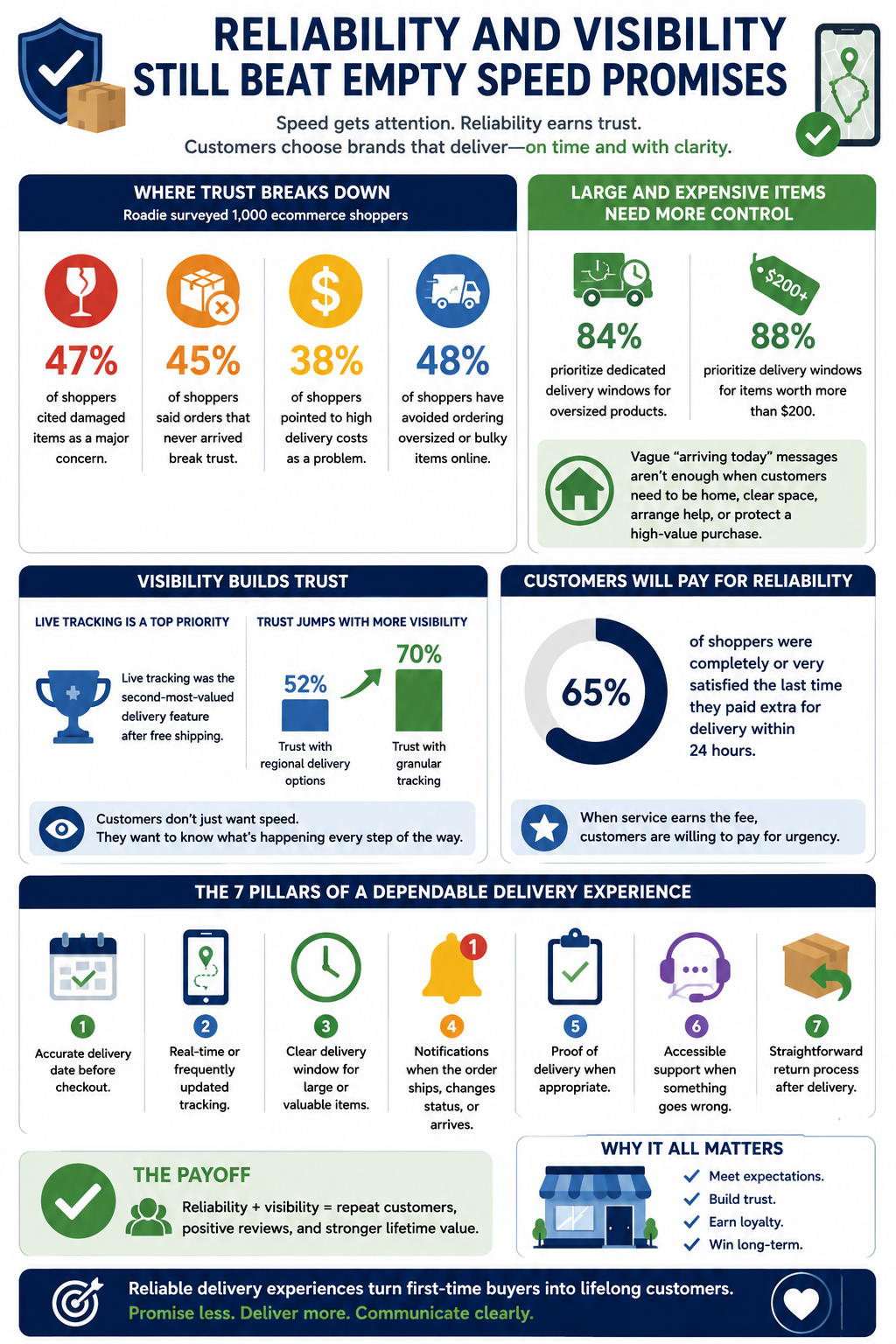
Speed attracts attention, but reliability earns repeat business. A customer who receives an order tomorrow as promised may be happier than one who was told it would arrive today and spent the evening waiting for a package that never appeared.
Roadie’s research shows where trust breaks down. Damaged items concerned 47% of surveyed shoppers, 45% cited orders that never arrived, and 38% pointed to high costs. Nearly half, 48%, had avoided ordering oversized or bulky goods online because they worried about damage, timing, or being available to receive the delivery.
Large and expensive items create an even greater need for control. Roadie found that 84% of shoppers prioritize dedicated delivery windows for oversized products. The share rises to 88% for items costing more than $200. A vague “arriving today” message isn’t enough when a customer needs to be home, clear space, arrange help, or protect a high-value purchase.
Live tracking was the second-most-valued delivery feature after free shipping in Roadie’s survey. The company also reported that regional delivery options earned 52% consumer trust, while granular tracking raised that figure to 70% within its service model. These findings point to a larger lesson: Customers don’t only want speed. They want to know what’s happening.
A dependable experience includes:
- An accurate delivery date before checkout.
- Real-time or frequently updated tracking.
- A clear delivery window for large or valuable items.
- Notifications when the order ships, changes status, or arrives.
- Proof of delivery when appropriate.
- Accessible support when something goes wrong.
- A straightforward return process after delivery.
Roadie also found that 65% of respondents were completely or very satisfied the last time they paid extra for delivery within 24 hours. Customers will pay for urgency when the service earns the fee.
“In a perfect world, you’d have the solution you needed in just a few clicks. In reality, not all software accommodates the specific needs of the individual retailer. When creating a balanced shipping strategy for your online business, it’s imperative that you ensure the feature sets you need are in place, so you can fulfill faster and go home early.” – Read Article on Forbes
“Post-purchase is a crucial part of the customer journey, but it often doesn’t get the attention it deserves, especially at the enterprise level. What’s interesting is how many growing e-commerce brands are outshining larger retailers when it comes to what happens after the “buy” button is clicked.” – Read Article on Forbes
Technology Holds The Delivery Experience Together
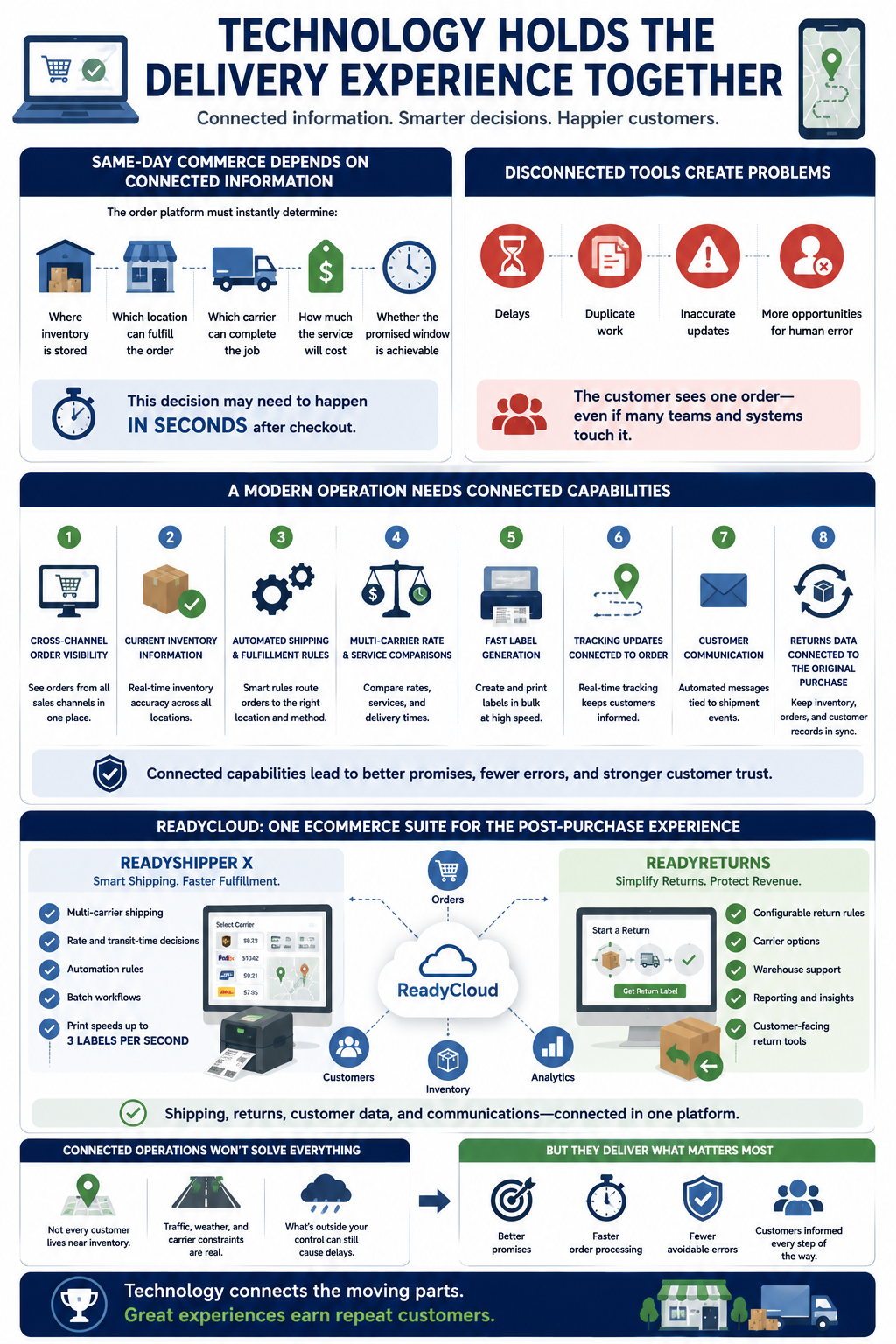
Same-day commerce depends on connected information. The order platform needs to know where inventory is stored, which location can fulfill it, what carrier can complete the job, how much the service will cost, and whether the promised window is achievable.
That decision may need to happen seconds after checkout. Disconnected tools create delays, duplicate work, inaccurate updates, and more opportunities for human error. The customer sees one order, even if sales channels, warehouses, stores, carriers, service teams, and returns departments all touch it.
A modern operation needs:
- Cross-channel order visibility.
- Current inventory information.
- Automated shipping and fulfillment rules.
- Multi-carrier rate and service comparisons.
- Fast label generation.
- Tracking updates connected to the order record.
- Customer communication tied to shipment events.
- Returns data connected to the original purchase.
ReadyCloud brings shipping, returns, customer information, and post-purchase communication into one ecommerce suite. ReadyShipper X supports multi-carrier shipping, rate and transit-time decisions, automation rules, batch workflows, and print speeds of up to three labels per second. ReadyReturns gives retailers configurable return rules, carrier options, warehouse support, reporting, and customer-facing return tools.
Connected operations won’t make every customer live near inventory, and they can’t remove traffic, weather, or carrier constraints. They can help teams make better promises, process orders faster, reduce avoidable errors, and keep customers informed after checkout.
“Many retailers are simply not equipped to manage what’s coming. But some are. These are the brands already investing in technology, training and process optimization to turn what used to be a logistical nightmare into a competitive edge.” – Read Article on Forbes
The Next Era Of Commerce Will Offer More Delivery Choice
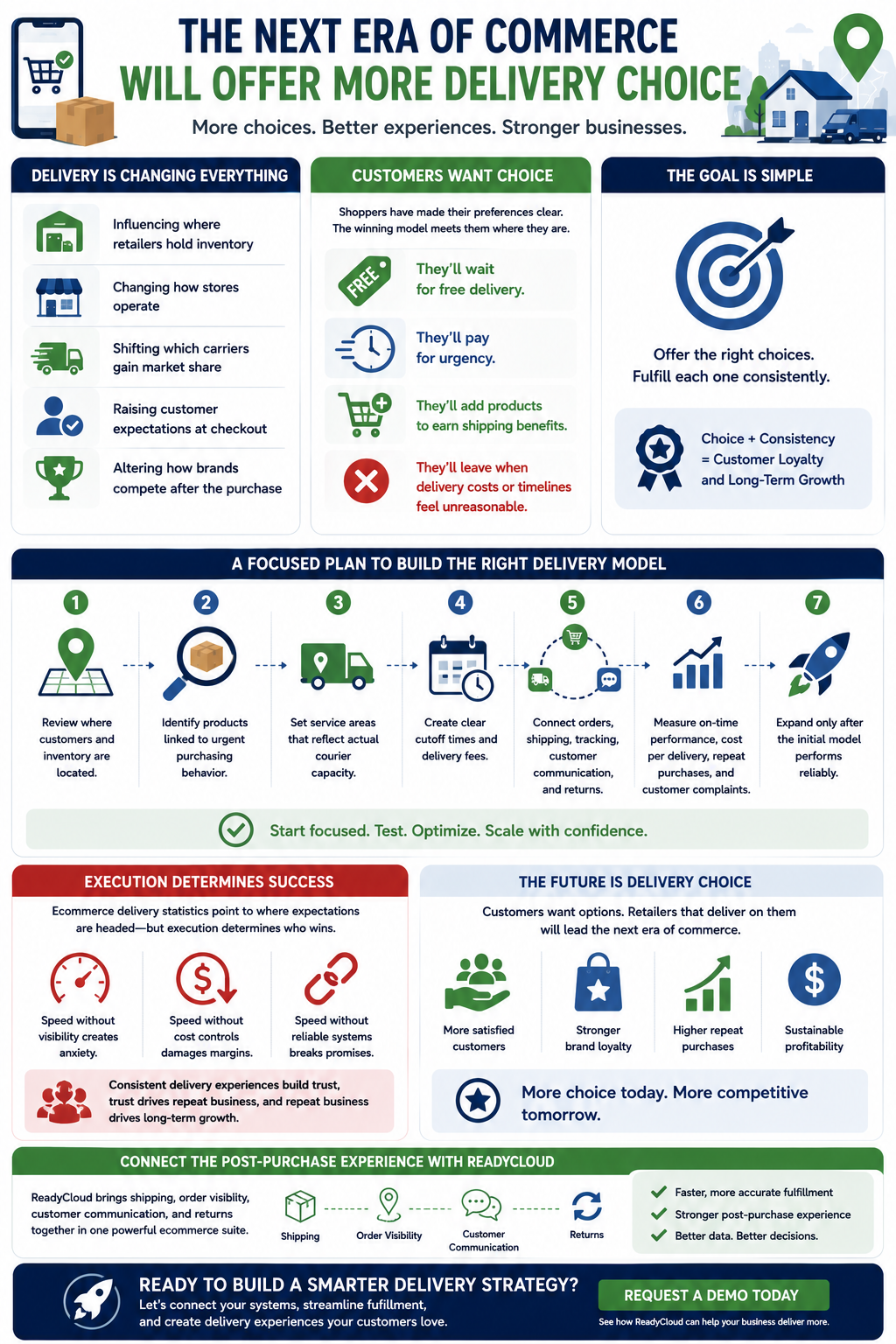
Online shopping and same-day delivery are reshaping commerce because they’re changing more than shipping speed. They’re influencing where retailers hold inventory, how stores operate, which carriers gain market share, what customers expect at checkout, and how brands compete after the purchase.
The winning model won’t force every order into the same timeline. Customers have already shown that they’ll wait for free delivery, pay for urgency, add products to earn shipping benefits, and leave when delivery costs or timelines feel unreasonable. The job is to offer the right choices and fulfill each one consistently.
Retailers should start with a focused plan:
- Review where customers and inventory are located.
- Identify products linked to urgent purchasing behavior.
- Set service areas that reflect actual courier capacity.
- Create clear cutoff times and delivery fees.
- Connect orders, shipping, tracking, customer communication, and returns.
- Measure on-time performance, cost per delivery, repeat purchases, and customer complaints.
- Expand only after the initial model performs reliably.
Ecommerce delivery statistics can show where buyer expectations are headed, but execution determines whether a retailer benefits from the shift. Speed without visibility creates anxiety. Speed without cost controls damages margins. Speed without reliable systems produces promises the business can’t keep.
ReadyCloud helps ecommerce teams connect the work that happens after checkout, from shipping and order visibility to customer communication and returns. See how ReadyCloud can support faster, more accurate fulfillment and a stronger post-purchase experience by requesting a demo today.
“Modern consumers expect transparency. They don’t want to chase tracking links across different carriers or dig through their inbox to figure out when a package is supposed to arrive. They want real-time updates and branded communication that feels consistent with the rest of their shopping experience.
Brands that offer detailed order tracking, SMS updates or branded tracking pages are already ahead of the curve. These shipping intelligence touchpoints show customers that the brand is still involved … even after the sale is complete.” Read Article on Forbes
The Future of Ecommerce is Now
Staying ahead in the ecommerce industry means embracing innovation and anticipating changes before they arrive. The ecommerce trends shaping 2025 provide valuable insights into what’s next, but the future also brings exciting new possibilities. Businesses that adapt quickly and leverage the right tools will thrive in this dynamic landscape.
Ready for 2026? ReadyCloud Has You Covered!
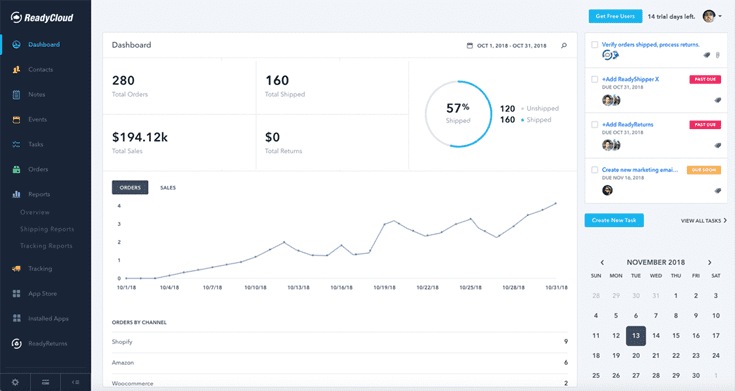
Success in 2026 starts with the right tools, and ReadyCloud’s suite of solutions is designed to propel your ecommerce business to new heights. With ReadyCloud, you’ll have all your data centralized in one place, offering insights that drive smarter decisions. Take your marketing to the next level with Action Alerts, delivering growth-focused, automated campaigns that keep your customers engaged.

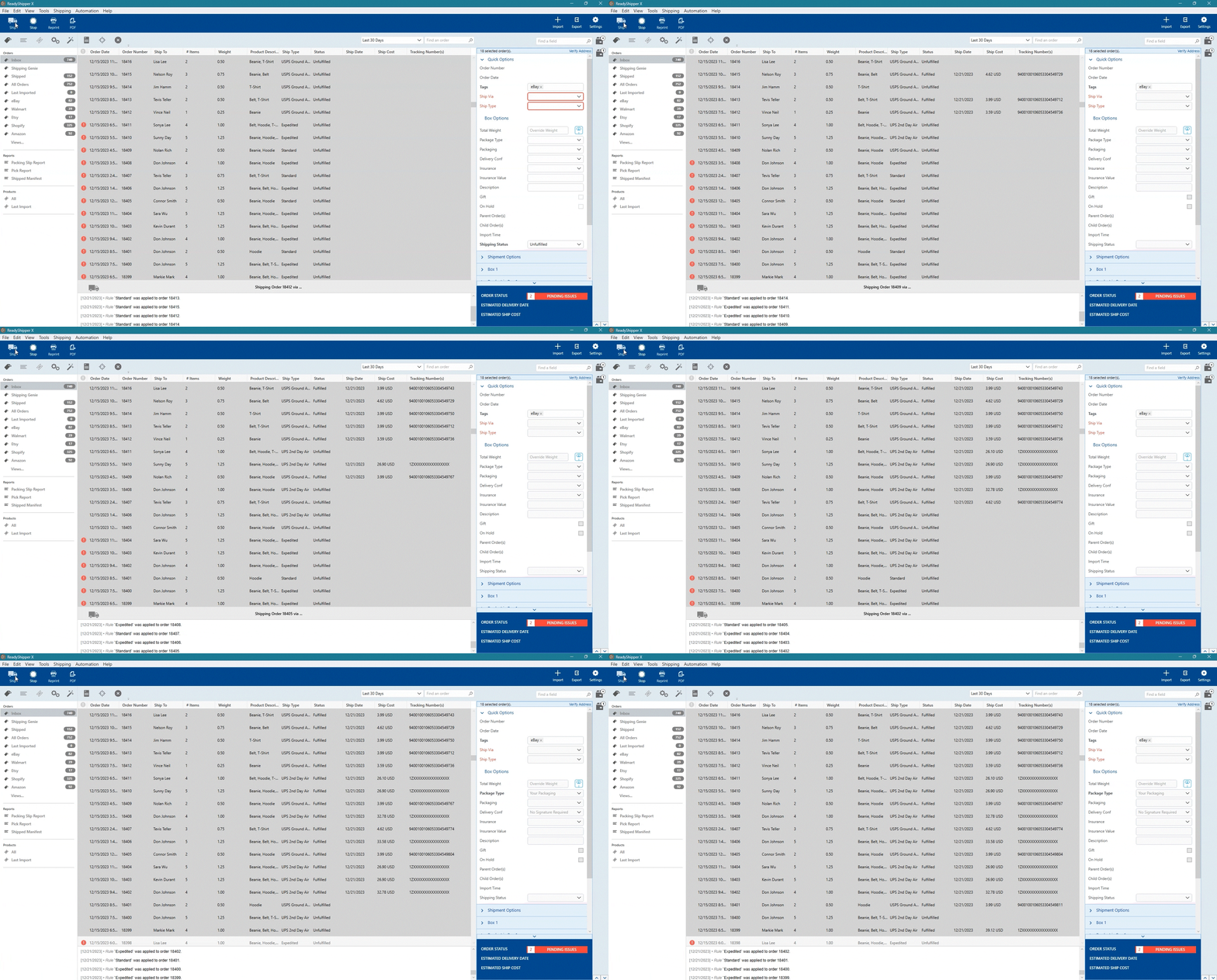
Shipping is easier than ever with ReadyShipper X, a multicarrier solution that simplifies your fulfillment process while saving time and money.

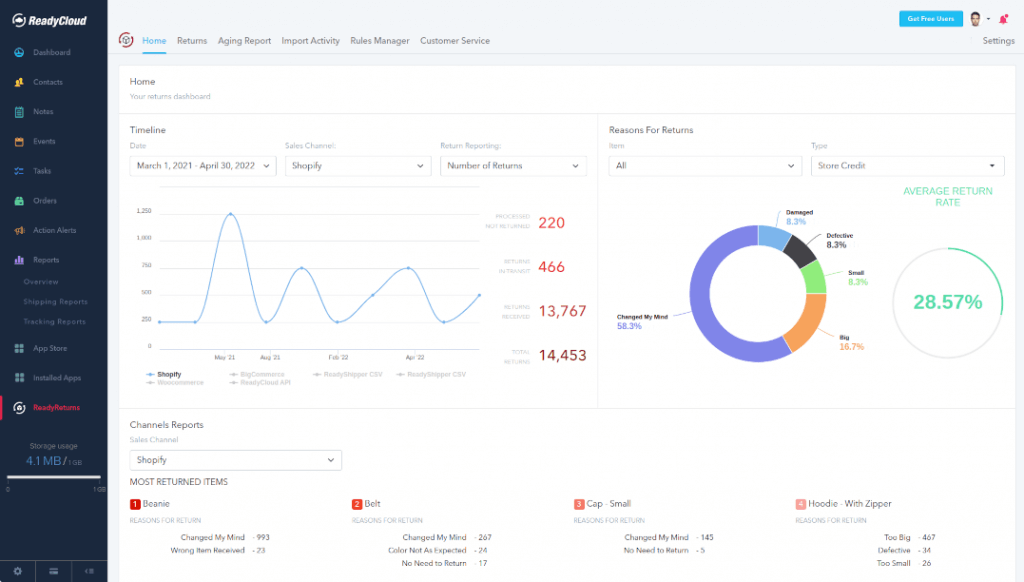
And when it comes to returns, ReadyReturns streamlines the entire process with an automated solution that boosts customer satisfaction and loyalty.

ReadyCloud is more than just a suite of systems—it’s your ticket to thriving in 2026 and beyond!
Start your journey to success today! Learn more and get started here.
Or contact our Sales Department at: 877-818-7447 ext. 1.
Frequently Asked Questions About Online Shopping And Same-Day Delivery
What Is Considered Same-Day Delivery?
Same-day delivery means the order is placed and received within the same calendar day. Retailers usually restrict the service to eligible products, approved locations, and orders received before a cutoff time. DeliveryApp reports that many programs set cutoff times around 1 p.m. or 2 p.m. Orders placed later may move to a next-day or within-24-hours service instead.
How Does Same-Day Delivery Affect Online Shopping?
Same-day service gives customers online convenience without requiring them to wait several days for the product. It can support urgent purchases and make categories once tied to in-store shopping more practical online. DeliveryApp found that 49% of shoppers would be more likely to shop online if same-day service were available. The effect is strongest when pricing, tracking, and delivery reliability meet the customer’s expectations.
Are Customers Willing To Pay For Same-Day Delivery?
Many customers will pay for speed when the purchase feels urgent or valuable. Roadie found that 65% of respondents were satisfied the last time they paid extra for delivery within 24 hours. DeliveryApp also reported that up to half of shoppers across four European markets would pay as much as 10% of the order value for same-day service. Willingness drops when the delivery fee feels excessive compared with the product price.
Does Faster Delivery Increase Ecommerce Sales?
Research cited by DeliveryApp found that 77% of participating industry leaders saw net new sales rise after implementing same-day delivery. Another 66% reported higher conversion rates, while nearly 80% saw more repeat purchases. These results show strong potential, but they don’t guarantee the same outcome for every retailer. Product demand, service coverage, fees, inventory placement, and dependable execution all affect performance.
How Do Retailers Provide Same-Day Delivery?
Retailers usually place inventory near customers through regional warehouses, stores, micro-fulfillment facilities, or third-party logistics partners. Order-routing systems determine which location should fulfill the purchase. Local couriers or regional carriers then complete the final trip. Accurate inventory, automated shipping rules, tracking, and customer notifications help keep the promise realistic.
What Products Are Best Suited For Same-Day Delivery?
Products tied to urgency are often strong candidates. Examples include groceries, household essentials, replacement electronics, gifts, office supplies, clothing, medical necessities, tools, and repair parts. Local availability, size, handling requirements, and margin also affect whether the service is practical. A low-margin item stored hundreds of miles away isn’t a good same-day candidate.
Is Same-Day Delivery Available In Rural Areas?
Same-day coverage is more common in urban and suburban markets because retailers can complete more deliveries within a smaller radius. Rural routes often involve longer distances and fewer orders, which raises the cost per stop. Some rural customers may receive expedited, next-day, or scheduled regional service instead. Availability depends on inventory location, carrier coverage, order volume, and the retailer’s service rules.
What Is The Biggest Challenge With Same-Day Delivery?
The central challenge is balancing speed with cost and reliability. Last-mile delivery can represent as much as 50% of total transportation costs, so poorly planned service can erase the financial gain from added sales. Retailers also need accurate inventory, trained fulfillment teams, courier capacity, realistic cutoff times, and dependable tracking. A fast promise only helps the brand when the order arrives correctly and on time.