



Returns are a normal part of doing business in eCommerce. Whether it’s the wrong size, wrong color, or just a change of heart, customers want reassurance that returning a product will be simple, fast, and stress-free. For Magento 2 sellers, managing returns manually is no longer a practical option.
If you’re running a growing eCommerce business, the return process can be either your weakest point or your greatest strength. Magento 2, while powerful for online sales, doesn’t include the returns management tools you need right out of the box. That’s why many retailers are now turning to returns extensions to bridge the gap and keep operations running smoothly.
Here’s what you need to know to make Magento 2 returns benefit your business, not hinder it.


“The post-purchase experience shapes your brand just as much as what draws a customer to it before they buy. Branding or advertising begin to shape customer confidence, but the experience that follows checkout influences loyalty more.” Read Article on Fast Company


Why Returns Management Matters in eCommerce
Returns are no longer just a backend task. They’re a vital part of the post-purchase experience and a key factor in building customer loyalty.
Think of it this way: over 90% of online shoppers say that a flexible and simple return policy affects whether they will buy again from a brand. That means if your returns are slow, confusing, or hidden with extra costs, you’re losing future revenue.
In addition, returns management affects almost every department in your operation. Warehouse teams need to restock items, customer service handles inquiries and refund requests, and accounting manages the financial aspects. Without a clean, connected system, these processes become slow, error-prone, and frustrating for everyone involved.
Customers are paying attention. And with competition fiercer than ever, the simplicity of your returns process could be the one thing that gives you an edge.
Returns are devastating retailers. In 2024, it was estimated that returns amounted to over $685 billion in lost revenue in the U.S. alone. That’s not just a logistics problem; it’s a significant business challenge.
As the director of sales & strategic partnerships for a company that makes a popular e-commerce returns software solution, I often talk with e-commerce leaders. And one thing I’ve noticed is that some treat returns as an afterthought, something to handle only when it becomes unmanageable. But the most successful brands I’ve worked with view returns differently. They don’t just absorb the cost; they use returns to inform better decisions, boost customer retention and open new doors for growth.


The Challenges of Handling Returns in Magento 2
Magento 2 is recognized for its flexibility and scalability. However, when it comes to managing returns, it falls short. Out of the box, Magento 2 lacks strong returns features. You often have to assemble your own solution, usually relying on manual processes or separate plugins.
Let’s begin with automation. Magento 2 doesn’t provide any. That means each return must be manually reviewed, every shipping label created by hand, and each refund processed one at a time. The more you grow, the more this becomes a time drain for your team.
Inventory management also becomes challenging. Returned products may sit idly, waiting for someone to manually update the system. Refund delays frustrate customers, and the lack of tracking causes confusion.
On the customer’s side, there’s often no portal to start returns or check their status. That lack of visibility makes shoppers anxious and results in more support tickets flooding your inbox.
These are just a few reasons why Magento 2 store owners begin looking for a more innovative way to manage returns.
What to Look for in a Magento 2 Returns Extension
When evaluating a Magento 2 returns extension, it’s not just about finding one that works. You need one that works effectively for your business.
Look for features that enhance both customer convenience and backend efficiency. At a minimum, a good returns extension should include:
- A self-service returns portal with your branding.
- Customize return rules based on product type, customer status, or geography.
- Built-in pre-paid return label generation.
- Email notifications to keep customers updated.
- Inventory and order integration.
- Return reason tracking and analytics.
- Automated RMA approvals and exceptions handling.
Furthermore, your extension should seamlessly connect with the rest of your tech stack. This includes your shipping software, CRM, order management system, and email platform. You want all components to communicate effectively to minimize delays and manual input.
If your returns system needs constant developer work just to keep working, it’s not the right fit. Pick an extension that installs easily, updates dependably, and provides real-time support when you need it.
How Magento 2 Returns Management Improves the Customer Experience
Returns might not seem like a top customer experience priority, but they truly are. For many shoppers, the return process is the last impression of your brand. If it’s hard to navigate, they remember it. And they often share that experience through reviews or on social media.
With a seamless Magento 2 returns extension, you can create a customer experience that builds trust even when the product isn’t quite right.
Here’s what customers expect:
- A clear, easy-to-find returns policy.
- A portal where they can start a return on their own.
- Instant access to their return label.
- Regular updates on their return and refund status.
- A fast and fair resolution without extra hassle.
Providing this level of convenience not only protects your reputation but also boosts the likelihood that a first-time buyer becomes a repeat customer. Additionally, it decreases customer support inquiries by empowering shoppers to handle their own returns without needing to email or call you.
Returns that seem like a non-event are the ones customers value most.
Boosting Operational Efficiency With the Right Magento 2 Returns Solution
Let’s discuss what a smart returns system can do for your internal team.
Managing returns the traditional way burdens multiple departments. From verifying return eligibility to creating shipping labels, processing refunds, updating stock, and alerting customer service, each step requires time.
Now compare that to an automated returns process.
- A customer submits a return request through your portal.
- The system checks if it qualifies.
- A return label is automatically generated and sent.
- Your team is notified when the item is in transit.
- Once scanned, the system initiates a refund or exchange.
That’s the power of automation. Instead of wasting hours each week handling returns manually, your team can concentrate on activities that drive growth.
What’s more, handling returns consistently reduces mistakes. You prevent double refunds, missed restocks, and customer frustration.
If your Magento 2 store is growing quickly, manual returns won’t be sufficient for much longer.
Integration with Shipping and CRM for Seamless Returns
Any reliable Magento 2 returns extension should integrate smoothly with your shipping and CRM systems. Without this connection, your returns process becomes disorganized.
Shipping integration allows you to automatically generate return labels using your preferred carrier. It also enables you to track each return as it moves through the system. This helps your team know exactly where a package is and when it has been received, which speeds up the refund process.
CRM integration enables your support team to access a customer’s complete order and return history quickly and efficiently. This reduces the time spent searching through emails, allowing them to focus more on providing helpful service.
These integrations also simplify the process of spotting return trends, customizing customer interactions, and dividing your marketing efforts into segments. For example, you could focus loyalty offers on high-value customers who seldom return items, while keeping an eye on accounts that misuse returns for closer oversight.
It’s all about building a connected ecosystem where returns are no longer a bottleneck.
Data Insights That Help You Reduce Returns in the Future
Returns are costly, but they also provide valuable insights. Each return has a reason, and each reason is an opportunity to improve.
With the right Magento 2 returns management tools, you can monitor these reasons over time and begin identifying patterns.
Perhaps one product is often returned due to sizing confusion, or maybe a customer is purchasing multiple sizes to find the one that fits, while sending the others back, a process called “Bracketing.” That’s a sign to update your product page with more precise fit details. Maybe some SKUs are frequently damaged during transit. That’s a prompt to review your packaging.
You can also analyze return frequency based on supplier, customer location, or time of year. These insights help you make smarter decisions across the board, from purchasing and merchandising to customer service training.
Over time, smarter return data helps you reduce returns altogether. And fewer returns lead to lower costs, better margins, and happier customers.
Why ReadyReturns is a Smart Add-On for Magento 2
ReadyReturns isn’t just another Magento 2 returns extension. It’s a comprehensive solution for online retailers looking to automate, simplify, and enhance every aspect of their returns process.
It connects directly to your Magento 2 store and links with your shipping provider and CRM. That means you receive real-time data, instant label generation, and automated return handling.
With ReadyReturns, you get:
- A branded returns portal that your customers trust.
- Rules-based automation for approving or denying RMAs.
- Pre-paid return labels with real-time tracking.
- Notifications at every step of the process.
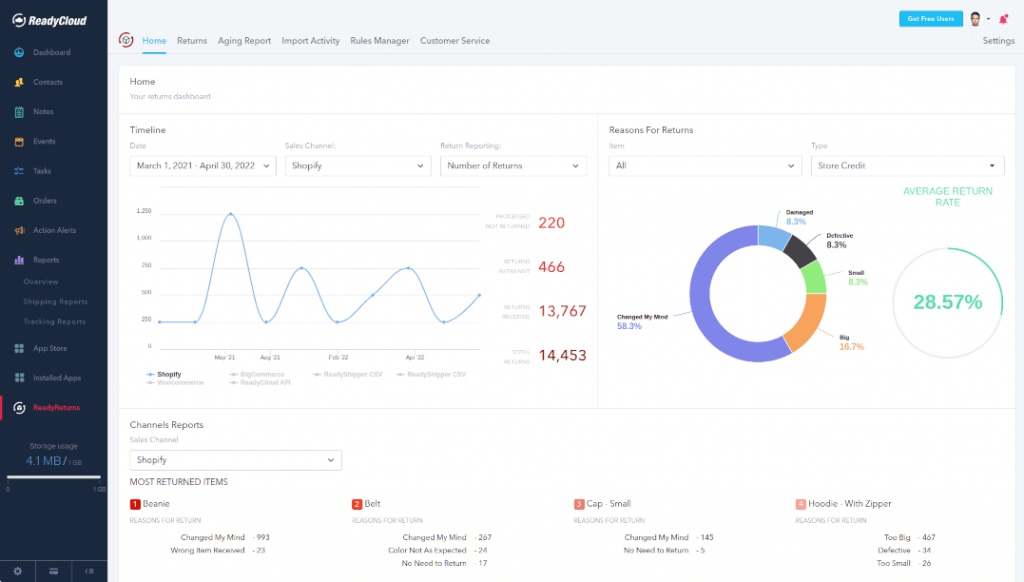
- Actionable reports on return trends and reasons.
And unlike other extensions that need ongoing developer help, ReadyReturns is built for business users. You can install it, personalize it, and start using it without writing any code.
It’s not just about managing returns. It’s about keeping your customers satisfied while reducing your expenses.
| 🌟 Feature | ReadyReturns | Narvar | Loop Returns |
|---|---|---|---|
| 🔌 Magento Compatibility | ✅ Native integration | ⚠️ Limited support | ❌ Shopify-only |
| 🎨 Branded Return Portal | Fully customizable | Branded interface | Branded interface |
| ⚙️ Automated RMA Approvals | ⚙️ Yes | ⚙️ Partial automation | ⚙️ Yes |
| 🛠️ Custom Return Rules | Full rule engine | Limited options | Exchange-focused |
| 📬 Self-Service Labels | Instant label generation | Setup required | Included |
| 🔄 Exchange Options | Optional & configurable | Basic support | Core feature |
| 💳 Refund to Original Payment | Yes | Yes | Yes |
| 💰 Store Credit Support | Fully supported | Enterprise only | Supported |
| 📊 Return Analytics Dashboard | Real-time insights | Limited data access | Premium only |
| 🚚 Carrier Integration | UPS, FedEx, USPS | Requires API setup | Shopify-native |
| 🌐 Works Outside Shopify | Yes | Yes | ❌ No |
| 💵 Pricing Model | Flexible + scalable | Enterprise pricing | Transaction-based tiers |
| ⚡ Installation | Plug-and-play | Guided onboarding | Shopify App install |
| 🧩 Designed for Magento | Absolutely | ❌ No | ❌ No |
A great e-commerce experience requires more than competitive prices, a robust selection of goods, fast shipping and easy returns … it takes them all. Today’s consumer mindset has changed. Services like Amazon Prime have set the bar at a higher level, with speedy delivery, low prices, a vast selection and hassle-free returns.

Future Trends: Returns Software for Retail in 2025 and Beyond
The next wave of innovation in retail returns software is already taking shape. Here are some trends gaining momentum:
- AI-powered fraud prevention: Using pattern recognition to flag suspicious return behavior before it affects your bottom line.
- Dynamic return policies: Customizing return options based on customer loyalty, purchase history, or order size.
- Sustainable return solutions: Offering box-free, printer-free, or local drop-off options to reduce carbon emissions
- ERP-level integrations: Syncing returns data with forecasting and supply chain systems in real time.
- Automated exchanges: Letting customers complete self-serve exchanges with minimal intervention.
Retailers who stay ahead of these trends will be able to offer a smarter, greener, and more personalized return experience.
Choosing the Right Returns Software for Your Store
When selecting a returns platform, consider your current systems, order volume, product types, and return policy goals. Some questions to ask include:
- Does it integrate with my ecommerce and shipping software?
- Can I customize the portal to match my brand and tone?
- Will it grow with my business as I expand into more sales channels?
- Does it offer robust analytics to help me reduce returns and improve operations?
- What does support look like if I need help during setup or scaling?
The ReadyCloud suite, including ReadyReturns, offers a fully integrated ecosystem for managing shipping, returns, customer profiles, and post-purchase marketing all in one place.
Making Returns Work for You
Returns are no longer a back-office task. They are a strategic part of your business that affects revenue, retention, and reputation. With the right retail returns software, you can take control of this process, cut operational waste, and create a better customer experience from start to finish.
This is not just about logistics. It is about growing smarter, faster, and more customer-friendly every step of the way.
Find Out How You Can Make Returns Hassle-Free
Want to make your returns process more profitable? Let ReadyReturns show you how to make smarter, faster, data-driven return decisions. See how easy it is to add branded returns portals to your site and reduce your return rate from the inside out. Schedule your demo today.
FAQs About Magento 2 Returns Management
How do I manage returns in Magento 2?
Magento 2 doesn’t have a built-in returns system, so you’ll need an extension like ReadyReturns to automate returns, generate labels, and track status.
What is the best Magento 2 returns extension?
ReadyReturns is among the most comprehensive Magento 2 returns solutions available. It supports automation, shipping integration, and a branded customer portal.
Can customers start returns themselves in Magento 2?
Yes, but only with a returns extension that offers a self-service portal. This enables customers to request a return without having to contact your team.
How do I create return labels for Magento 2 orders?
You can automatically generate return labels with a shipping-integrated extension like ReadyReturns, which creates and emails labels as part of the RMA process.
Is there a way to automate RMA approval in Magento 2?
Yes. ReadyReturns allows you to set custom rules that approve or deny returns based on SKU, order value, or timeframe.
Does Magento 2 track return reasons?
Not by default. A returns extension like ReadyReturns adds this functionality and helps you analyze return data to reduce future returns.
Can I set different return rules for other products in Magento 2?
Absolutely. Advanced return tools enable rule-based returns by SKU, category, region, or customer group.
How long does it take to process a return in Magento 2?
With automation in place, most returns can be processed quickly. This results in faster refunds and more satisfied customers.
Is ReadyReturns compatible with all Magento 2 versions?
ReadyReturns supports most current versions of Magento 2. Be sure to verify compatibility with your setup before installing.
Get Started With ReadyReturns
ReadyReturns powers some of today’s leading retailers with its customer-centric approach.
Learn more about ReadyReturns. Reach out with any questions by Contacting Our Sales Team.