


Shoppers rarely interact with a retailer through just one channel anymore. They might see a product on social media, research it on a retailer’s website, check store inventory, place an order on their phone, and track the package via email.
That behavior is already widespread. About 91% of consumers are omnichannel shoppers and that shoppers interact with brands across an average of 11 touchpoints before making a purchase.
For retailers, the harder part starts once that shopper clicks Buy. Every new sales channel creates another stream of orders that must connect to inventory, warehouses, carriers, customer records, tracking updates, and returns.
A retailer can offer dozens of ways to shop and still create a poor customer experience if those systems do not work together. RETHINK Retail’s 2026 State of US Omnichannel report points to inventory accuracy, fulfillment economics, and reverse logistics as major operational issues for modern retailers.
The goal is not simply to sell everywhere. The goal is to fulfill, communicate and handle returns consistently no matter where the order starts.
“The post-purchase experience deserves a seat at the executive table because it affects both brand equity and margin. A better return process can reduce service volume while increasing customer confidence. Clearer shipping communication can lower inbound tickets while improving trust. Faster resolution can protect repeat purchases. Cleaner workflows can reduce stress on teams and make the business easier to scale.” Read Article on Forbes


What Is Omnichannel Delivery?
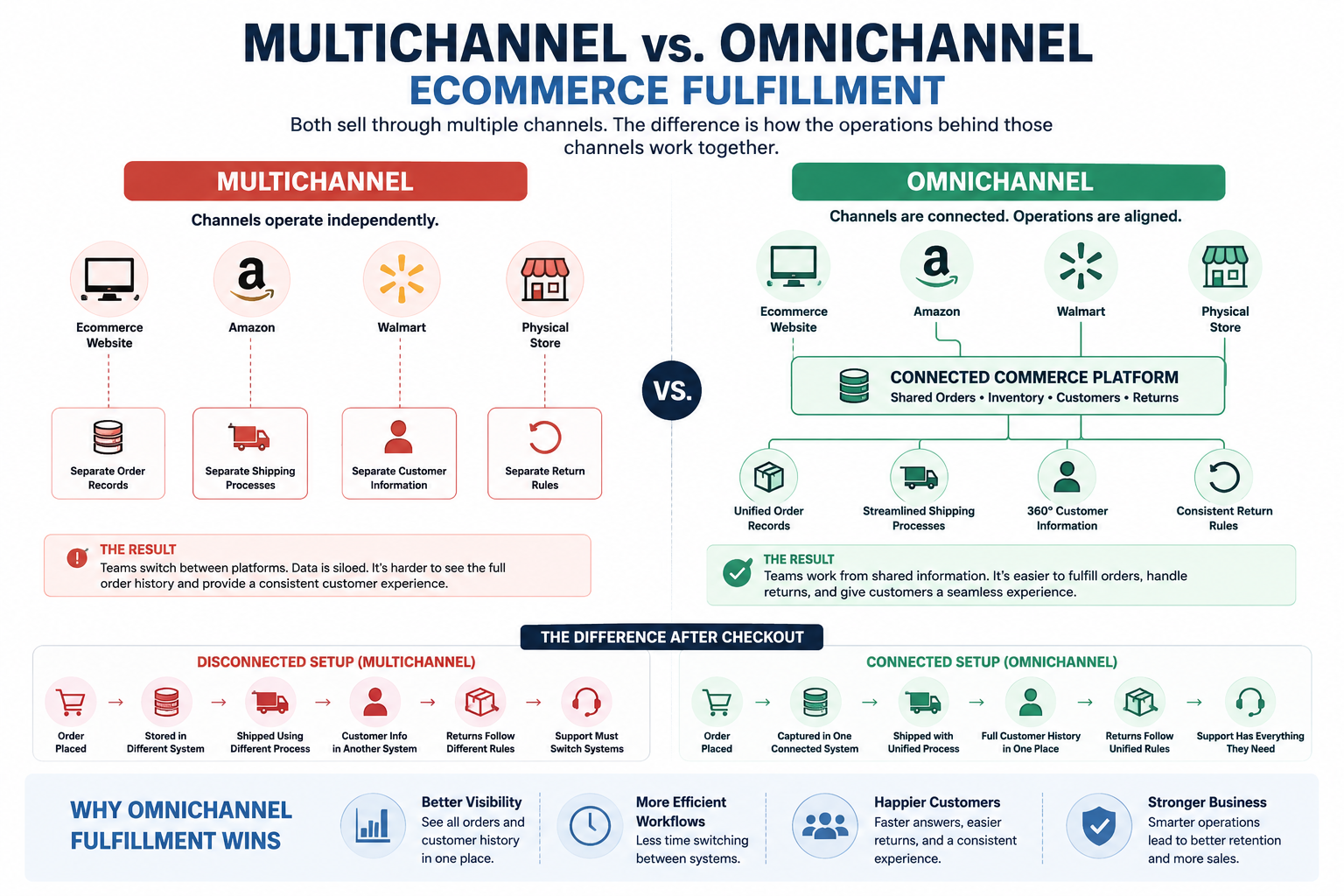
Omnichannel delivery connects the operational side of retail across the different channels customers use to shop. That can include ecommerce websites, online marketplaces, physical stores, mobile commerce, warehouses, distribution centers, and third-party fulfillment locations.
The customer may place an order through one channel and receive or return it through another. A shopper might buy online and pick up at a store, order from a marketplace and receive the item from a warehouse, or make an online purchase and return it to a physical location.
Salesforce describes omnichannel commerce as connecting customer interactions across digital and physical channels rather than treating each touchpoint as a separate experience.
That same thinking has to extend into fulfillment. The retailer’s systems need to know what was ordered, where inventory is located, how the order should ship, and what should happen if the product is returned.
For growing ecommerce brands, that gets more complicated as order volume rises. Adding more places to sell can quickly create more manual work unless the systems behind those channels stay connected.



Multichannel vs. Omnichannel Ecommerce Fulfillment
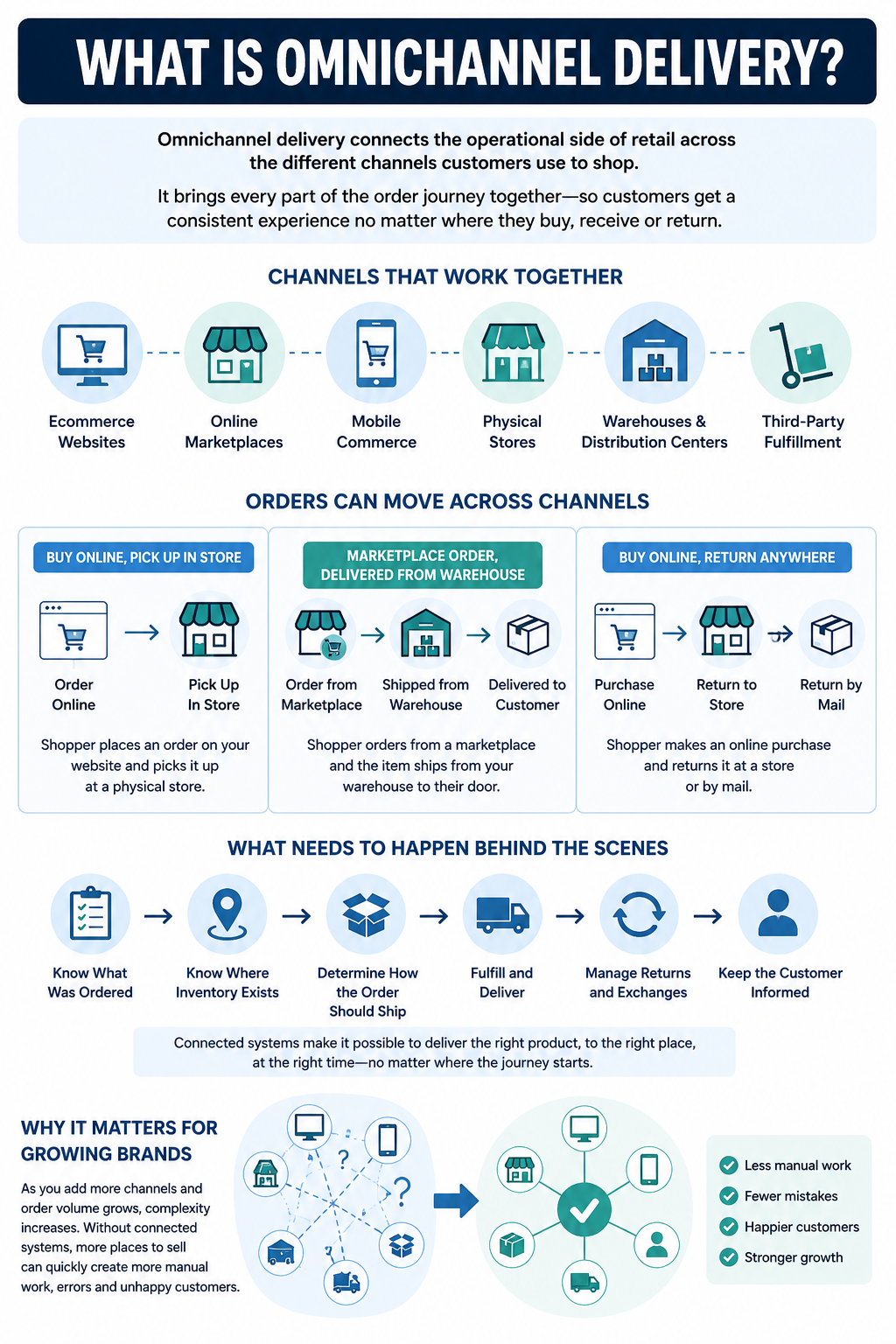
Multichannel and omnichannel retail are not the same thing. A multichannel retailer may sell through a Shopify store, Amazon, Walmart, and physical retail locations, but each channel can still run on separate operational workflows.
Marketplace orders may live in one system while ecommerce orders live in another. Store transactions may reside elsewhere entirely, leaving warehouse and customer support teams to switch between platforms just to understand what happened.
In short: An omnichannel approach connects those workflows more closely, while multichannel retail gives customers several individual ways to interact with a retailer, while omnichannel strategies connect those channels into a more coordinated experience.
The difference becomes especially clear after checkout. In a disconnected setup, each sales channel may have its own order records, shipping processes, customer information, and return rules.
In a more connected setup, teams can work from shared order and customer information. That can make it easier to process shipments, handle returns, and answer customer questions without jumping across several systems.

“In my experience, the most effective enterprise organizations are the ones that make it easy for people to understand what needs to happen next. This is because simplicity isn’t about removing capability. On the contrary, it’s about removing unnecessary friction.” Read Article on Forbes

Inventory Truth Comes Before Fast Fulfillment
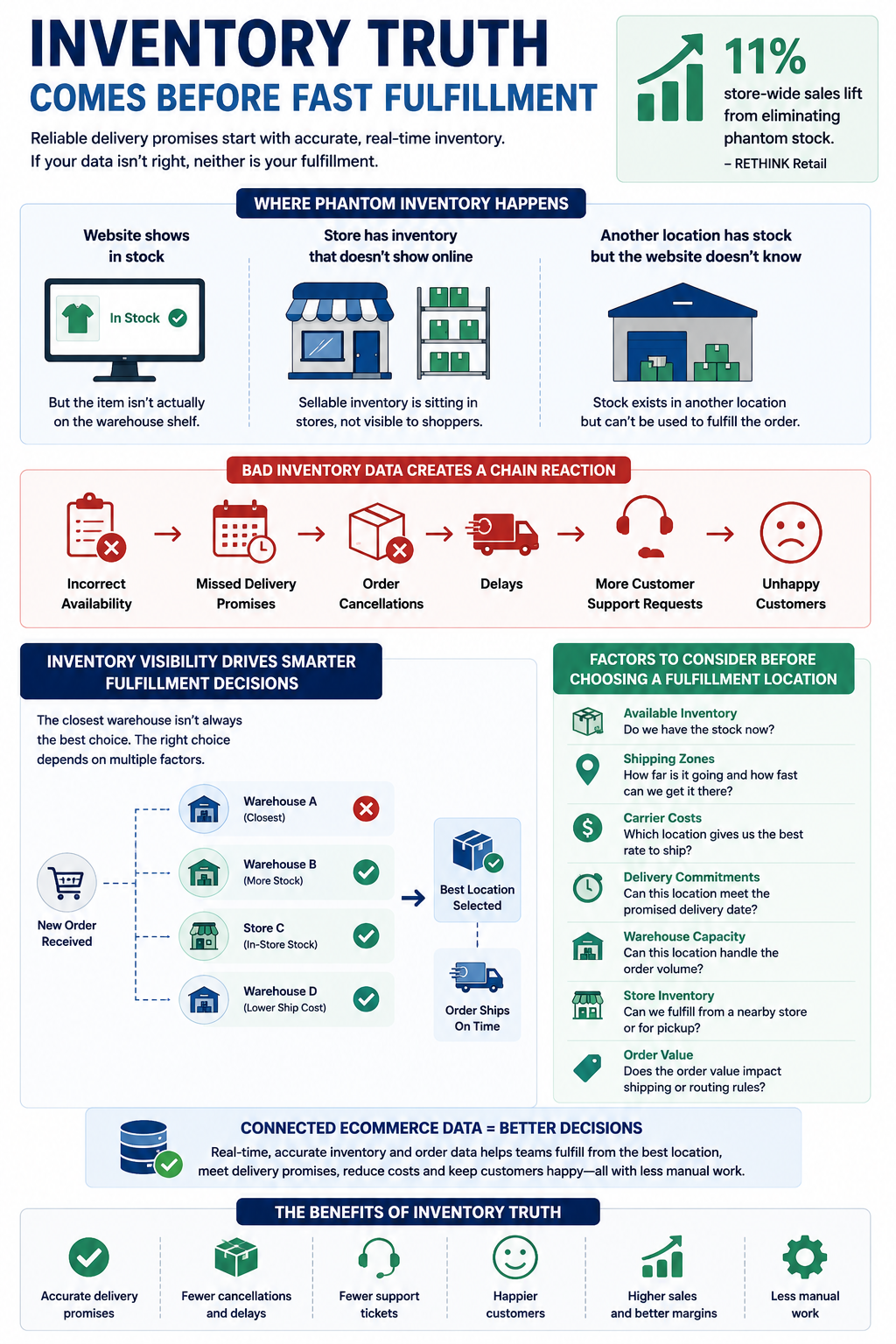
Retailers cannot make reliable delivery promises without reliable inventory. A website may show a product as available even though the item is not actually sitting on the warehouse shelf.
A physical store may have sellable inventory that never appears online. Another location might be holding stock that could fulfill an ecommerce order while the website tells the shopper the product is unavailable.
This is where phantom inventory becomes a serious problem. RETHINK Retail identifies inventory accuracy as a major part of successful order orchestration and reports that eliminating phantom stock can produce an 11% store-wide sales lift.
Bad inventory data can create a chain reaction. Incorrect availability can lead to missed delivery promises, order cancellations, delays, and more customer support requests.
Inventory visibility also affects where an order should ship from. The closest warehouse is not always the best fulfillment choice if another location has better stock availability, lower carrier costs, or a better chance of meeting the promised delivery date.
Retailers may need to consider several factors before choosing a fulfillment location, including:
- Available inventory
- Shipping zones
- Carrier costs
- Delivery commitments
- Warehouse capacity
- Store inventory
- Order value
Connected ecommerce data gives teams a better chance of making accurate decisions. It can also reduce the manual work required to move between order, inventory, and shipping systems.
“The post-purchase experience shapes your brand just as much as what draws a customer to it before they buy. Branding or advertising begin to shape customer confidence, but the experience that follows checkout influences loyalty more.” Read Article on Fast Company
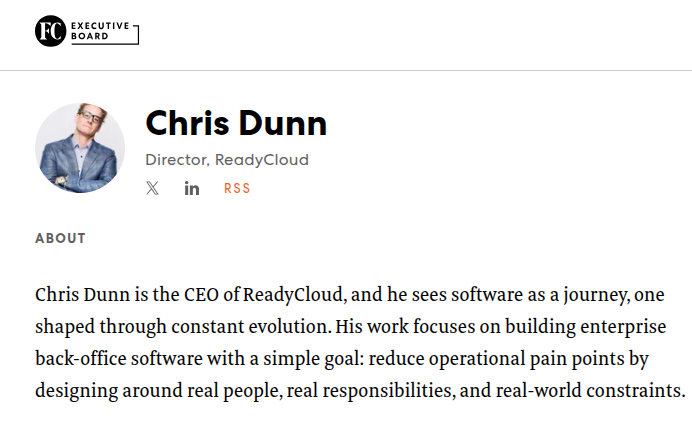

Fast Delivery Has to Make Financial Sense
Customers like fast shipping, but retailers still have to pay for it. That creates a constant balancing act between delivery expectations, carrier costs and margins.
RETHINK Retail highlights the economics of fast delivery as a major challenge for omnichannel. Its 2026 report explains that leading retailers are looking for ways to support expensive delivery models through additional profit sources such as memberships, marketplaces and retail media.
Most ecommerce businesses cannot send every package via the fastest available carrier, commonly which happens to be USPS Ground Advantage for their cubic shipping option. A better shipping decision takes into account package weight, destination, shipping zone, delivery commitment, order value, carrier pricing, and available service levels.
This is where shipping automation can help. Instead of asking employees to make the same carrier and service decisions order after order, shipping rules can handle repeatable choices automatically.
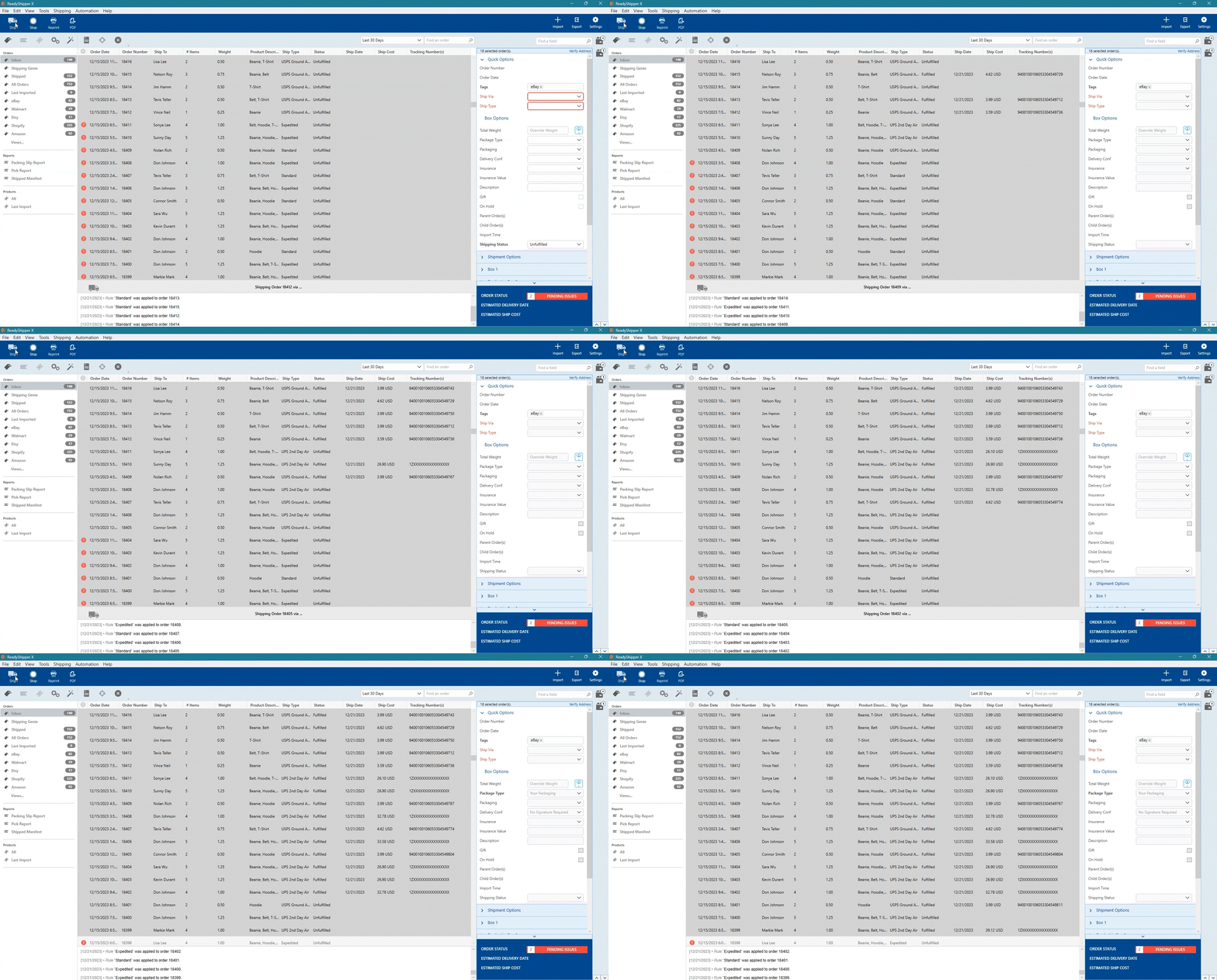
ReadyShipper X helps ecommerce teams manage high-volume shipping with multi-carrier shipping tools, automated shipping rules, carrier options, and faster label printing. For online retailers, speed is not optional, but paying more than necessary for every package is not a strong long-term strategy either.
Shipping software should help teams handle more orders without adding unnecessary manual work. It should also make it easier to choose the right service level for each shipment.
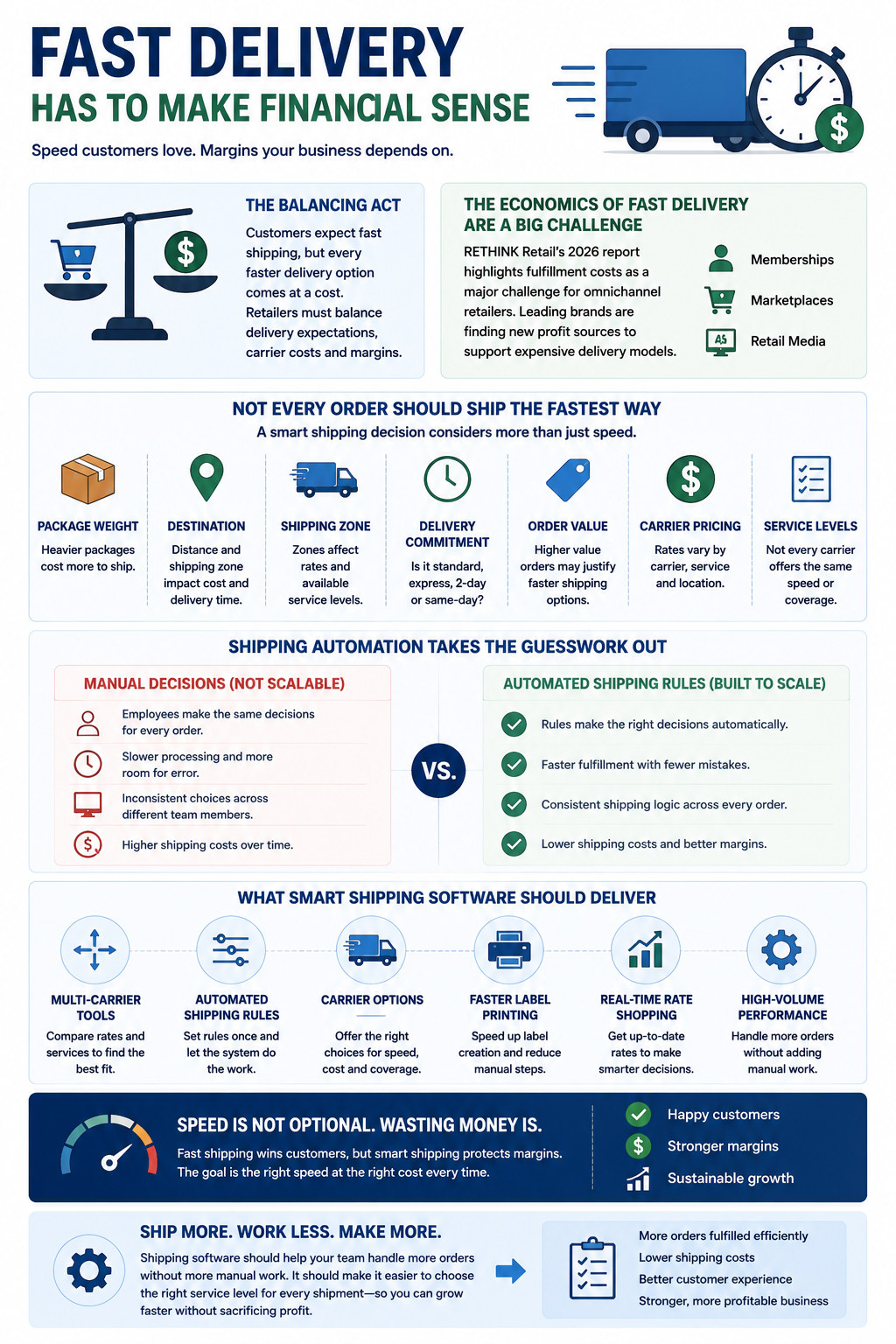
Customers Expect One Brand, Not Separate Systems
Customers do not think about your technology stack. They think about your brand and expect the experience to feel connected from one interaction to the next.
A shopper who purchases from your website does not care whether the warehouse uses a different platform from customer support. Someone returning an online purchase to a store does not want to hear that the store cannot access the ecommerce order.
SAP Engagement Cloud reports that customers increasingly expect connected interactions across channels. Its omnichannel marketing statistics also show that email and brand websites remain important customer engagement channels.
The disconnect often becomes obvious after checkout. A shopper may receive a shipping confirmation from one system, tracking information from another, and a marketing email from a third platform that does not know the order has already been returned.
That creates confusion instead of continuity. Connected order, shipment, return, and customer data gives ecommerce teams a better chance of keeping communication relevant.
“System failure often shows up in other ways. For example, a customer service employee may not be able to answer a basic question without opening four systems and four tabs. The warehouse team may be unable to reach the right person. Or a shipment delay can create five internal messages to five different people, each with multiple support tickets attached.” Read Article on Fast Company
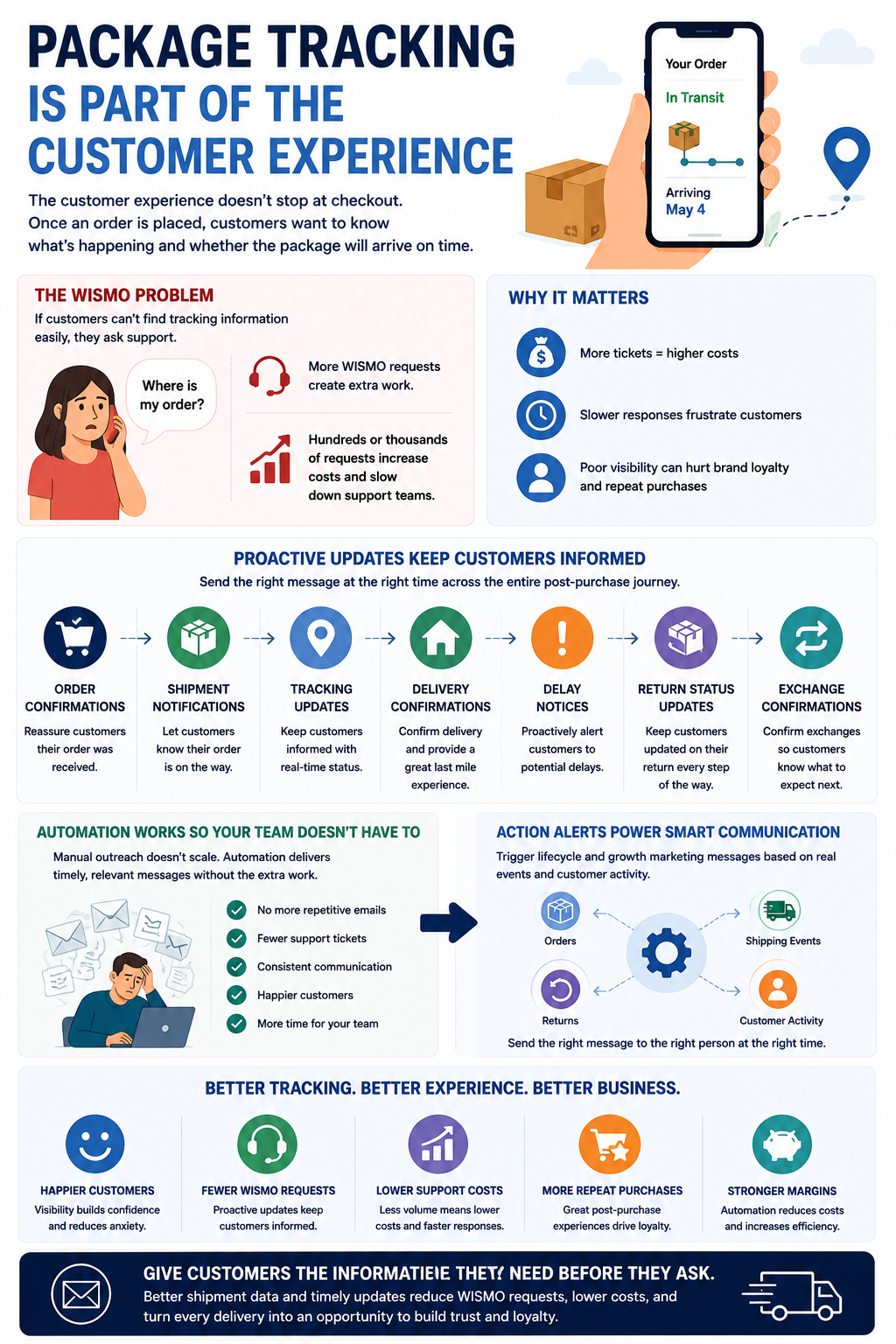
Package Tracking Is Part of the Customer Experience
The customer experience does not stop at checkout. Once an order is placed, customers want to know what is happening and whether the package will arrive on time.
If they cannot find that information easily, many shoppers contact customer support. Those WISMO requests, short for “Where is my order?”, can create significant extra work during busy periods.
One WISMO request may seem minor. Hundreds or thousands of similar requests can put unnecessary pressure on customer service teams and make a simple shipping question more expensive to handle.
Retailers can reduce that pressure with proactive post-purchase communication. Helpful updates can include:
- Order confirmations
- Shipment notifications
- Tracking updates
- Delivery confirmations
- Delay notices
- Return status updates
- Exchange confirmations
ReadyCloud’s Action Alerts can help ecommerce teams trigger lifecycle and growth marketing messages based on orders, shipping events, returns, and customer activity. This is where automation can replace repetitive communication without making the experience feel disconnected.
The answer is not more manual emails from customer service. Better shipment data and timely updates can help customers get the information they need before they ever open a support ticket.
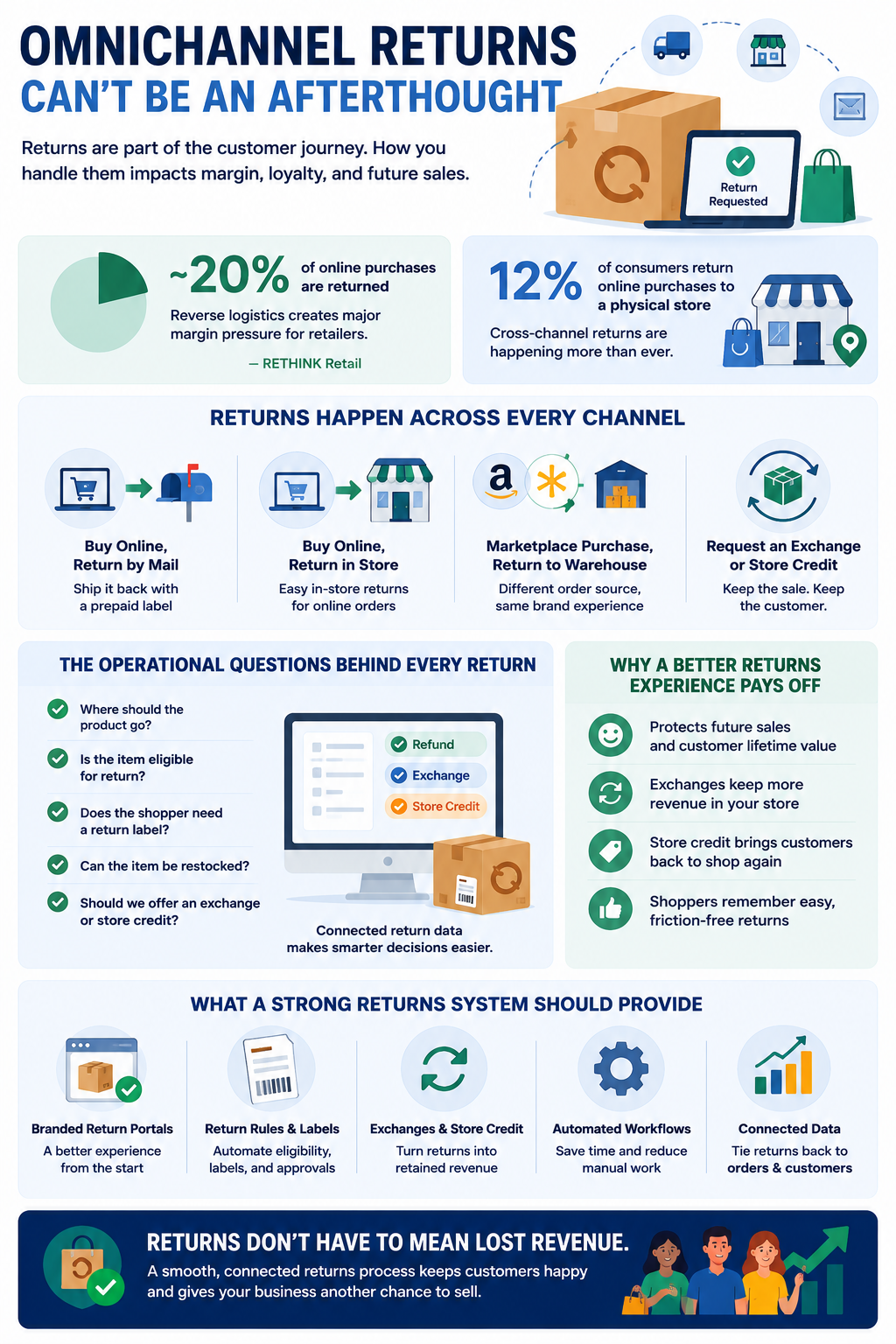
Omnichannel Returns Cannot Be an Afterthought
Getting an order to the shopper is only part of the fulfillment story. For many retailers, the process becomes more complicated once the product starts moving in the opposite direction.
Online return rates cost retailers nearly $685 billion in 2025 with reverse logistics as a major source of margin pressure.
Cross-channel shopping makes the returns process more complex, too. A customer might buy online and return through the mail, purchase online and return in a store, send a marketplace order back to a warehouse or request an exchange through a return portal.
About 12% of consumers return products to a retailer’s physical store after purchasing them online with online return rates hovering at about 25% nationwide. That shows how easily the purchase and return can take place across different channels.
Every return creates a new set of operational questions. Retailers have to decide where the product should go, whether it is eligible for return, whether the shopper needs a label, and whether the item can be restocked.
Teams also need to decide whether an exchange or store credit can preserve more of the original sale. Those decisions become harder if the returns system does not connect back to the original order and customer record.
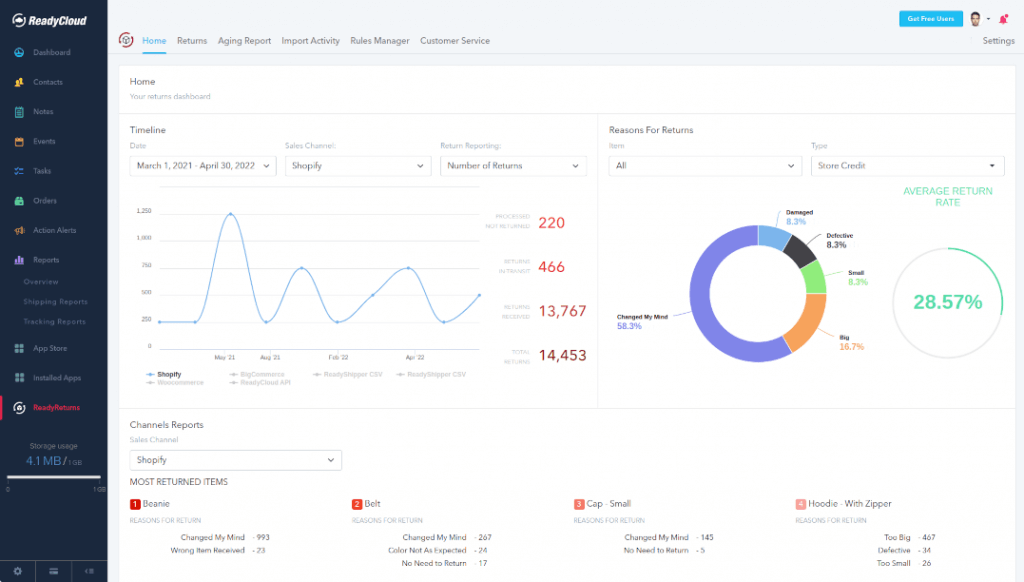
ReadyReturns helps retailers manage branded return experiences, return rules, labels, exchanges, store credit, and automated return workflows. A better returns experience can protect future sales because customers remember how difficult or easy it was to return an item.
Returns do not have to mean lost revenue. Exchanges and store credit can give retailers another opportunity to keep the customer engaged.
Customer Data Makes Retention Smarter
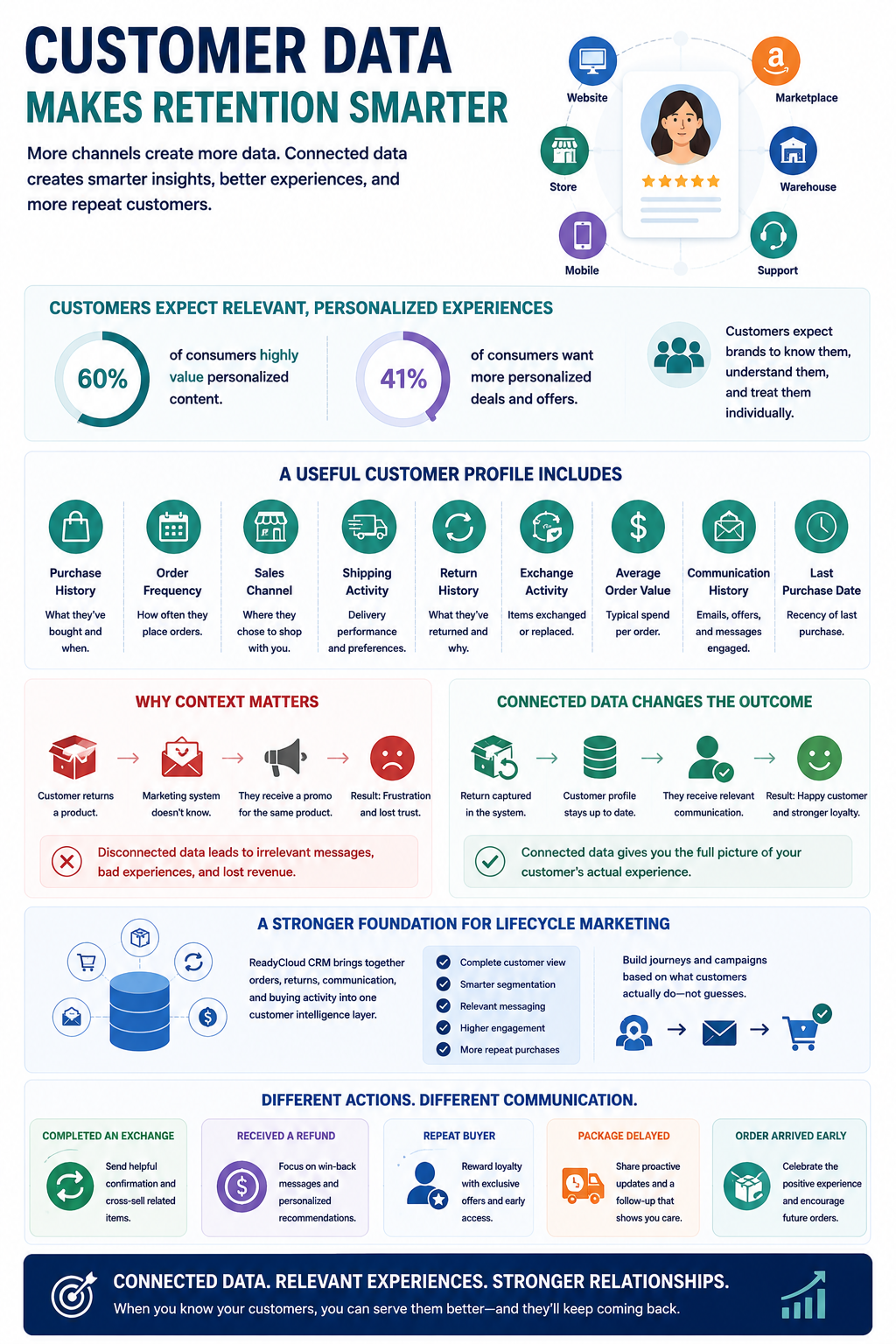
Selling through more channels creates more customer data. That information becomes more valuable when retailers can connect it instead of leaving purchase, shipment, and return history in separate systems.
A useful customer profile may include:
- Purchase history
- Order frequency
- Sales channel
- Shipping activity
- Return history
- Exchange activity
- Average order value
- Communication history
- Last purchase date
In 2026, roughly 60% of consumers highly value personalized content, and 41% want more personalized deals and offers.
Useful personalization requires context. A shopper who just returned a product probably should not receive a campaign promoting that same product a day later.
That kind of mistake often happens because the marketing system does not know what happened after the original purchase. Connected data gives ecommerce teams a better picture of the customer’s actual experience.
ReadyCloud gives ecommerce teams a customer intelligence layer that brings together shopper information, orders, returns, communication, and buying activity. That creates a stronger foundation for lifecycle marketing tied to what customers actually do.
A customer who completes an exchange can receive different communication from someone who receives a refund. A repeat buyer can also be treated differently from a first-time shopper, and a customer whose package was delayed may need a different follow-up than someone whose order arrived early.
Click-and-Collect Raises the Stakes
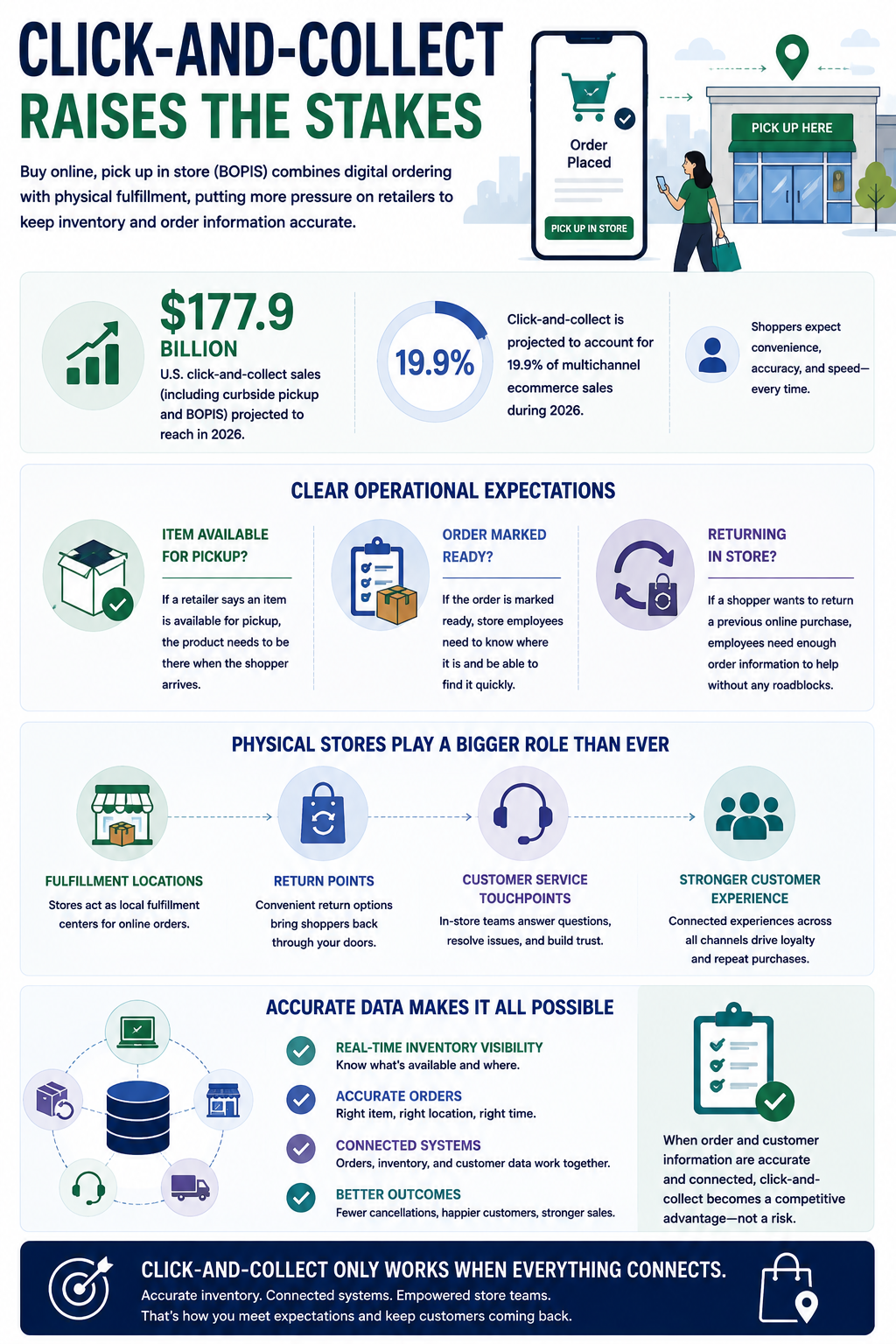
Buy online, pick up in store (BOPUS) has become another major part of cross-channel commerce. It combines digital ordering with physical fulfillment, putting more pressure on retailers to keep inventory and order information accurate.
U.S. click-and-collect sales, including curbside pickup and BOPIS, are projected to reach $177.9 billion in 2026. The same research estimates that click-and-collect will account for 19.9% of multichannel ecommerce sales during the year.
Those services create clear operational expectations. If a retailer says an item is available for pickup, the product needs to be there when the shopper arrives.
If the order is marked ready, store employees need to know where it is. If that same shopper wants to return a previous ecommerce purchase while they are in the store, employees need enough order information to help.
Physical stores are increasingly acting as fulfillment locations, return points, and customer service touchpoints. That makes accurate order and customer information more valuable across the business.
What an Omnichannel Ecommerce Stack Needs
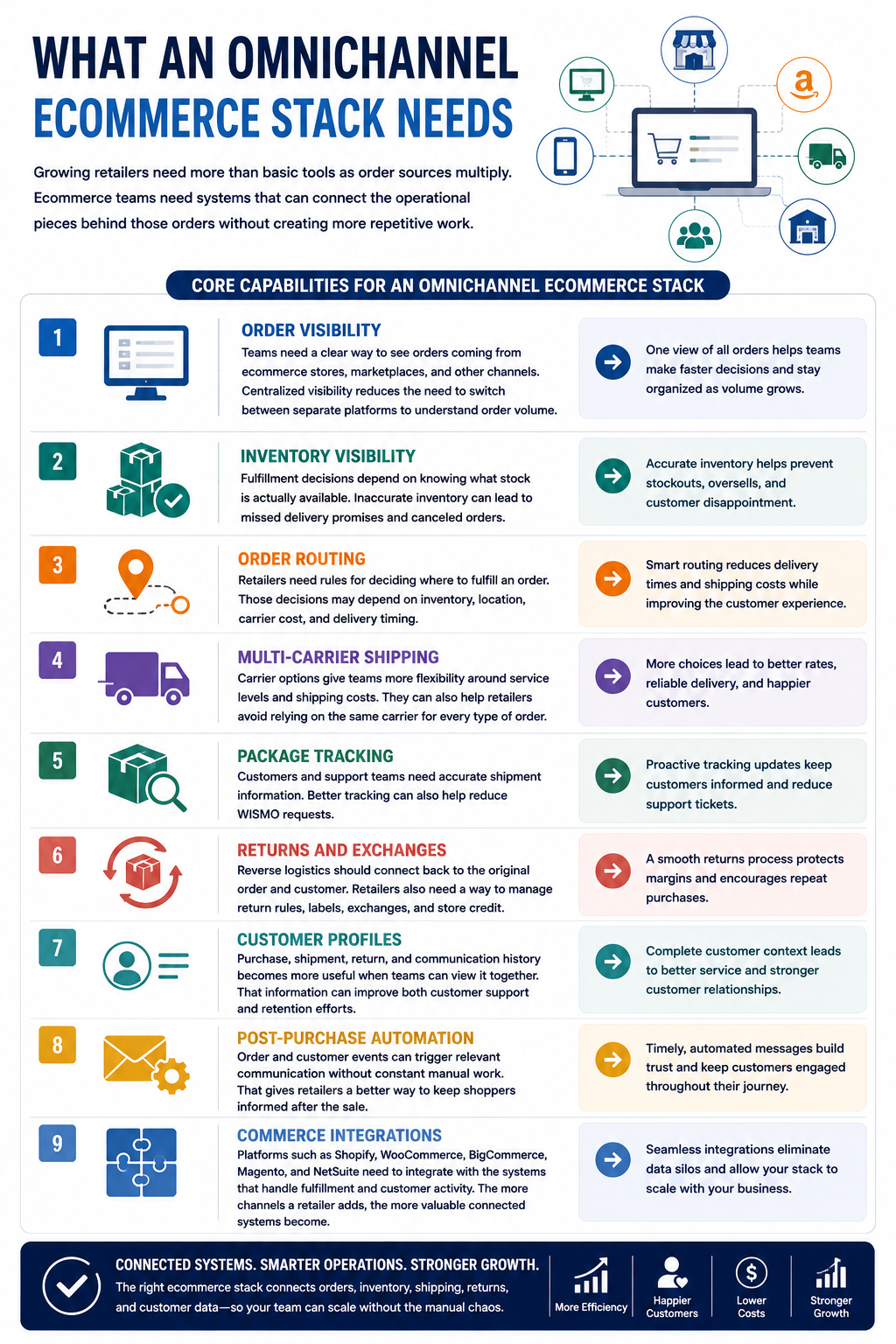
Growing retailers need more than basic tools as order sources multiply. Ecommerce teams need systems that can connect the operational pieces behind those orders without creating more repetitive work.
A strong setup typically needs several core capabilities:
- Order visibility. Teams need a clear way to see orders coming from ecommerce stores, marketplaces, and other channels. Centralized visibility reduces the need to switch between separate platforms to understand order volume.
- Inventory visibility. Fulfillment decisions depend on knowing what stock is actually available. Inaccurate inventory can lead to missed delivery promises and canceled orders.
- Order routing. Retailers need rules for deciding where to fulfill an order. Those decisions may depend on inventory, location, carrier cost, and delivery timing.
- Multi-carrier shipping. Carrier options give teams more flexibility around service levels and shipping costs. They can also help retailers avoid relying on the same carrier for every type of order.
- Package tracking. Customers and support teams need accurate shipment information. Better tracking can also help reduce WISMO requests.
- Returns and exchanges. Reverse logistics should connect back to the original order and customer. Retailers also need a way to manage return rules, labels, exchanges, and store credit.
- Customer profiles. Purchase, shipment, return, and communication history becomes more useful when teams can view it together. That information can improve both customer support and retention efforts.
- Post-purchase automation. Order and customer events can trigger relevant communication without constant manual work. That gives retailers a better way to keep shoppers informed after the sale.
- Commerce integrations. Platforms such as Shopify, WooCommerce, BigCommerce, Magento, and NetSuite need to integrate with the systems that handle fulfillment and customer activity. The more channels a retailer adds, the more valuable connected systems become.
Common Omnichannel Fulfillment Problems
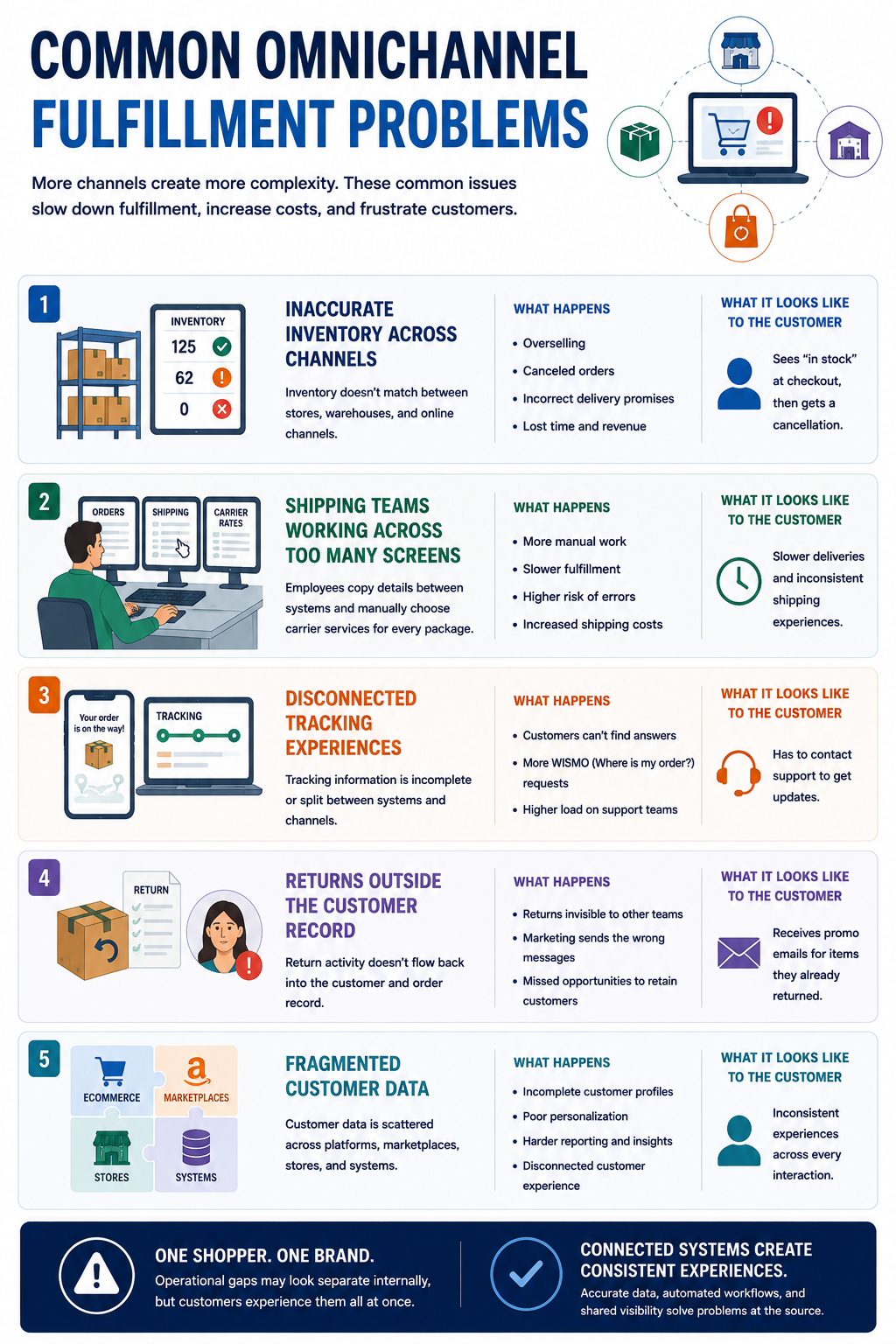
Adding sales channels can quickly expose operational gaps. One of the most common is inventory that does not match across stores, warehouses, and online channels.
That can result in overselling, canceled orders, and incorrect delivery promises. Customers see the problem at checkout, but the root cause often starts much earlier in the data.
Another common issue is shipping teams working across too many screens. Employees may copy order details between systems or manually choose carrier services for every package, which adds time to the fulfillment process.
Tracking can become disconnected too. Customers receive incomplete updates and then turn to customer support for answers that should already be available.
Returns create another gap when return activity lives outside the customer record. Marketing teams may continue communicating as if the shopper kept the purchase because the return never reached the CRM.
Customer data can also become fragmented between ecommerce platforms, marketplaces, and physical stores. Each issue may appear separate internally, but the shopper experiences them all as part of the same brand.
How Retailers Can Improve Omnichannel Operations
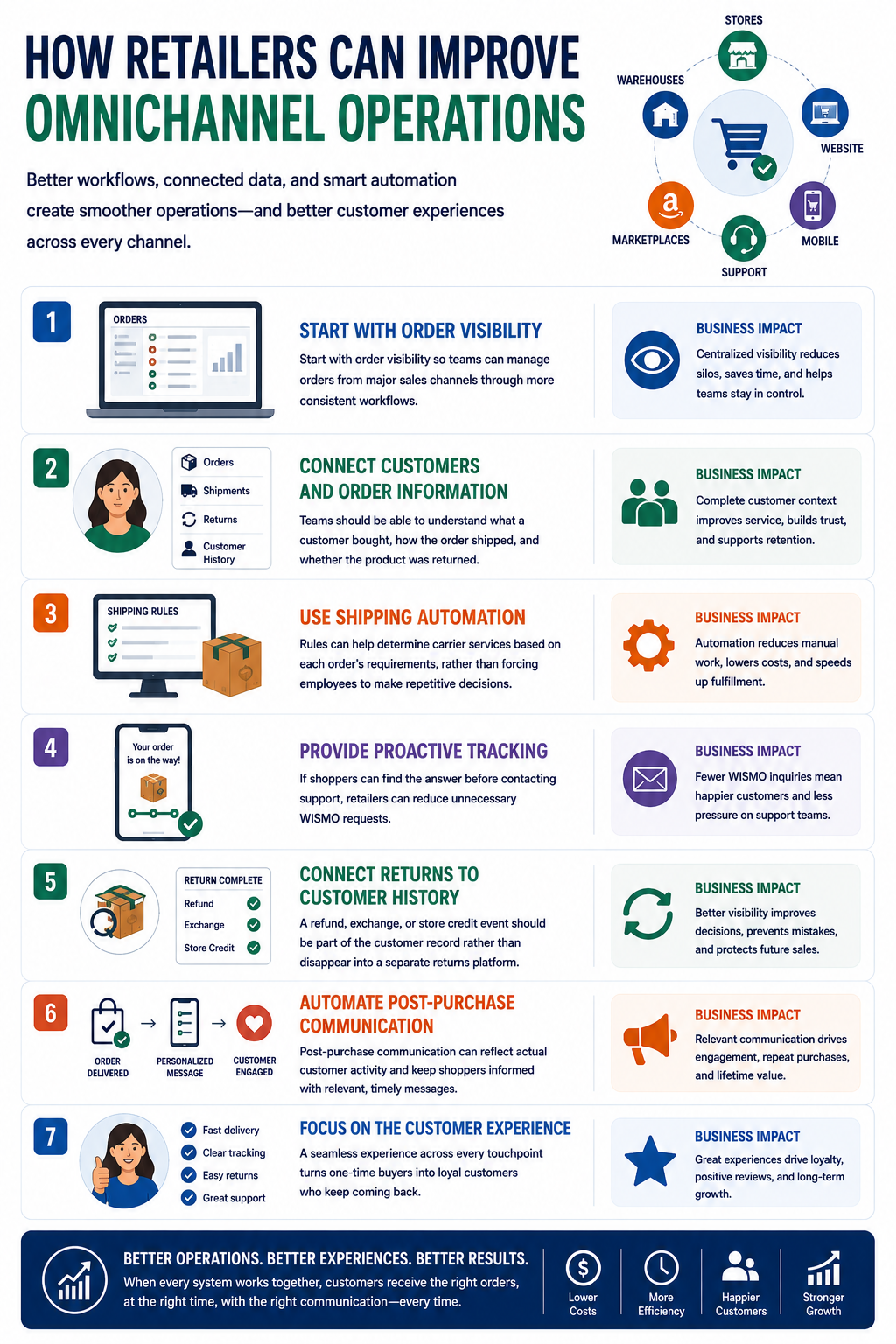
Improving these workflows does not require adding another manual process. Start with order visibility so teams can manage orders from major sales channels through more consistent workflows.
Next, connect customers and order information. Teams should be able to understand what a customer bought, how the order shipped, and whether the product was returned.
Shipping automation should also be part of the process. Rules can help determine carrier services based on each order’s requirements, rather than forcing employees to make repetitive decisions.
Proactive tracking is another practical improvement. If shoppers can find the answer before contacting support, retailers can reduce unnecessary WISMO requests.
Returns should also connect back to customer history. A refund, exchange, or store credit event should be part of the customer record rather than disappear into a separate returns platform.
Post-purchase communication can then reflect actual customer activity. The next sale often starts with the last order, and relevant communication gives retailers a better chance of keeping that customer engaged.
A shopper who receives an order quickly, knows where the package is, and can make a return without unnecessary friction has a very different experience from someone who spends days contacting support. Better operations create better customer experiences because customers see the results of every system working behind the scenes.
“Customers don’t separate departments. They don’t care whether a delay came from the carrier, the warehouse, the support team or the return platform. They only know whether the brand made the experience easy or painful.” Read Article on Forbes
The Sale Can Happen Anywhere. The Experience Still Has to Connect.
Retailers have spent years adding websites, marketplaces, apps, store pickup, and faster delivery options. Those capabilities create additional ways to sell, but they also place greater pressure on the systems responsible for fulfillment, returns, and customer communication.
Having a long list of omnichannel features is no longer enough on its own. Operational synchronization, accurate inventory, fulfillment economics, and reverse logistics are becoming much bigger parts of the retail conversation.
The shopper data points in the same direction. Since omnichannel consumers shop 70% more frequently than single-channel shoppers and deliver a 30% higher lifetime return on investment, the point is clear: shoppers want options and they want them to be convenient across the board.
Retailers have good reasons to serve customers across more channels. The bigger challenge is making sure orders move, packages arrive, returns make sense, and customer communication reflects what actually happened.
Shipping is easier than ever with ReadyShipper X, a multicarrier solution that simplifies your fulfillment process while saving time and money.

And when it comes to returns, ReadyReturns streamlines the entire process with an automated solution that boosts customer satisfaction and loyalty.

ReadyCloud is more than just a suite of systems—it’s your ticket to thriving in 2026 and beyond!
Start your journey to success today! Learn more and get started here.
Or contact our Sales Department at: 877-818-7447 ext. 1.
Frequently Asked Questions About Omnichannel Delivery
What is omnichannel delivery in ecommerce?
Omnichannel delivery is the process of coordinating fulfillment, shipping, pickup, tracking, and returns across the different channels a retailer uses to sell. The goal is to give customers a more consistent experience even if they purchase through one channel and receive or return the product through another.
It can include ecommerce websites, marketplaces, physical stores, warehouses, and third-party fulfillment locations. The operational systems behind those channels need access to accurate order, inventory, and customer information.
What is the difference between multichannel and omnichannel fulfillment?
Multichannel fulfillment means a retailer processes orders from several sales channels. Those channels may still use separate order records, shipping systems, customer profiles, and return processes.
Omnichannel fulfillment connects those workflows more closely. That can make it easier for retailers to manage orders, shipments, customer service, and returns without treating every channel as an isolated operation.
Why is inventory accuracy important for omnichannel retail?
Inventory accuracy affects whether a retailer can make reliable availability and delivery promises. If systems show inventory that is not actually available, customers may place orders that later have to be delayed or canceled.
Accurate inventory also helps teams decide where an order should ship from. Retailers can compare stock availability, fulfillment locations, carrier costs, and delivery commitments before choosing the best option.
How does multi-carrier shipping support omnichannel fulfillment?
Multi-carrier shipping gives retailers more options for matching each order with the right carrier and service level. That can help teams balance shipping speed, delivery commitments, and carrier costs.
ReadyShipper X supports multi-carrier shipping, automated shipping rules, and high-volume label processing. Those tools can help ecommerce teams handle more complex fulfillment workflows without having to make every carrier decision manually.
How do returns fit into omnichannel delivery?
Returns are part of the same customer journey as the original order. A shopper may buy through an ecommerce store and return the item by mail, bring it to a physical store, or request an exchange through an online return portal.
Retailers need a way to connect those return events to the original order and customer. ReadyReturns helps retailers manage return rules, labels, exchanges, store credit, and branded return experiences.
Can better tracking reduce WISMO requests?
Better tracking and proactive shipment updates can reduce the number of customers who need to ask about the status of their orders. Customers are less likely to contact support if they can easily see when an order ships, where the package is, and whether there is a delay.
Automated notifications also reduce repetitive work for customer service teams. Action Alerts can help retailers send messages tied to shipment, order, return, and customer activity.
How does omnichannel fulfillment support customer retention?
Customers remember what happens after checkout. Fast fulfillment, accurate tracking, easier returns and relevant communication can all affect whether a shopper chooses to buy from the same retailer again.
Connected customer data can also make retention marketing more relevant. ReadyCloud CRM helps ecommerce teams see orders, returns, communications, and buying activity together so customer outreach can better reflect the shopper’s actual history.
What software do retailers need for omnichannel ecommerce operations?
The exact technology stack depends on the retailer, but most growing ecommerce businesses need tools for order visibility, inventory, shipping, tracking, returns, customer data, and post-purchase communication. Integrations with platforms such as Shopify, WooCommerce, BigCommerce, Magento, NetSuite, and major marketplaces also become increasingly important as sales channels expand.
ReadyCloud brings shipping, returns, ecommerce CRM, and growth marketing tools together in one suite. That gives retailers a more connected way to manage what happens after the sale.