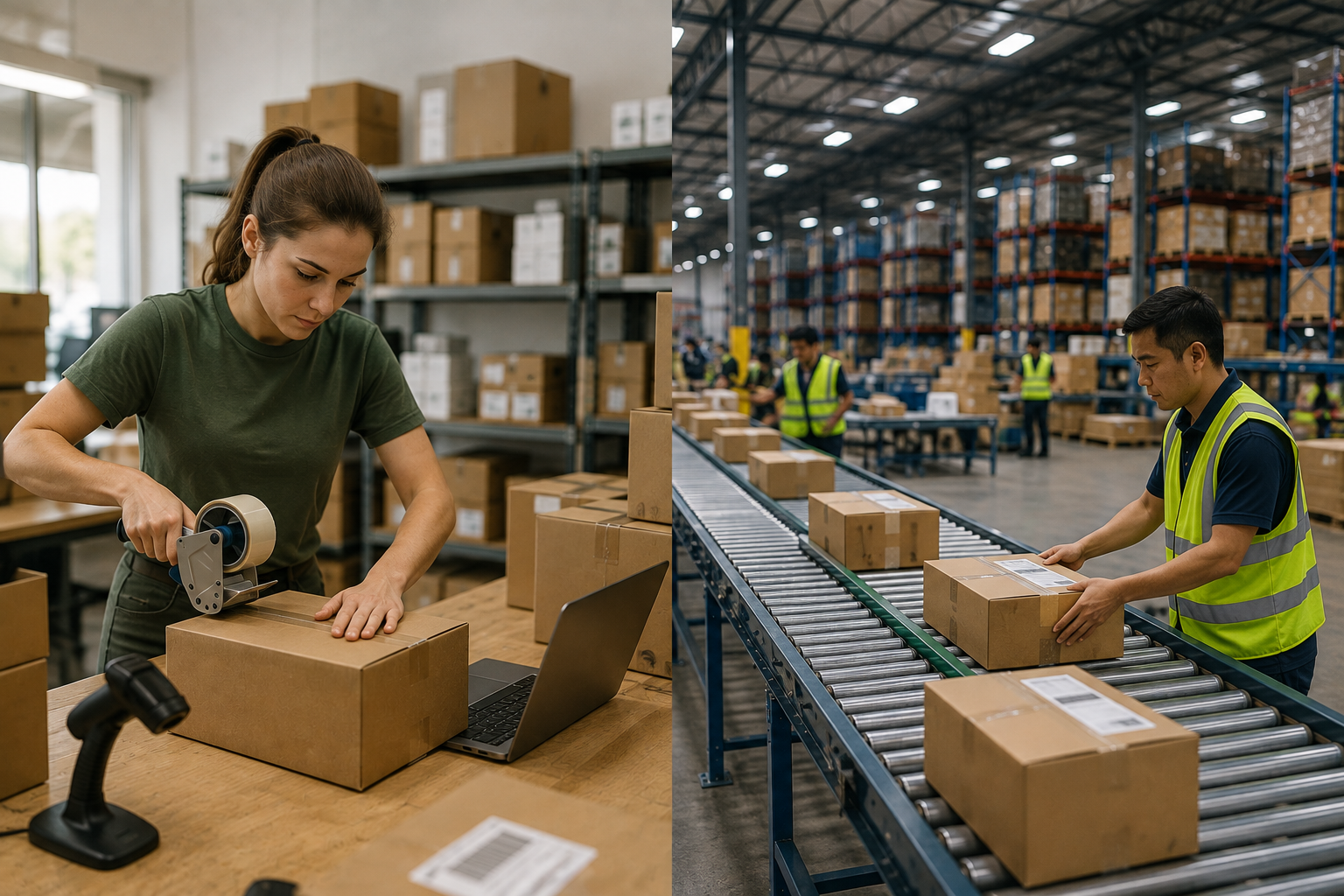
Fulfillment gets complicated long before a retailer considers itself a large company. An operation that once handled a few hundred weekly orders with little trouble can start to feel stretched as sales channels multiply, SKU counts rise, and customers expect faster delivery. More volume puts pressure on warehouse space, packing stations, employees, carrier selection, shipping costs, and the systems connecting everything behind the scenes.
That’s usually when the 3PL vs in-house fulfillment conversation becomes serious. Keeping fulfillment under your own roof gives you direct control over the warehouse, employees, and packing process, while outsourcing to a third-party logistics provider can reduce the amount of physical infrastructure your company has to manage. Neither approach fixes weak fulfillment processes on its own, and neither guarantees faster shipping or lower costs.
The better choice depends on how your business actually operates. A growing retailer shipping standardized products nationwide has different fulfillment needs than a subscription brand assembling custom boxes or an apparel seller dealing with heavy seasonal demand and high return volume. Looking at cost, capacity, control, technology, and post-purchase experience together gives you a much clearer picture of which model can support the next stage of growth.
Here’s what you need to know.
“The post-purchase experience deserves a seat at the executive table because it affects both brand equity and margin. A better return process can reduce service volume while increasing customer confidence. Clearer shipping communication can lower inbound tickets while improving trust. Faster resolution can protect repeat purchases. Cleaner workflows can reduce stress on teams and make the business easier to scale.” Read Article on Forbes

What Is In-House Ecommerce Fulfillment?
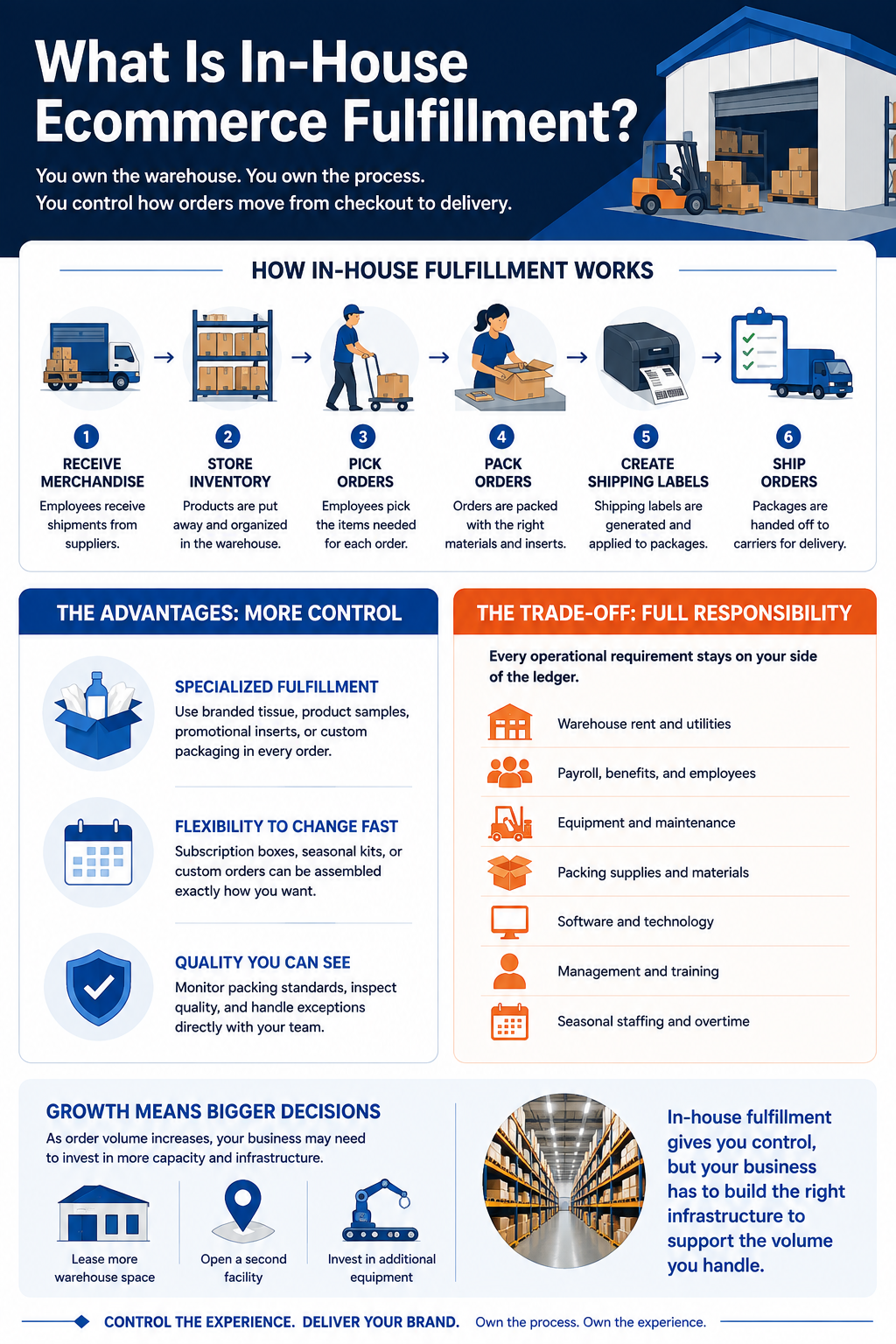
In-house fulfillment means the retailer owns or controls the operation responsible for storing inventory and getting orders out the door. Your employees receive merchandise, put products away, pick orders, pack boxes, generate shipping labels, and prepare packages for carrier pickup. The company also sets warehouse procedures, determines packing standards, and decides how to handle shipping exceptions.
That level of control can be a major advantage for retailers with specialized fulfillment requirements. A premium cosmetics brand may use branded tissue, product samples, and promotional inserts in every order. A subscription business may assemble different boxes every month. A company selling fragile or unusually shaped merchandise may have packing requirements that are difficult to hand off without extensive training. Keeping those processes internal makes it easier to change them quickly and monitor quality directly.
The cost is that every operational requirement stays on your side of the ledger. Warehouse rent, payroll, benefits, equipment, packing supplies, software, management, and seasonal staffing all become the retailer’s responsibility. Growth can also force larger capital decisions, such as leasing more space, opening a second facility, or investing in additional warehouse equipment. An internal operation gives you control, but the business has to build sufficient infrastructure to support the volume it handles.

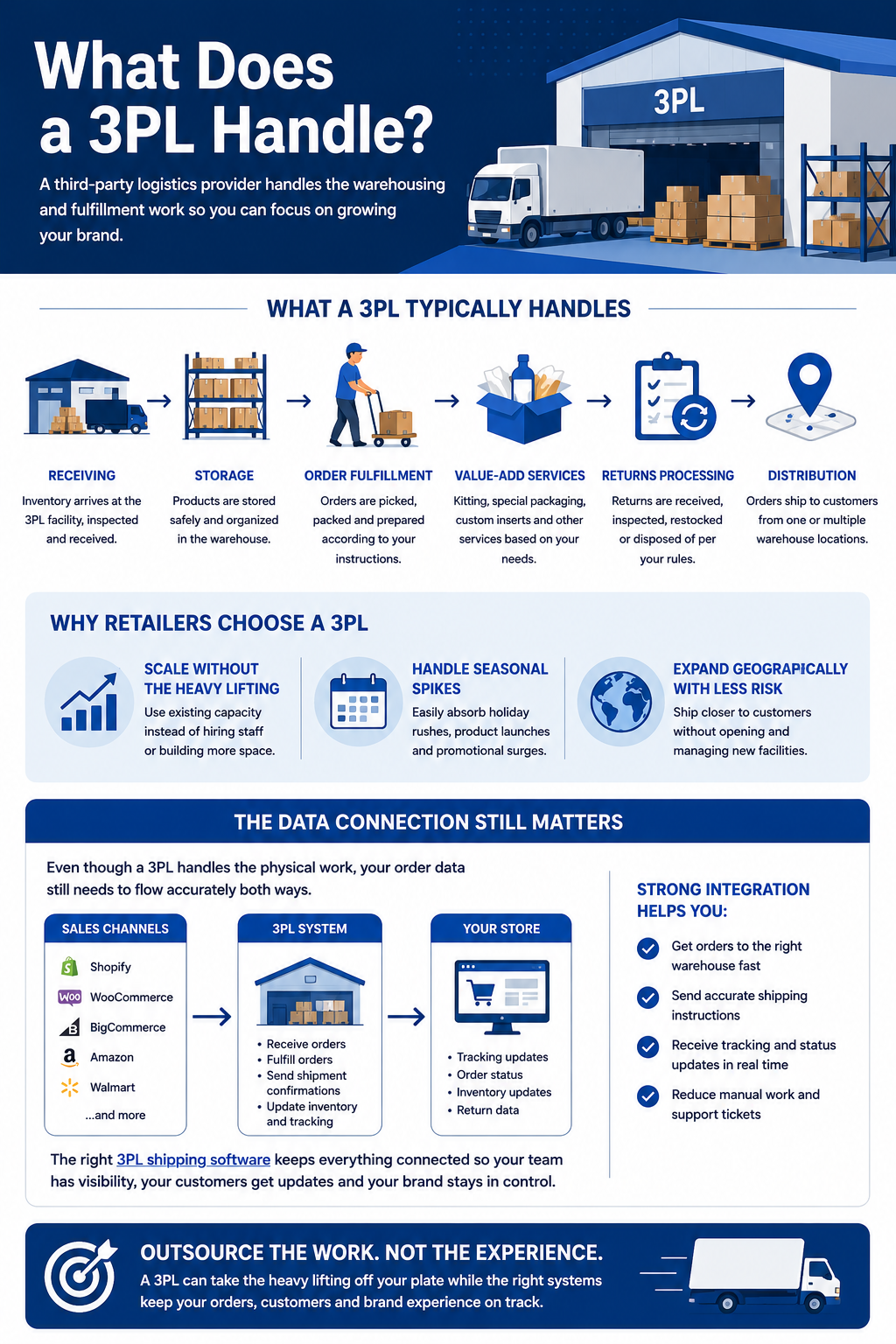
What Does a 3PL Handle?
A third-party logistics provider performs warehousing and fulfillment services for retailers that don’t want to manage every physical step themselves. Inventory is sent to the provider’s facility, where warehouse employees store products and fulfill incoming orders based on the retailer’s instructions. Depending on the provider, services may also include kitting, special packaging, returns processing, inventory management, and distribution from multiple warehouse locations.
This arrangement can remove a large amount of physical work from the retailer’s plate. Instead of recruiting warehouse employees or adding packing stations whenever demand increases, the brand can leverage existing capacity within the provider’s network. That can be especially useful during holiday spikes, product launches, or geographic expansion, when opening another company-operated warehouse may not make financial sense.
The physical work may be outsourced, but the order data still needs to move accurately. Orders coming from Shopify, WooCommerce, BigCommerce, Amazon, Walmart, or other channels need to reach the correct fulfillment location with the correct customer details and shipping instructions. Shipment confirmations and tracking numbers need to move back to the storefront after the package leaves. Strong 3PL shipping software helps keep that information connected without forcing employees to re-enter the same order details across multiple systems.
“Cloud-based solutions are tethered to the uptime of the service provider, whereas hybrid-cloud solutions mean you can keep shipping packages even if your SaaS provider is experiencing a disruption of service.” – Read Article on Forbes

Compare the Full Cost, Not Just the Warehouse Bill
Retailers often start this comparison with a simple question: Which model costs less?
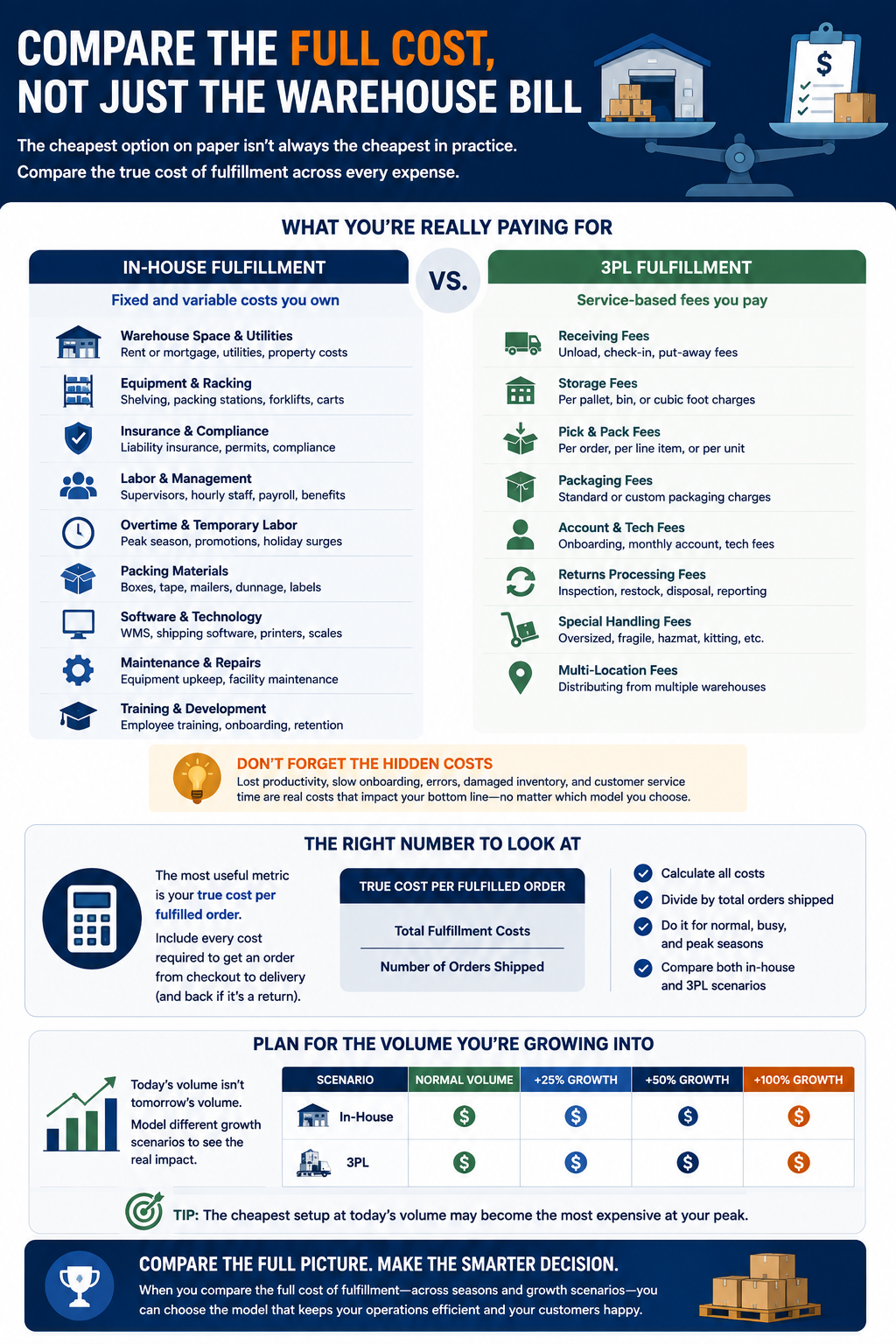
That question is useful, but the answer gets distorted if you compare only warehouse rent against a 3PL’s pick-and-pack fee. Fulfillment costs extend much further in both directions, and many of the expenses inside an internal operation are easy to overlook because they’re spread across different departments and budgets.
An in-house warehouse may include rent, utilities, equipment, racking, insurance, warehouse management, supervisors, hourly labor, overtime, temporary employees, packing materials, shipping software, printers, maintenance, and employee training. The operation also needs sufficient additional capacity to absorb promotion-driven or seasonal volume without causing late shipments. If the team regularly works overtime or hires temporary staff every holiday season, that expense belongs in the real fulfillment calculation.
A 3PL usually replaces many fixed warehouse expenses with a service-based pricing structure. Retailers may pay receiving fees, storage charges, pick-and-pack costs, packaging fees, account fees, return processing charges, and other costs tied to the work performed. Certain products or order types may also trigger special handling charges. A business that ships oversized products, complex bundles, or high-return merchandise needs to model those details rather than relying on a provider’s basic advertised rate.
The useful number is your true cost per fulfilled order at realistic volume. Calculate what internal fulfillment costs during a normal month, a busy month, and peak season. Do the same with potential 3PL pricing. Then model what happens if annual order volume grows 25%, 50% or 100%. A setup that looks inexpensive at current volume can become much less attractive once another lease, another shift, or another management layer is required.
“The post-purchase experience shapes your brand just as much as what draws a customer to it before they buy. Branding or advertising begin to shape customer confidence, but the experience that follows checkout influences loyalty more.” Read Article on Fast Company
In-House Fulfillment Gives Retailers More Direct Control
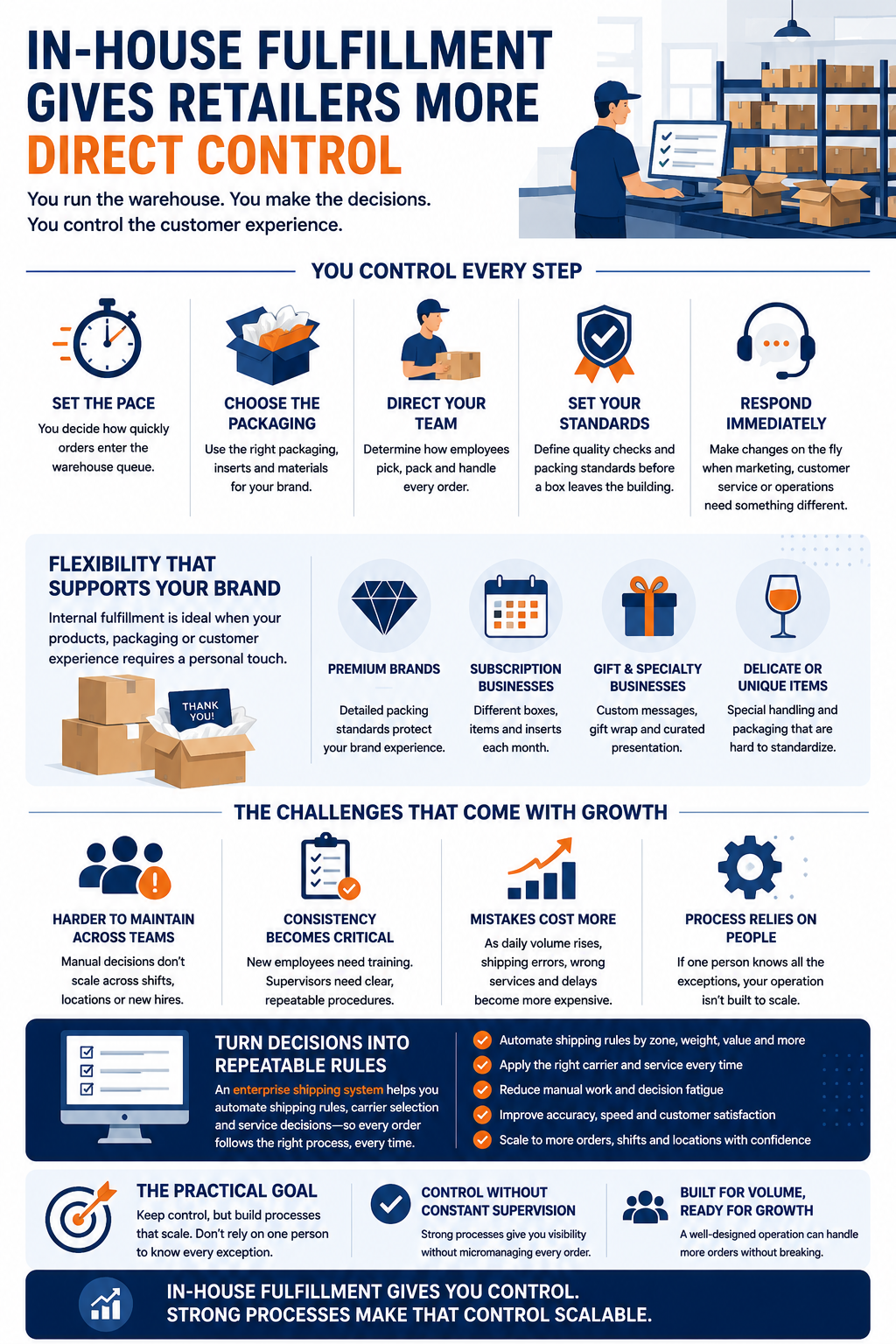
Control is one of the clearest reasons retailers keep fulfillment internal. Your company can decide how quickly orders enter the warehouse queue, which packaging is used, how employees pick products, and what standards must be met before a parcel leaves the building. If the marketing team wants to add an insert to tomorrow’s orders or customer service needs a special shipment handled differently, an internal warehouse may be able to make that adjustment immediately.
That flexibility is especially useful for brands where packaging is part of the product experience. Luxury retailers, subscription companies, gift businesses, and sellers of delicate merchandise may have detailed packing requirements that are difficult to standardize through an outside provider. Internal fulfillment can also make exception handling easier because warehouse employees can communicate directly with customer service, purchasing, and merchandising teams when something unusual happens.
The challenge starts as the operation expands. A shipping process that relies on experienced employees to remember which carrier to use for certain zones or which service to select for high-value orders becomes harder to maintain across additional shifts and locations. New employees need training, supervisors need consistent procedures, and mistakes become more expensive as daily volume rises. An enterprise shipping system can help turn those shipping decisions into repeatable rules rather than leaving them to individual judgment for every order.
The practical goal isn’t simply to maintain control. It’s to create a process that gives the business control without requiring constant manual supervision. If every exception has to be escalated to one experienced warehouse manager, the operation may technically be internal, but it isn’t well prepared for higher volume.
A 3PL Can Reduce the Pressure of Adding Warehouse Capacity
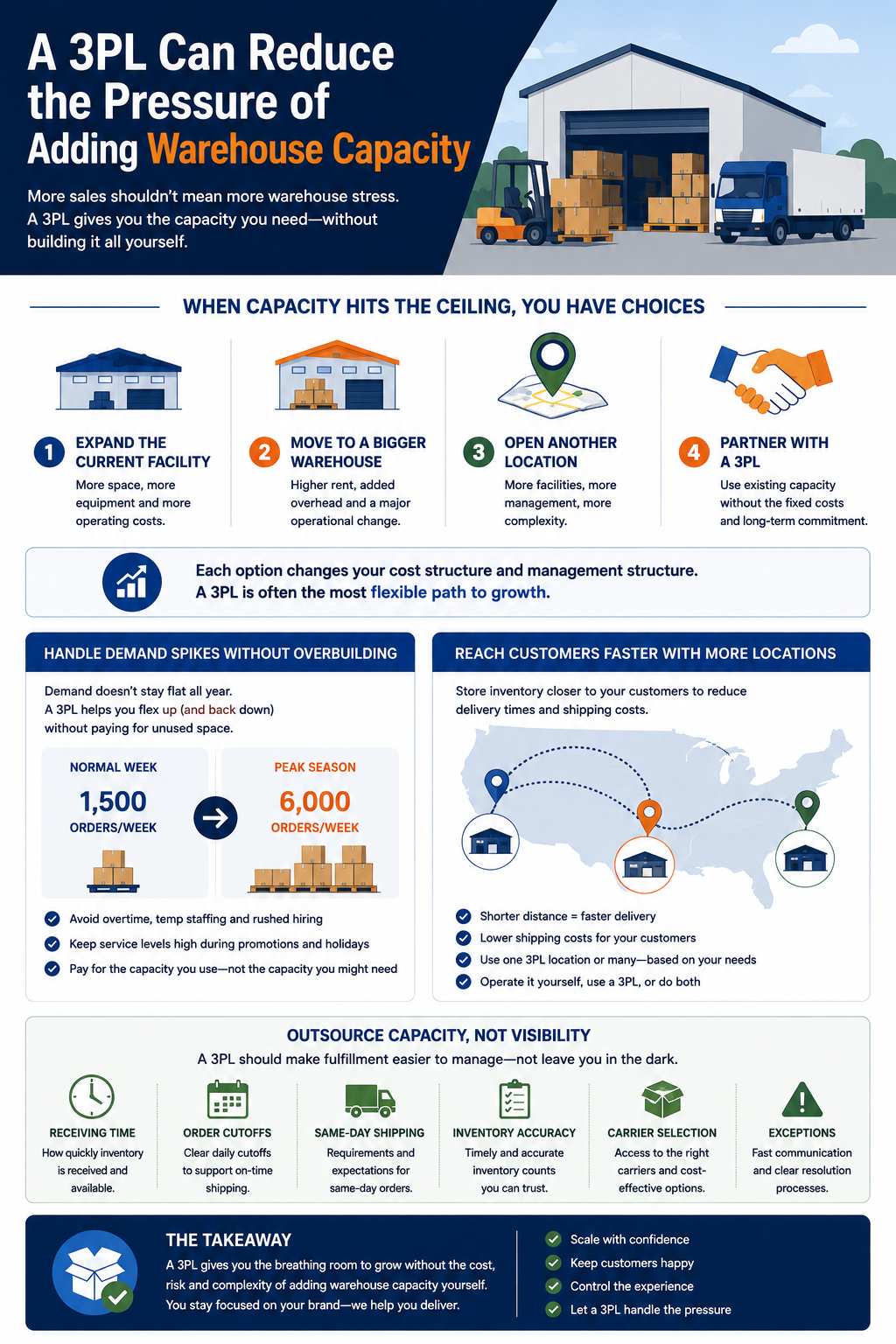
Warehouse space has a hard limit. Once racks are full, packing stations are crowded, and aisles are carrying more activity than they were designed for, retailers have to make a larger decision. They can expand the current facility, move into a bigger one, open another location, or send some fulfillment to an outside partner. Each path changes the business’s cost structure and management structure.
A 3PL can be especially attractive when demand fluctuates heavily throughout the year. Imagine a retailer that normally ships 1,500 orders per week but sees that number climb to 6,000 during major holiday promotions. Building enough internal warehouse capacity for the highest-volume weeks may mean paying for space and equipment that sits underused during quieter months. An outside provider can give the retailer another way to handle those spikes without having to size the entire internal operation around peak demand.
Geographic expansion adds another layer. Shipping every order from one side of the country can increase delivery times and transportation costs for customers farther away. Using another fulfillment location closer to those buyers can shorten the distance parcels need to travel. A retailer may choose to operate that location itself, use a 3PL, or combine both approaches depending on order volume and available capital.
Outsourcing capacity doesn’t remove the need to monitor performance. Retailers still need clear service expectations around receiving time, order cutoffs, same-day shipping, inventory accuracy, carrier selection, and exceptions. A 3PL should make physical fulfillment easier to manage, not leave the retailer blind to what happens after an order is placed.
Shipping Speed Comes Down to Process
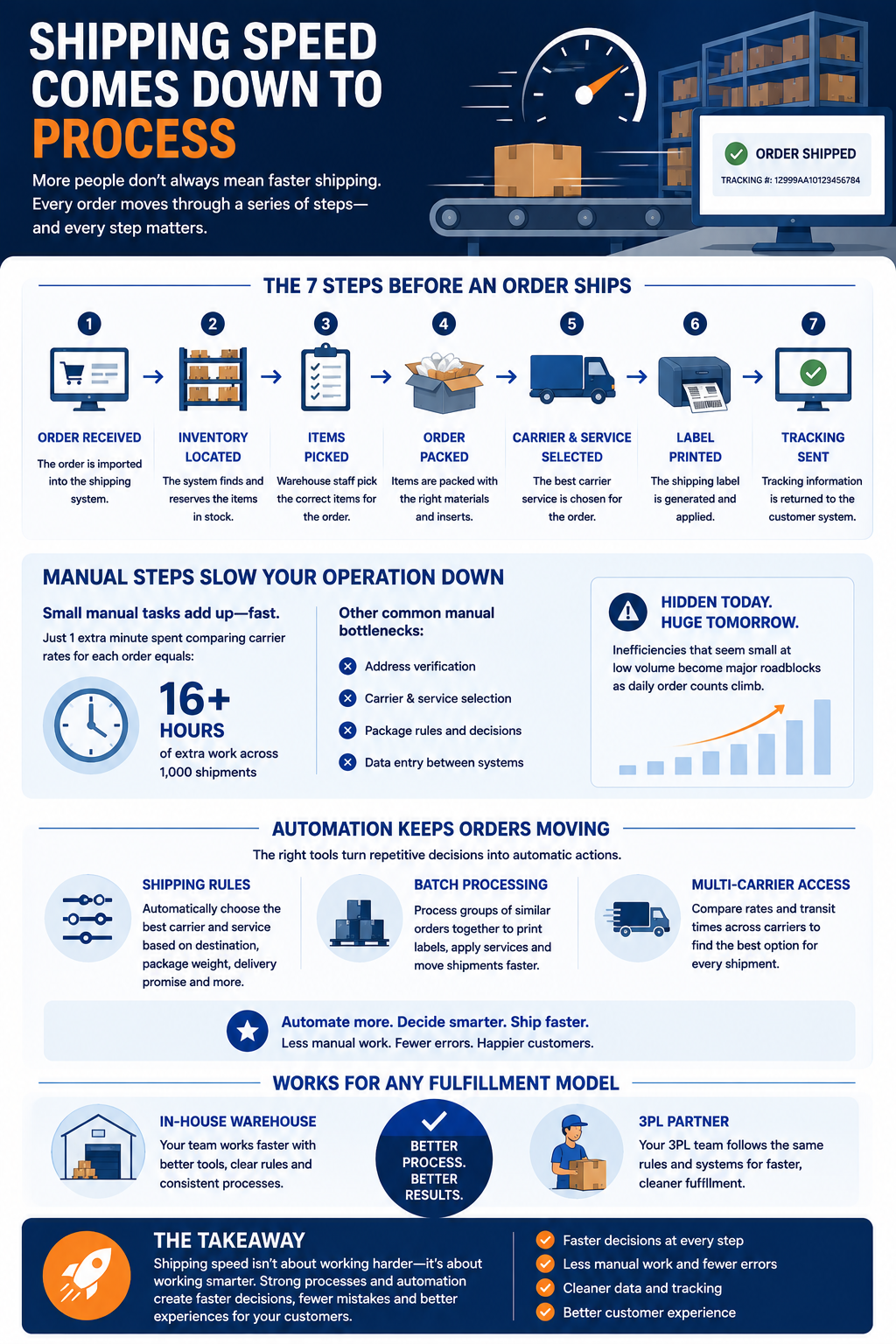
Fast fulfillment isn’t simply a matter of having more people on the warehouse floor. Every ecommerce order passes through a series of decisions before the carrier ever sees the package. The order has to be entered into the shipping system, inventory has to be located, items need to be picked correctly, the shipment has to be packed, the appropriate carrier service has to be selected, and the label needs to be printed. Once that’s done, the tracking information has to be returned to the customer-facing system.
Manual steps create extra time throughout that chain. An employee comparing carrier services for one shipment at a time may spend only another minute on each order, but that amounts to more than 16 additional hours of work across 1,000 shipments. The same problem applies to repetitive address checks, service selection, package rules, and data entry. Small inefficiencies can remain hidden at low volumes and become serious constraints as daily order counts increase.
Automation can remove many of those repetitive decisions. Shipping rules can select services based on destination, package weight, delivery promise, or another predefined condition. Batch processing can help warehouse teams move groups of similar orders through the shipping process faster. Multi-carrier access gives retailers more options if one service becomes too expensive, congested, or poorly suited to a particular destination.
Those capabilities are useful whether your own employee packs the box or a 3PL employee does it. The warehouse model changes who performs the labor, but the retailer still benefits from faster decisions, fewer avoidable errors, and cleaner shipment data.
Fulfillment Technology Has to Connect the Entire Order Flow
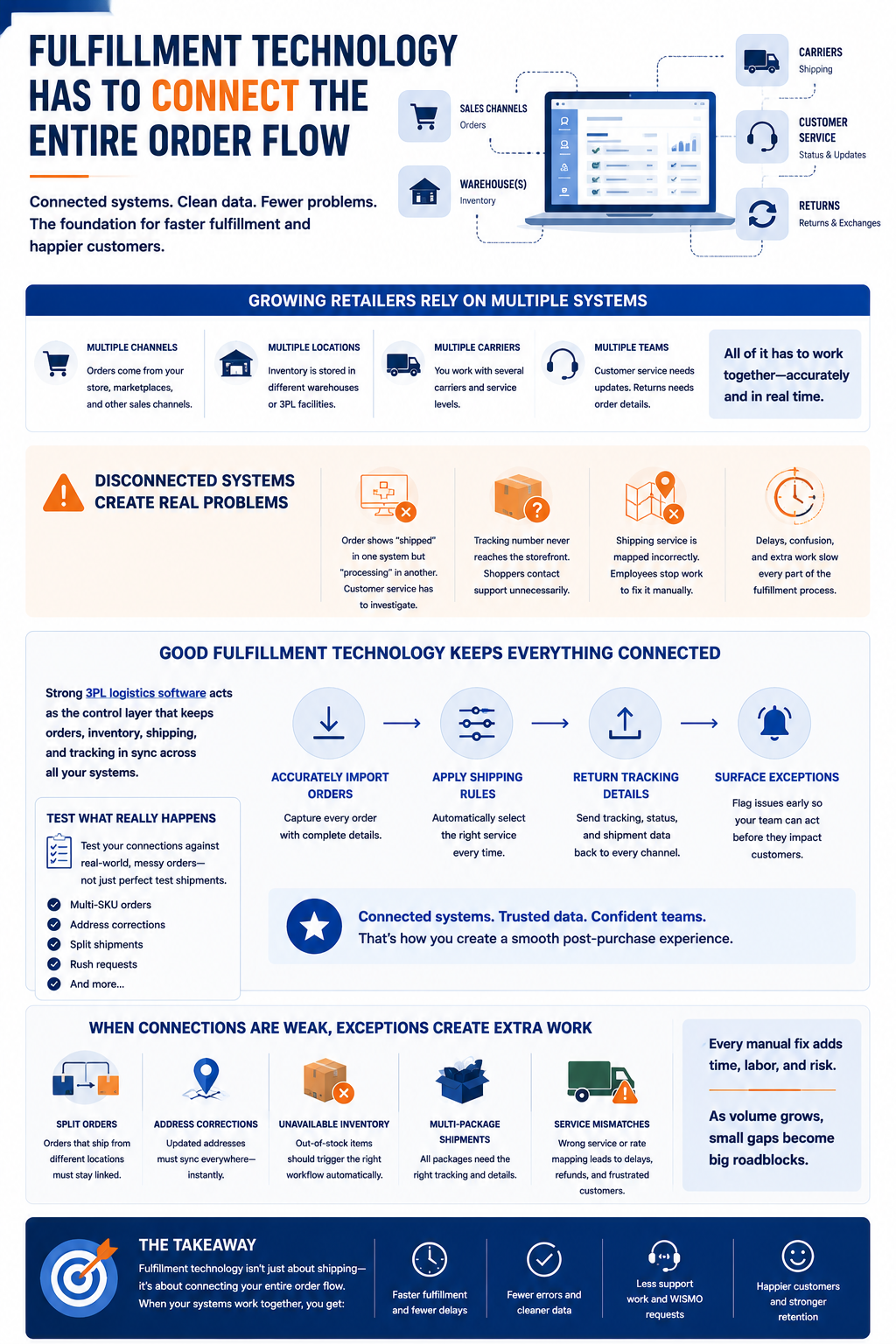
Most growing retailers don’t operate from a single system. Orders may arrive from several ecommerce platforms and marketplaces, inventory may sit in multiple locations and shipping may involve several parcel carriers. Customer service teams also need shipment status, while returns teams need enough information to connect incoming merchandise to the original transaction.That creates a data problem as much as a warehouse problem. If on
The system shows an order as shipped while another still shows it as processing, customer service has to investigate. If a tracking number never reaches the storefront, the shopper may contact support even though the package is already in transit. If a shipping service is mapped incorrectly between platforms, employees may have to stop and correct the order manually.
Good 3PL logistics software should support operational rules that ensure orders remain consistent across systems and warehouse locations. That includes accurately importing orders, applying shipping rules, returning tracking details, and surfacing exceptions that require attention. Retailers should test those connections against the messy orders they actually receive, not only a perfect test shipment with one SKU and a standard address.
Split orders, address corrections, unavailable inventory, multi-package shipments, and service mismatches are where weak connections tend to show themselves. If the systems can’t handle those situations cleanly, employees end up filling the gaps manually. That adds labor, slows fulfillment, and makes it harder to maintain consistent performance as volume rises.
Returns Belong in the Fulfillment Conversation Too
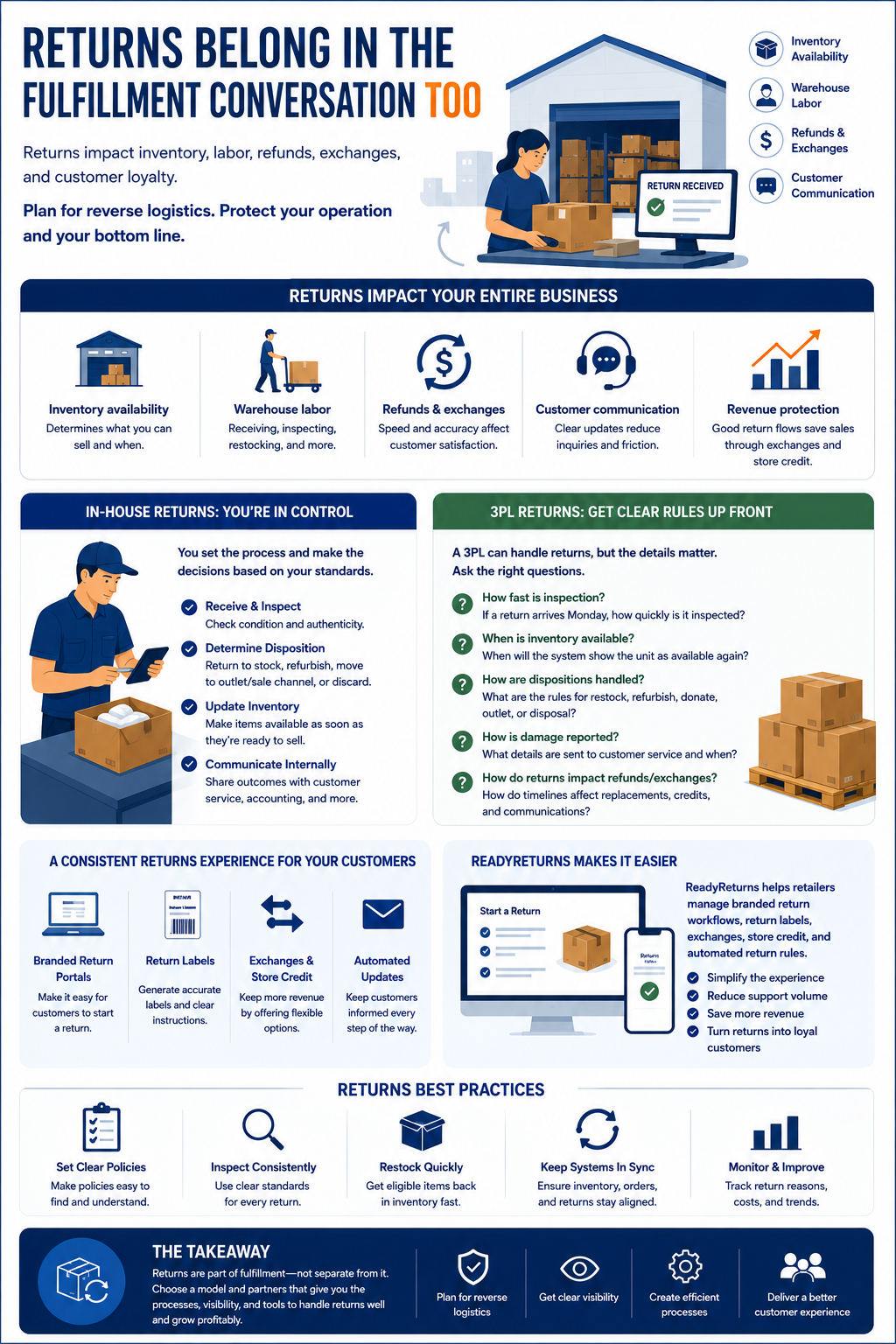
Outbound shipping gets most of the attention during a fulfillment review, but the warehouse also has to deal with merchandise coming back. Returns affect inventory availability, warehouse labor, refunds, exchanges, and customer communication. A retailer that chooses a fulfillment model without considering reverse logistics may solve one operational problem while creating another.
An in-house warehouse gives the retailer direct control over receiving and inspection. Employees can determine whether merchandise should be returned to sellable inventory, refurbished, moved to a secondary sales channel, or removed from stock. That can be especially useful for products that require detailed inspection before they’re resold.
A 3PL may also provide returns processing, but retailers need clear rules on timing and disposition. If a customer sends an item back on Monday, how quickly does the provider inspect it? When does the system show that unit as available inventory again? What information is sent to customer service if the product arrives damaged? Those details directly affect refunds, replacement orders, and the retailer’s ability to sell available inventory accurately.
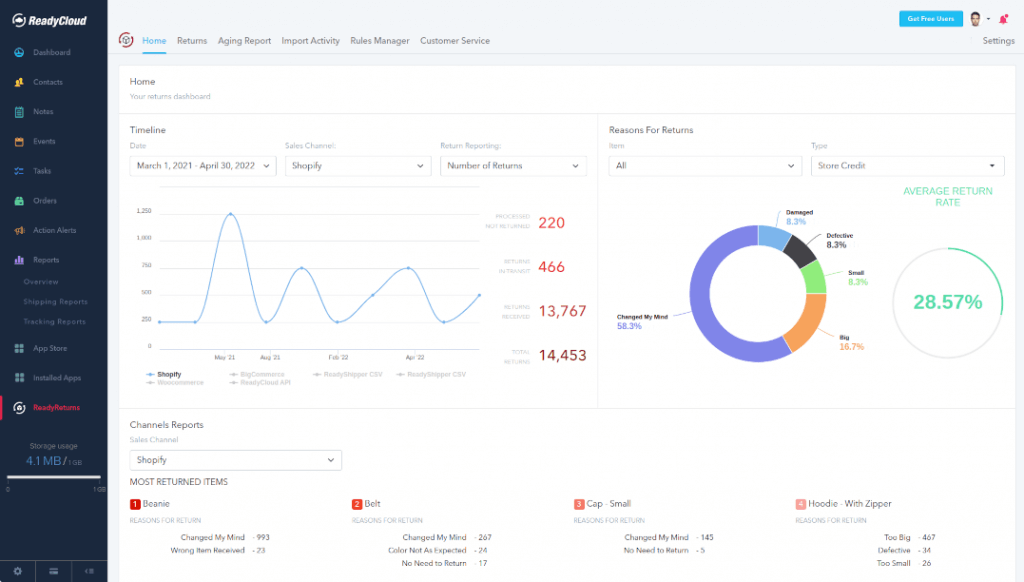
The customer-facing returns process should also remain consistent regardless of who receives the package. ReadyReturns helps retailers manage branded return workflows, return labels, exchanges, store credit, and automated return rules, giving shoppers a clearer process while the operational side handles the merchandise. Easier returns can reduce customer service workload and create more opportunities to save revenue through exchanges or store credit, rather than treating every return as a lost sale.
When In-House Fulfillment Is Usually a Strong Fit
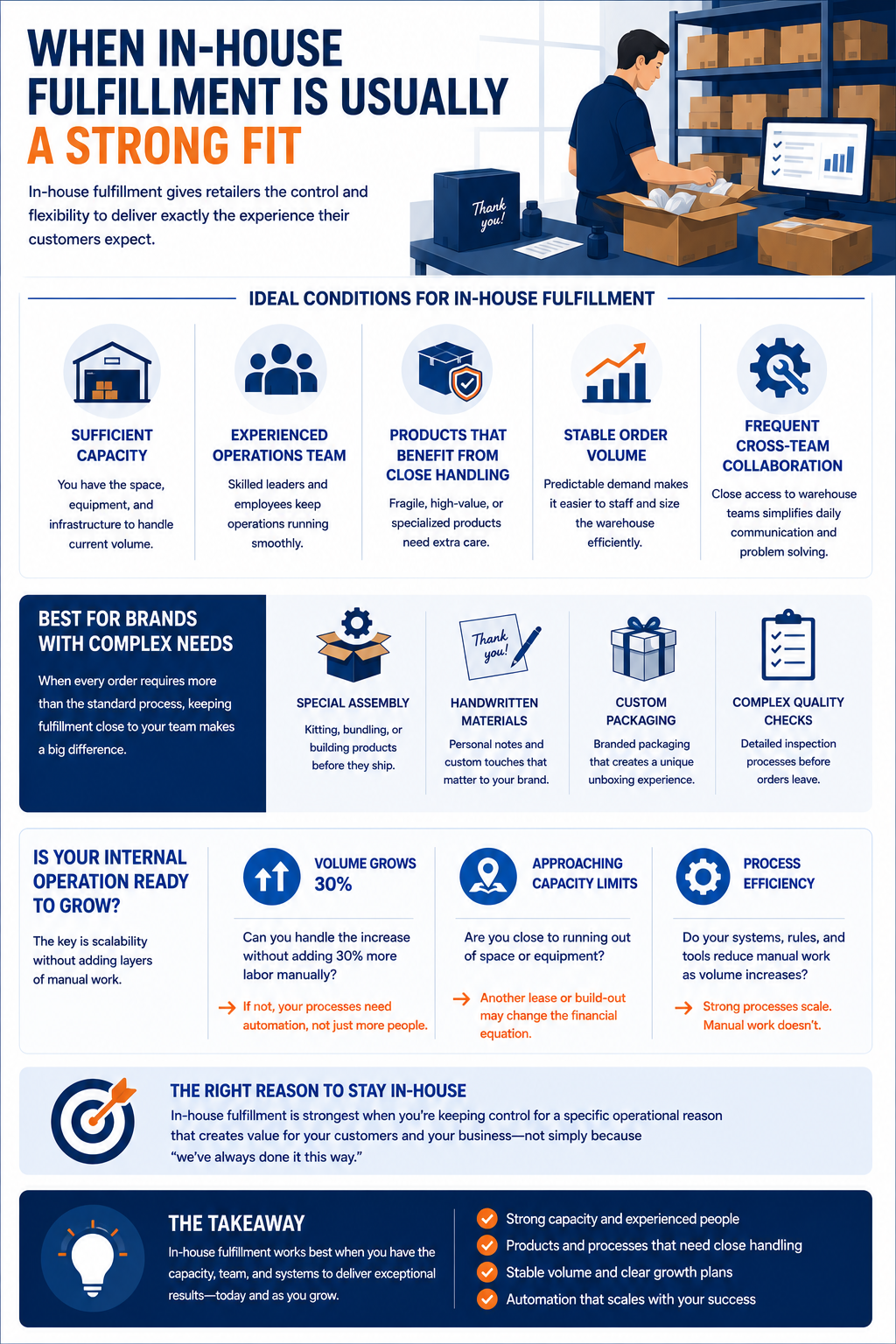
Internal fulfillment often makes sense when a retailer already has sufficient warehouse capacity, an experienced operations team, and products that benefit from close handling. Stable order volume also helps, as the business can staff and size the warehouse with greater confidence, rather than carrying excess capacity for unpredictable spikes.
Brands with heavy customization may also prefer this route. If every order includes special assembly, handwritten materials, custom packaging, or complex quality checks, keeping that work near the rest of the business can make communication easier. Direct access to warehouse employees can be valuable when merchandising, customer service, and operations need to coordinate frequently.
The key question is whether the internal process can grow faster than sales are increasing without adding manual work. If volume rises by 30% and warehouse labor must rise by 30% just to keep pace, the operation may need better automation. If the business is close to running out of space and another lease is approaching, the financial comparison may change again.
In-house fulfillment is strongest when the retailer is keeping control for a specific operational reason, not simply because “we’ve always done it this way.”
When a 3PL Is Usually a Strong Fit
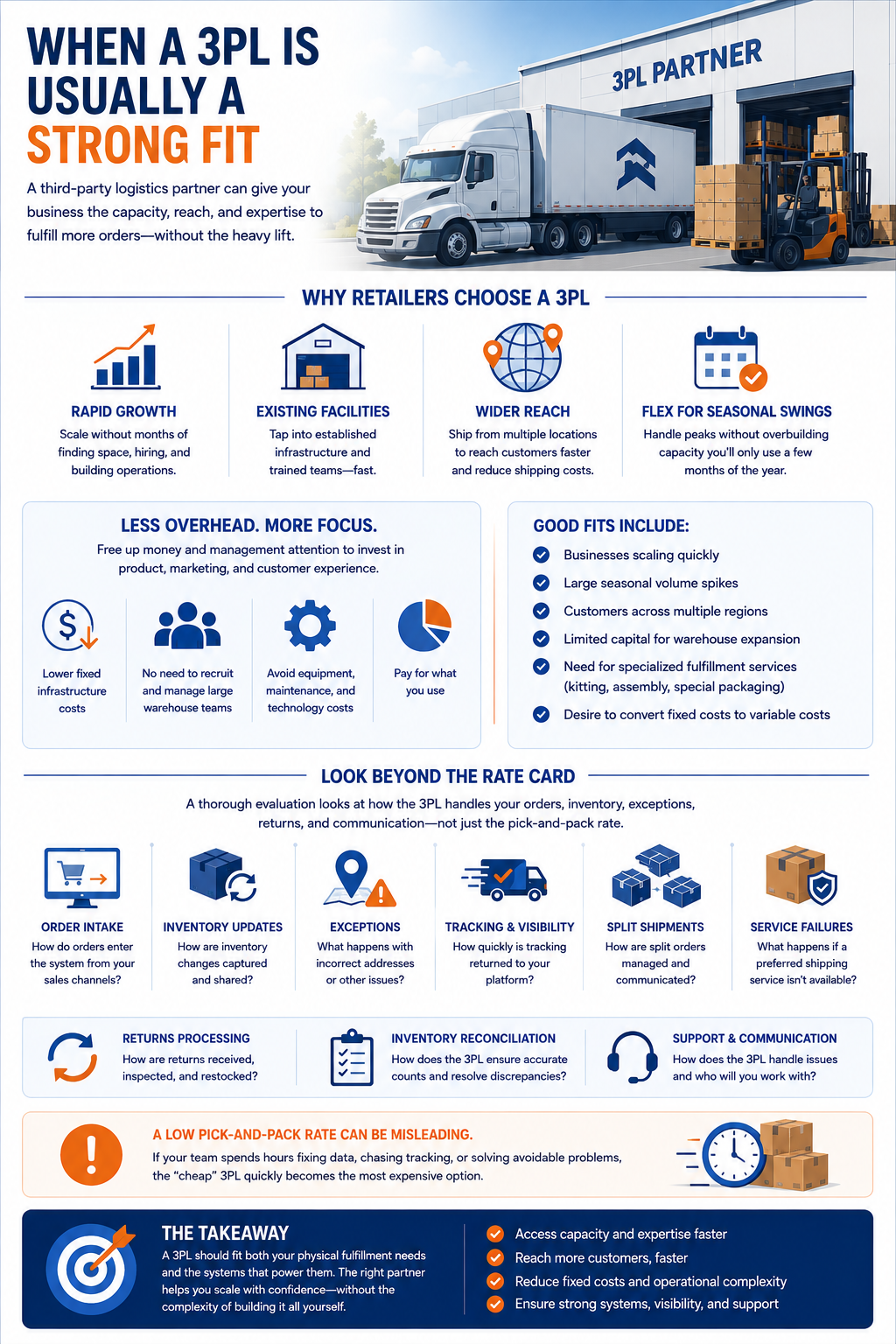
Outside fulfillment becomes attractive when the physical demands of warehousing start pulling too much money or management attention away from the rest of the business. Retailers expanding rapidly may not want to spend months finding warehouse space, recruiting supervisors, buying equipment, and building a second operation from scratch. A capable partner can provide access to an existing facility and trained workforce much faster.
A 3PL can also work well for businesses with large seasonal swings or customers spread across several regions. Instead of trying to build every fulfillment node internally, the retailer can place inventory in external facilities that support delivery coverage and expected order volume. This approach can reduce the amount of fixed warehouse infrastructure the brand has to own.
The evaluation needs to go much deeper than a rate card. Ask how orders enter the provider’s system, how inventory updates are handled, what happens to orders with incorrect addresses, and how quickly tracking gets returned to your ecommerce platform. Ask how split shipments are managed and what happens when a preferred shipping service isn’t available. Review return processing, inventory reconciliation, and support procedures before signing a contract.
A low pick-and-pack rate doesn’t help much if your team spends hours every week correcting bad order data or chasing missing tracking numbers. The 3PL has to fit both the physical operations and the systems that support them.
A Hybrid Fulfillment Model Can Fill the Gap Between the Two
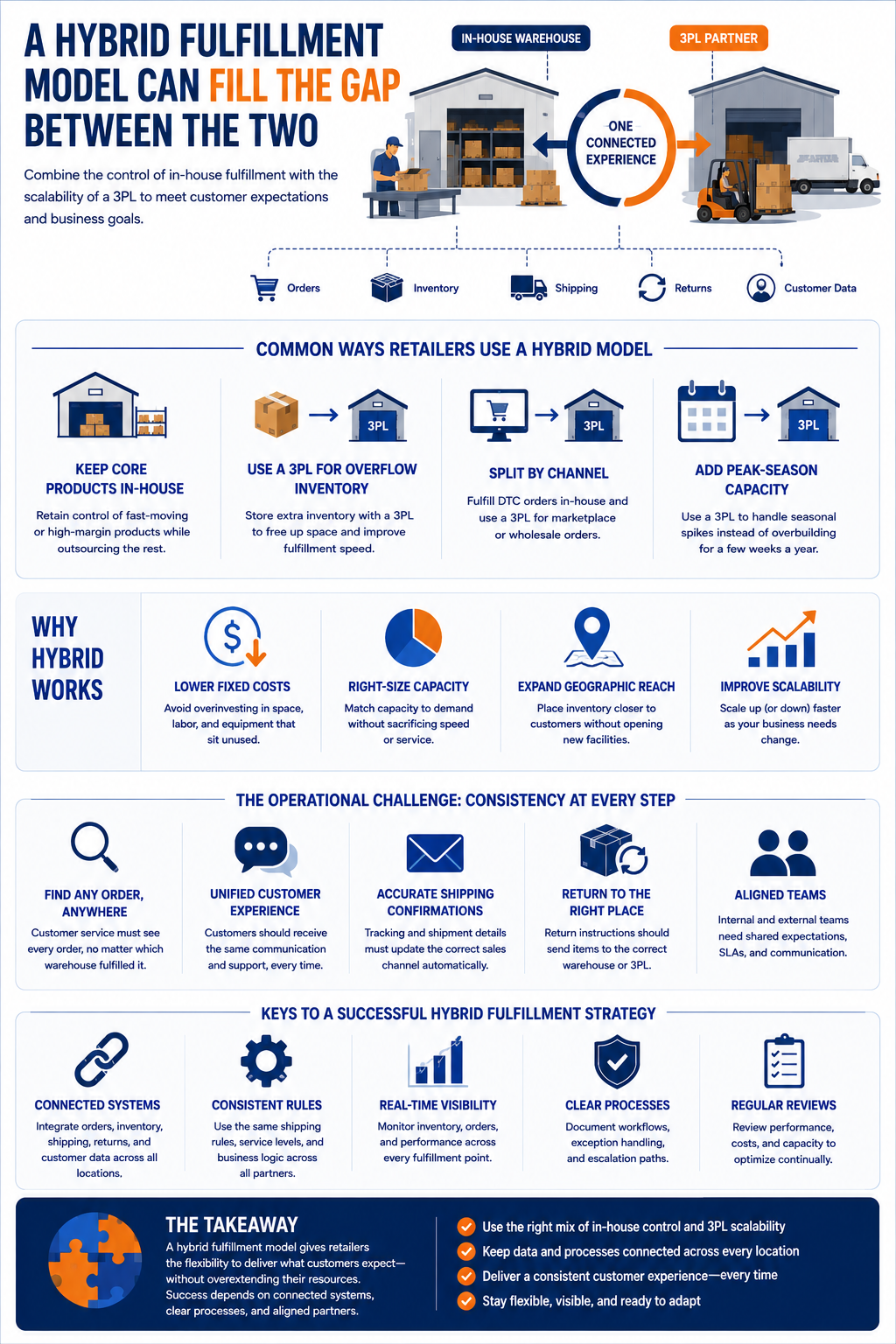
Some ecommerce businesses are better served by combining internal and outsourced fulfillment rather than choosing one model for every order. A retailer may keep fast-moving products inside its primary warehouse while sending overflow inventory to a 3PL. Another brand may handle direct-to-consumer orders internally and use a separate provider for marketplace fulfillment or geographic expansion.
Peak-season support is another common reason to consider a hybrid setup. Instead of building an internal warehouse around the busiest six weeks of the year, a retailer can maintain its normal capacity and use an outside provider for overflow. This can reduce the amount of unused space and labor the company carries during slower periods.
The operational challenge is consistency. Orders may now ship from several locations run by different teams, but customers still expect the same delivery communication and support. Customer service needs to find an order quickly, regardless of which warehouse packed it. Shipping confirmations need to reach the correct sales channel. Return instructions have to direct merchandise to the right place.
Hybrid fulfillment can give retailers more flexibility, but it also increases the need for connected order, shipping, returns, and customer data. Every additional fulfillment point creates another place where information must remain synchronized.
Questions to Ask Before Choosing a Fulfillment Model
A useful fulfillment review starts with operational facts. Calculate your actual warehouse cost per order, including labor, management, software, and overhead. Measure how much capacity remains in the current facility and how often employees work overtime during demand spikes. Look at shipping error rates, same-day fulfillment performance, carrier usage, and the amount of manual work required to get a typical order out the door.
Then look ahead. Estimate what happens if order volume grows 25%, 50%, and 100%. Determine whether the current warehouse can physically handle that volume and what additional employees or equipment would be required. If another facility is likely, price that expansion rather than treating it as a future problem.
Use the same level of detail with potential 3PL partners. Ask for pricing based on your actual SKU count, order profile, package sizes, return volume, and seasonal peaks. Test the integration with real order scenarios and clarify how inventory discrepancies, failed shipments, and customer service issues are handled.
The strongest decision usually comes from comparing two complete operating models rather than comparing one internal expense against one outside fee.
Where ReadyCloud Fits Into Either Model
Whether fulfillment stays in-house, moves to a 3PL, or uses a combination of both, retailers still need accurate shipping, clear returns, and connected customer information. The physical warehouse may change, but shoppers still expect timely tracking, predictable delivery, and an easy way to resolve problems after the sale.
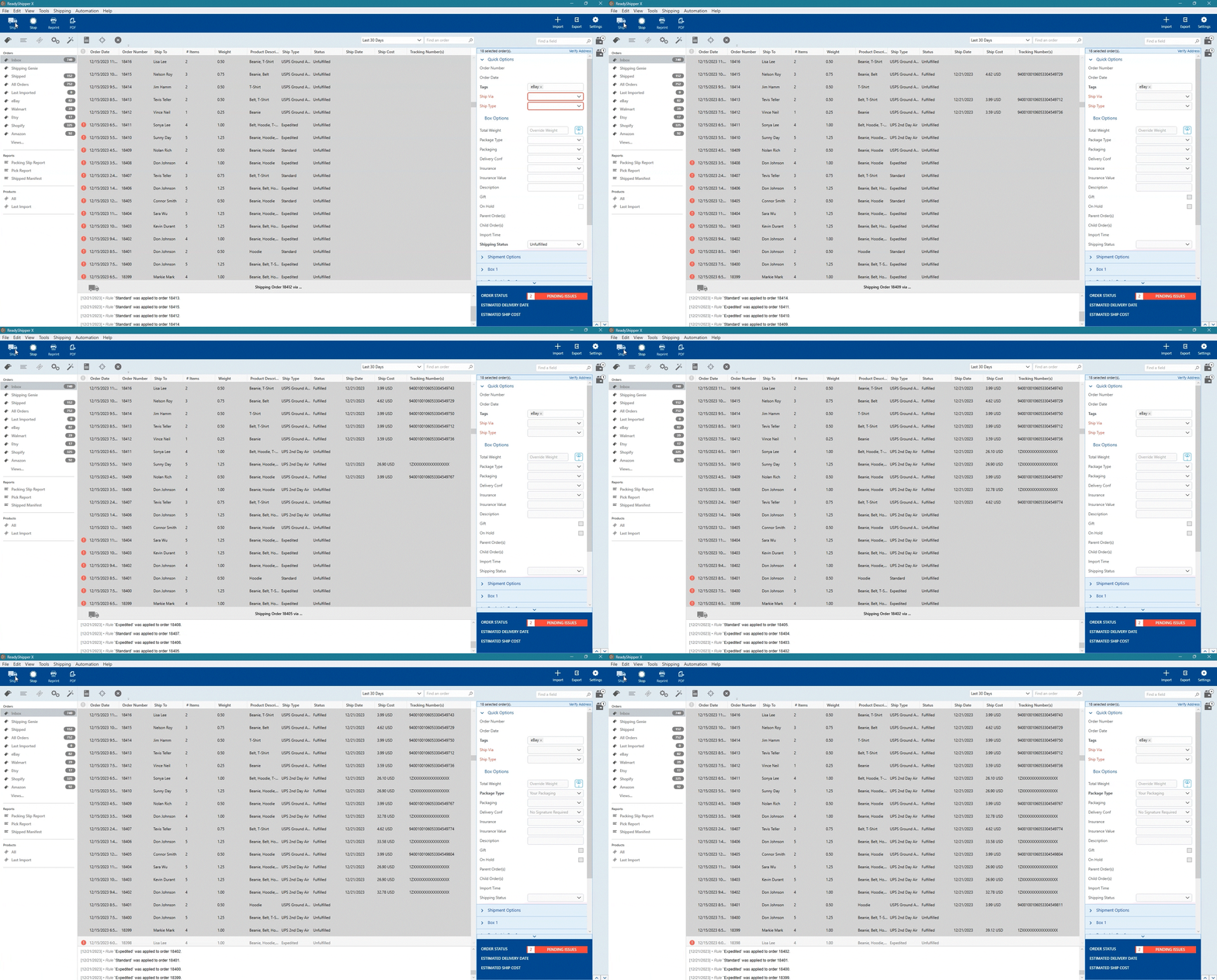
ReadyShipper X helps ecommerce teams manage high-volume, multi-carrier shipping with tools for shipping rules, batch processing, carrier rate comparison, and label creation. That can reduce repetitive decisions at the packing station and help teams create more consistent shipping processes as order volume increases.
ReadyReturns supports the other direction of the fulfillment cycle with branded returns, exchanges, store credit, return labels, and automated return rules. ReadyCloud CRM gives ecommerce teams a clearer view of customer, order, and return activity, while Action Alerts can support behavior-based communication tied to customer and order events.
Bringing those areas together gives retailers a better way to manage what happens after checkout without making the warehouse itself the only source of operational information.
ReadyCloud Has You Covered!
Success in ecommerce starts with the right tools, and ReadyCloud’s suite of solutions is designed to propel your ecommerce business to new heights. With ReadyCloud, you’ll have all your data centralized in one place, offering insights that drive smarter decisions. Take your marketing to the next level with Action Alerts, delivering growth-focused, automated campaigns that keep your customers engaged.
Shipping is easier than ever with ReadyShipper X, a multicarrier solution that simplifies your fulfillment process while saving time and money.
And when it comes to returns, ReadyReturns streamlines the entire process with an automated solution that boosts customer satisfaction and loyalty.
ReadyCloud is more than just a suite of systems—it’s your ticket to thriving in 2026 and beyond!
Start your journey to success today! Learn more and get started here.
Or contact our Sales Department at: 877-818-7447 ext. 1.
FAQs About 3PL and In-House Fulfillment
What is the main difference between in-house fulfillment and a 3PL?
In-house fulfillment means the retailer manages its own warehouse, employees, inventory storage, picking, packing, and shipping. A 3PL handles some or all of those fulfillment tasks for the retailer using its own facilities, staff, and systems.
Is a 3PL cheaper than in-house fulfillment?
Not always. A 3PL can reduce expenses tied to warehouse space, equipment, and staffing, but retailers still pay for storage, receiving, picking, packing, returns, and other services. The best comparison is the total cost per fulfilled order at current volume and at the volume the business expects to reach.
When should an ecommerce business consider using a 3PL?
A retailer may want to consider a 3PL when warehouse space is tight, staffing is becoming difficult, seasonal volume creates fulfillment challenges, or expansion into new regions requires additional capacity. It can also make sense when warehouse operations are consuming more management time than the business wants to dedicate internally.
What are the main advantages of keeping fulfillment in-house?
In-house fulfillment gives retailers more direct control over packing standards, warehouse processes, employees, shipping decisions, and exception handling. It can be especially useful for brands with custom packaging, specialized products, or frequently changing fulfillment requirements.
Can a 3PL help ecommerce brands ship faster?
A 3PL can support faster delivery if it has the right warehouse locations, staffing, and shipping processes, but outsourcing alone doesn’t guarantee faster fulfillment. Order routing, carrier selection, shipping rules, label processing, and tracking updates still need to work efficiently.
Does using a 3PL mean giving up control of fulfillment?
It means giving up some direct control over the physical warehouse, but retailers can still maintain visibility into orders, shipping activity, and inventory, as well as tracking. Strong integrations and clear operating rules are essential because the shopper still sees the delivery experience as part of the retailer’s brand.
What fulfillment costs should retailers compare before choosing a model?
For in-house fulfillment, retailers should include warehouse space, labor, management, equipment, software, packing materials, overtime, and seasonal staffing. For a 3PL, the comparison should include receiving, storage, pick-and-pack charges, shipping, returns, special handling, and any additional service fees.
How does fulfillment software fit into the decision?
Shipping technology remains important under either model because orders, carrier services, tracking information, and customer data must still move between systems. Growing retailers should look for tools that support multi-carrier shipping, automated shipping rules, batch processing, and reliable shipment updates.
How should returns factor into the choice between a 3PL and in-house fulfillment?
Retailers need to consider who will receive returned products, inspect them, update inventory, and determine what happens to each item. The customer-facing process also needs to remain clear and consistent, with easy return labels, exchanges, store credit options, and status updates.
Can an ecommerce business use both a 3PL and in-house fulfillment?
Yes. A hybrid model can let a retailer keep certain products or channels in-house while using a 3PL for overflow, seasonal volume, marketplace orders, or additional geographic regions. This approach can provide more capacity, but it also makes connected order, shipping, and inventory data more important.
What should retailers ask a 3PL before signing a contract?
Retailers should ask how orders enter the provider’s system, how quickly inventory updates, how shipping exceptions are handled, and how tracking gets returned to the ecommerce platform. It’s also useful to understand return processing, service-level expectations, peak-season capacity, and the full fee structure before making a decision.
Which fulfillment model is better for a growing ecommerce business?
The better model is the one that can support higher order volume without incurring higher costs, slower shipping, or more manual work. Some growing retailers benefit from keeping fulfillment internal; others gain more flexibility from a 3PL, and many eventually use a combination of both.