
Mobile commerce keeps getting bigger, but the real story is not just growth. It is how fast shopper behavior keeps shifting toward phones for product discovery, comparison shopping, repeat purchases, and checkout. That shift matters to every ecommerce operator because mobile is no longer a secondary experience. It is often the first storefront a customer sees and, more often than ever, the last step before a sale.
The latest market data shows U.S. retail ecommerce sales reached $1.2337 trillion in 2025, while ecommerce accounted for 16.4% of total U.S. retail sales for the year. That broader growth helps explain why phone-based buying continues to matter more every quarter. According to the U.S. Census Bureau, the market is still moving up rather than leveling off.

Smartphone adoption is a huge reason for that momentum. The Pew Research Center reports that 98% of U.S. adults own a cellphone and 91% own a smartphone. Pew also found that about four in ten Americans say they are online almost constantly. That combination matters. A customer who is always connected is also always one tap away from browsing, buying, abandoning a cart, or coming back later. In practical terms, mobile shopping is now built into everyday behavior.
The global picture is just as important. The GSMA said 4.7 billion people, or 58% of the world’s population, were using mobile internet on their own device in 2025, and 200 million more people came online through mobile internet in 2024 alone. That tells ecommerce brands something simple yet powerful: even outside the U.S., the phone remains the primary digital doorway for a large share of shoppers.
ReadyCloud has been following this shift for years. Since 2019, we’ve been extensively covering mobile commerce statistics to help cross channel sellers better understand the scope of their impact. Keep reading to learn more about what mobile commerce statistics for 2026 matter most for your bottom line.
What Mobile Commerce Includes In 2026
A lot of brands still think mobile commerce only means a customer checking out on a phone browser. That definition is too narrow now. Mobile commerce includes purchases made through mobile websites, shopping apps, digital wallets, and social commerce flows that happen on mobile devices.
An Emarketer report for 2026 on the category frames mobile shopping, social shopping, and mobile payments as part of the same connected ecosystem. That makes sense because the path from seeing a product to paying for it is getting shorter and more blended on mobile.
What’s more, the mobile journey is often less linear than desktop. A shopper might spot a product in social media, read reviews on a mobile browser, click an email later, then complete checkout with a wallet in seconds. That is why mobile strategy now touches design, speed, content, payments, retention, and post-purchase tools all at once. Retailers that treat mobile as a stripped-down version of desktop usually end up behind the shopper rather than ahead of them.
“The customer experience begins when they find your online brand. It continues as they connect with it. It is cemented in the biggest brand experience when this results in a purchase. What comes next is commonly referred to as the “post-purchase experience.” Along the way, businesses have the option to cater to and customize this customer journey to improve retention and attract new customers from word-of-mouth referrals and improved loyalty. ” Read Article on Forbes

Why Mobile Commerce Is Still Growing
The easiest way to understand the current moment is to examine the overlap among ecommerce growth, smartphone saturation, and payment behavior. The U.S. Census Bureau shows ecommerce is still expanding. In the fourth quarter of 2025, U.S. retail e-commerce sales reached an estimated $316.1 billion on a seasonally adjusted basis, marking a 1.7 percent increase over the third quarter. Total retail sales came in at $1,900.5 billion, up 0.4 percent during the same period. Compared to the fourth quarter of 2024, e-commerce sales rose 5.3 percent, outpacing total retail sales growth of 2.7 percent. E-commerce also made up 16.6 percent of all retail sales in the quarter, showing its continued strength as a major part of the retail economy.
Data from the Pew Research Center shows smartphones are nearly universal.
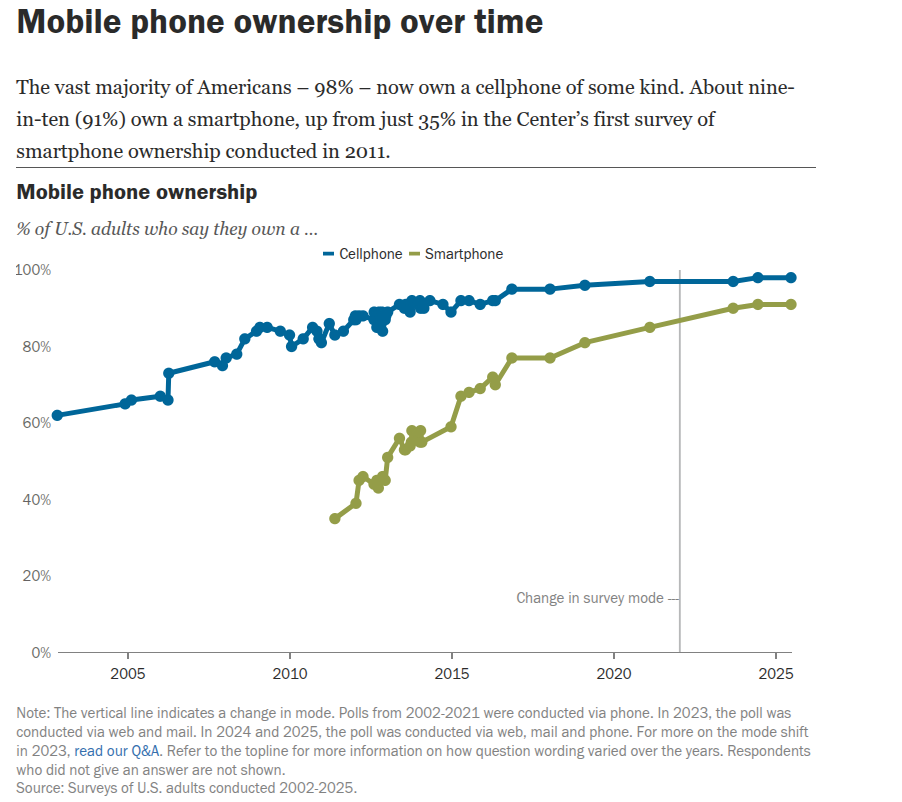
Source: PEW Research, 2026
The Worldpay Global Payments Report adds another piece: smartphone share of global ecommerce spend rose from 19% in 2014 to 57% in 2024. In the same report, digital wallets represented 53% of ecommerce and 32% of point-of-sale spend in 2024. Those are not small shifts. They show that the phone is not only where people browse. It is where payment behavior is being normalized.
| Trend Area | Key Data Point | What It Tells Us |
|---|---|---|
| U.S. Ecommerce Growth | U.S. retail ecommerce sales reached an estimated $316.1 billion in Q4 2025, up 1.7% from Q3 2025 and 5.3% from Q4 2024. | Ecommerce continues to grow faster than overall retail, reinforcing its role as a major force in the broader retail economy. |
| Total Retail Sales | Total retail sales came in at $1,900.5 billion in Q4 2025, rising 0.4% quarter over quarter and 2.7% year over year. | Retail overall is still growing, but ecommerce is expanding at a noticeably faster pace. |
| Ecommerce Share of Retail | Ecommerce accounted for 16.6% of all U.S. retail sales in Q4 2025. | Online buying is no longer a side channel. It represents a meaningful and lasting share of total retail activity. |
| Smartphone Adoption | Pew Research Center data shows smartphone ownership is now close to universal. | The mobile device is already in consumers’ hands, which makes it the natural center of browsing, buying, and payment behavior. |
| Mobile Share of Global Ecommerce Spend | Worldpay reported that smartphone share of global ecommerce spend climbed from 19% in 2014 to 57% in 2024. | Mobile has moved from a supporting role to the primary place where online commerce happens. |
| Digital Wallet Usage | In 2024, digital wallets made up 53% of ecommerce spend and 32% of point-of-sale spend globally. | Consumers are not just shopping on phones. They are also completing transactions there, with mobile-first payment habits becoming standard. |
| Holiday Mobile Spending | Adobe reported that U.S. shoppers spent $145.2 billion on mobile devices during the 2025 holiday season, up 10.7% from 2024. | Mobile spending keeps accelerating during peak shopping periods, showing stronger trust and higher conversion on smaller screens. |
| Total Online Holiday Spending | Total U.S. online holiday spending reached $257.8 billion in 2025. | More than half of holiday ecommerce spending came through mobile, confirming that phones are now driving a large share of completed purchases. |
| Bottom-Line Takeaway | Ecommerce is growing, smartphones are everywhere, and payment behavior is increasingly mobile-first. | The phone is no longer just where shoppers browse. It is where they buy, pay, and complete the transaction. |

That shift also shows up in seasonal spending. Adobe’s holiday shopping coverage reported that U.S. shoppers spent $145.2 billion on mobile devices during the 2025 holiday season, up 10.7% from 2024, while total online holiday spending reached $257.8 billion. In other words, more than half of online holiday spending came through mobile. According to Adobe, reporting based on its data, mobile is now doing far more than assisting with purchases. It is closing them.
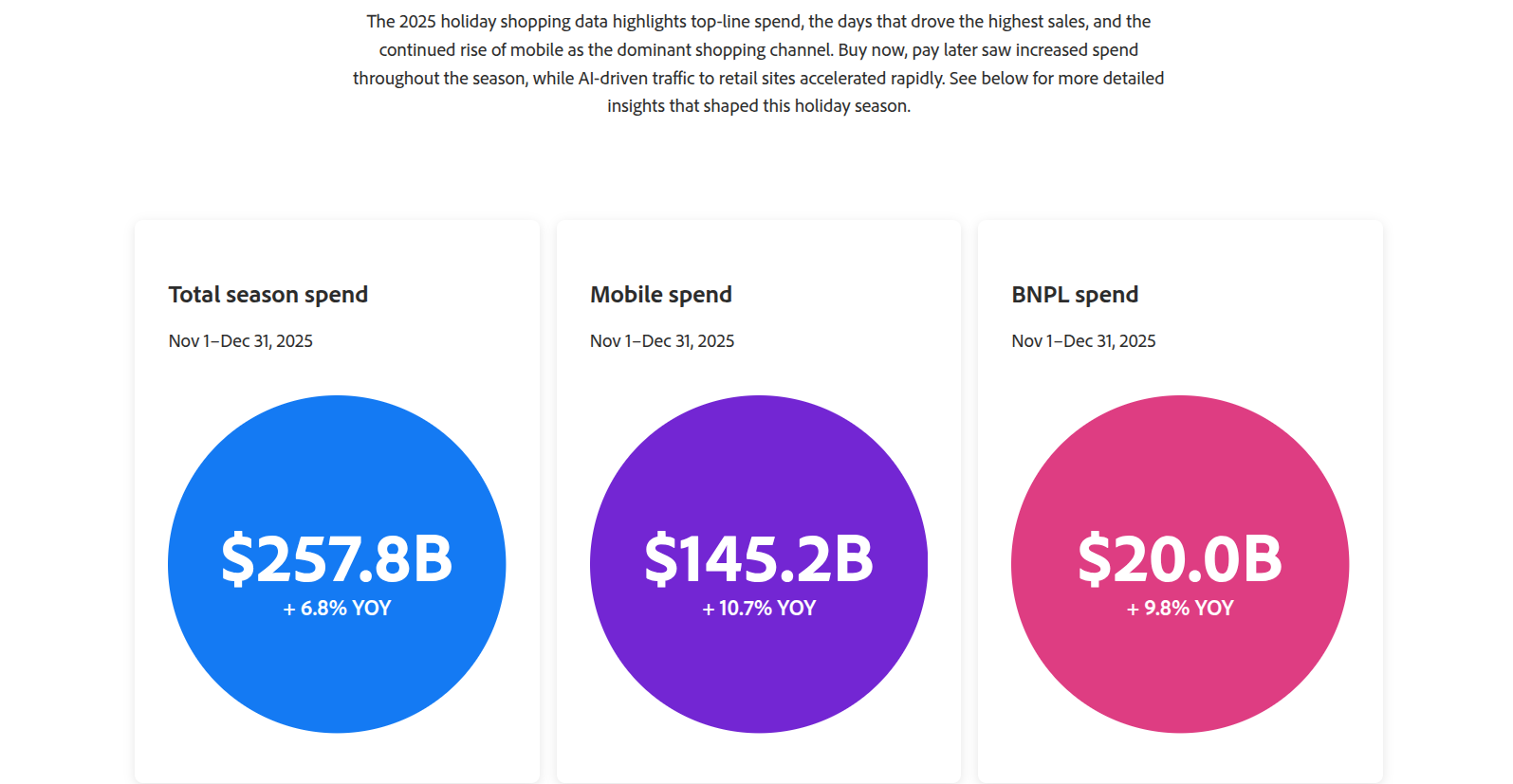
Source, Adobe, 2026
“Growing e-commerce brands have set a new standard. They’re demonstrating that, with the right strategy in place, the post-purchase experience can be elevated. And customers are noticing it. For the larger retailers in the pond, this represents a monumental shift that swings from traditional customer acquisition to long-term retention.” Read Article on Forbes
Mobile Commerce Facts For 2026
Here’s what you need to know if you want the fast, useful version in one place.
- U.S. retail ecommerce sales hit $1.2337 trillion in 2025, according to the U.S. Census Bureau.
- Ecommerce made up 16.4% of total U.S. retail sales in 2025, according to the U.S. Census Bureau.
- Fourth-quarter 2025 U.S. retail ecommerce sales were $316.1 billion on a seasonally adjusted basis, according to the U.S. Census Bureau.
- Fourth-quarter 2025 ecommerce accounted for 16.6% of all retail sales in the U.S., according to the U.S. Census Bureau data.
- 91% of U.S. adults own a smartphone, according to the Pew Research Center.
- 98% of U.S. adults own a cellphone of some kind, according to the Pew Research Center.
- About four in ten Americans say they are online almost constantly, according to a 2026 Pew Research Center.
- 4.7 billion people worldwide used mobile internet on their own device in 2025, according to the GSMA.
- That equals 58% of the world’s population, based on the same GSMA release.
- The GSMA said 200 million more people started using the mobile internet in 2024 alone.
- Adobe forecasts that mobile will account for 56.1% of online spending during the 2025 holiday season, according to the Adobe Holiday Forecast.
- Adobe holiday reporting showed mobile shopping spend climbed to $145.2 billion during the 2025 season, up 10.7% year over year. See Adobe and follow-on reporting citing Adobe.
- Total online holiday spending reached $257.8 billion in 2025, based on Adobe reporting cited in trade coverage.
- Adobe’s own holiday trend resources show that mobile holiday spend has risen sharply over the last several years, reinforcing that this is a durable pattern rather than a one-year spike.
- Emarketer says mobile commerce now spans shopping apps, browsers, social shopping, and mobile payments, according to its 2026 category FAQ.
- Worldpay said the smartphone share of global ecommerce spend rose from 19% in 2014 to 57% in 2024, according to its latest decade view of payments. See Worldpay.
- Worldpay also said digital wallets represented 53% of ecommerce spend in 2024.
- The same Worldpay reporting said digital wallets accounted for 32% of point-of-sale spend in 2024.
- Baymard’s current cart abandonment benchmark is about 70.22%, according to the Baymard Institute.
- Baymard says large ecommerce sites can potentially improve conversion by as much as 35% through better checkout usability, based on its checkout UX research. See the Baymard Institute.
- Think with Google continues to frame fast mobile experiences as a conversion issue, not just a technical nicety, in its mobile page speed guidance. See Think with Google.
- ReadyCloud’s own earlier reporting has tracked this trend for years, which makes the current 2026 picture feel like acceleration, not a surprise. You can see that in 50 Facts About Mobile Commerce for 2022 and A Cavalcade of Mcommerce Statistics for the Cross-Channel Seller on 2022.
| Metric | 2026 Mobile Commerce Snapshot | Why It Matters |
|---|---|---|
| U.S. Ecommerce Scale | ||
| Annual U.S. Ecommerce Sales | $1.2337 trillion in 2025 | Online retail is operating at massive scale, which keeps mobile commerce central to growth planning. |
| Share of Total U.S. Retail Sales | 16.4% in 2025 | Ecommerce is not a side channel anymore. It holds a meaningful share of total retail activity. |
| Q4 2025 Ecommerce Sales | $316.1 billion on a seasonally adjusted basis | Peak shopping periods continue to generate huge digital volume, and mobile captures a large share of that demand. |
| Q4 2025 Ecommerce Share of Retail | 16.6% of all U.S. retail sales | The year ended with ecommerce taking an even stronger share, showing continued momentum. |
| Device Ownership and Digital Behavior | ||
| U.S. Smartphone Ownership | 91% of U.S. adults | Smartphones are nearly universal, which makes mobile commerce an everyday consumer behavior. |
| U.S. Cellphone Ownership | 98% of U.S. adults own some type of cellphone | Mobile reach is about as broad as it gets, which lowers friction for mobile-first shopping strategies. |
| Always-Online Behavior | About 4 in 10 Americans say they are online almost constantly | That level of digital presence means shopping decisions can happen anytime, not just during planned sessions. |
| Global Mobile Internet Reach | ||
| Worldwide Mobile Internet Users | 4.7 billion people used mobile internet on their own device in 2025 | Mobile internet access is now a global commerce foundation, not a niche behavior. |
| Share of World Population | 58% | More than half the planet is already reachable through mobile internet, which expands the addressable market for sellers. |
| New Mobile Internet Users Added | 200 million more people started using mobile internet in 2024 alone | Growth is still happening, which means mobile commerce still has room to expand further. |
| Holiday Mobile Spending | ||
| Projected Share of Online Holiday Spend | 56.1% from mobile during the 2025 holiday season | More than half of holiday ecommerce spending is expected to come through mobile devices. |
| Mobile Holiday Shopping Spend | $145.2 billion in 2025, up 10.7% year over year | Mobile is not just helping conversions. It is closing them at an accelerating rate. |
| Total Online Holiday Spending | $257.8 billion in 2025 | Mobile is driving a major share of one of the most important retail periods of the year. |
| Mobile Holiday Trend Direction | Adobe trend resources show multi-year growth in mobile holiday spend | This is a durable shift, not a one-season bump. |
| How Mobile Commerce Works Today | ||
| Mobile Commerce Scope | Includes shopping apps, browsers, social shopping, and mobile payments | Mobile commerce now spans the full customer journey, from discovery to payment. |
| Smartphone Share of Global Ecommerce Spend | Rose from 19% in 2014 to 57% in 2024 | The smartphone has become the dominant device for ecommerce spending worldwide. |
| Digital Wallet Share of Ecommerce Spend | 53% in 2024 | Wallets are shaping checkout expectations and making mobile payments feel normal and fast. |
| Digital Wallet Share of POS Spend | 32% in 2024 | Mobile payment behavior is extending beyond ecommerce and into in-store transactions too. |
| Checkout and Conversion Reality | ||
| Cart Abandonment Benchmark | About 70.22% | There is still a major gap between shopping intent and completed purchase, especially when checkout friction gets in the way. |
| Potential Conversion Lift | Up to 35% through better checkout usability | Better UX can create meaningful revenue gains without needing more traffic. |
| Mobile Speed Impact | Fast mobile experiences continue to be framed as a conversion issue | Page speed is not just a technical detail. It directly affects whether shoppers finish the purchase. |
| Big-Picture Takeaway | ||
| What the 2026 Data Shows | Ecommerce is large, smartphones are everywhere, mobile spending is climbing, and wallet-based checkout is becoming standard. | The mobile commerce story in 2026 is not about future potential. It is about execution, conversion, and keeping up with behavior that is already here. |
| ReadyCloud Historical Context | Earlier ReadyCloud reporting tracked these trends years ago, making today’s picture look like acceleration rather than surprise. | This shift has been building for a long time, and the current market confirms it has moved into the mainstream. |
“The customer journey is more important than the products you sell. Optimizing it has the potential to supercharge your conversion rate. Along the way, put yourself in the office chair of the average online shopper. What makes you click and convert and why?” – Read Article on Forbes
What These Numbers Mean for Ecommerce Brands
The first takeaway is that mobile is no longer just an acquisition channel. It is a revenue channel. A brand can no longer assume shoppers will browse on a phone and wait to purchase on a desktop. Adobe’s holiday data points in the opposite direction. Worldpay’s decade-long trend does too. If mobile already commands more than half of online spending during huge seasonal windows, then the quality of your mobile experience has a direct line to top-line growth.
The second takeaway is that convenience now carries more weight than brand promises. People will absolutely abandon a purchase if the experience feels slow, confusing, or too demanding on a phone. Baymard’s roughly 70% cart abandonment benchmark is the blunt reminder here. Not every abandoned cart is caused by bad UX, of course, but friction plays a real role, especially on smaller screens. The brands that reduce taps, simplify forms, make shipping costs obvious, and support popular payment methods tend to give themselves a better shot at winning the sale.
In addition, payment behavior is trending toward rewarding retailers that make mobile checkout feel effortless. Worldpay’s data on digital wallets matters because wallet-based payments reduce typing, speed up transactions, and make many shoppers feel safer. That means Apple Pay, Google Pay, PayPal, Shop Pay, and related options are no longer just nice to have. They are part of a conversion strategy.

“Amazonification is about more than just low prices and overnight shipping. It involves redefining what convenience truly means. Consumers now expect a seamless, connected experience—from browsing to post-purchase tracking and everything in between.” – Read Article on Forbes
Mobile Checkout Is Still Where Revenue Slips Away
This is where many brands feel the pain. They may have strong products, solid traffic, and even good ads, yet the phone checkout experience still drags behind. Baymard’s checkout research has been consistent for years: usability gaps cost money. Long forms, forced account creation, unclear shipping costs, poor error handling, and weak field design create drop-off. On a desktop, some shoppers will tolerate the hassle. On a phone, many will not.
That matters beyond the cart itself. A clunky or slow mobile checkout can make every other growth investment less efficient. Your SEO may bring the visit. Your email flow may bring the click. Your public relations coverage may build awareness. Your product page may do its job. Yet the sale still disappears if the checkout feels like work. That is why mobile optimization belongs in the same conversation as ecommerce website design, digital marketing, and operational tools. It is not an isolated design task. It is a business performance issue.
| Mobile Checkout Issue | What Commonly Happens | Business Impact |
|---|---|---|
| Where Mobile Revenue Starts Leaking | ||
| Long Forms | Shoppers are asked to fill out too many fields on a small screen, which makes checkout feel slow and frustrating. | More users abandon the process before finishing the purchase, especially on mobile devices. |
| Forced Account Creation | Buyers are required to create an account before completing the order instead of checking out quickly as guests. | Extra friction pushes high-intent shoppers out of the funnel right before conversion. |
| Unclear Shipping Costs | Shipping fees appear too late or are not explained clearly during checkout. | Unexpected costs create distrust and cause shoppers to leave the cart. |
| Poor Error Handling | When users make a mistake, the checkout flow does not explain the problem clearly or guide them to fix it fast. | Confusion slows completion and increases drop-off at the worst possible moment. |
| Weak Field Design | Input fields may be hard to tap, unclear to understand, or poorly matched to mobile behavior. | Even simple actions start to feel like effort, which hurts completion rates. |
| Why Mobile Checkout Hurts More Than Desktop | ||
| Lower Friction Tolerance | Desktop shoppers may tolerate minor hassle, but phone users are less patient with checkout obstacles. | Small usability issues become major conversion problems on mobile. |
| Smaller-Screen Pressure | Every extra tap, scroll, and correction feels bigger on a phone than it does on a desktop. | Checkout inefficiency becomes more visible and more expensive on mobile traffic. |
| The Bigger Performance Problem | ||
| SEO Can Still Lose the Sale | Search efforts may succeed in bringing qualified traffic to the site. | That investment becomes less efficient if checkout friction prevents the order from closing. |
| Email Can Still Lose the Sale | Email campaigns may drive clicks from interested buyers back to product pages. | The return on email drops if the mobile checkout experience feels like work. |
| PR Can Still Lose the Sale | Media coverage may build awareness and trust around the brand. | Revenue still slips away if the final purchase step is frustrating on a phone. |
| Product Pages Can Still Lose the Sale | Even strong product presentation can do its job and move buyers toward checkout. | The purchase may still disappear if the last step creates resistance. |
| What This Means for Brands | ||
| Not Just a Design Detail | Mobile checkout optimization should sit alongside ecommerce website design, digital marketing, and operational planning. | It affects overall business performance, not just visual polish. |
| Conversion Is the Real Test | Traffic, awareness, and product interest only matter when the checkout experience helps shoppers finish the order easily. | Checkout quality directly shapes revenue efficiency across every growth channel. |
| Bottom-Line Takeaway | A clunky mobile checkout turns strong brand and marketing efforts into incomplete transactions. | Mobile optimization is not an isolated task. It is a revenue protection strategy. |
The Connection Between Mobile Commerce And Better Ecommerce Operations
There is a second layer to this that does not get enough attention. Mobile growth changes what customers expect after they buy, too; something referred to as the “Post-Purchase Experience.” If the shopping experience is fast and smooth on a phone, customers also expect shipping updates, order tracking, easy returns, and support to feel just as easy. That is one reason ecommerce SaaS tools like ReadyCloud matter so much in this conversation. The sale is only the start. Post-purchase confidence helps create repeat buying, stronger reviews, and fewer support headaches.
That is also why ReadyCloud’s ecosystem matters for growing retailers. Brands are not just trying to capture a mobile purchase. They are trying to support the whole customer experience across shipping, returns, order visibility, and retention.
How Ecommerce Brands Should Respond In 2026
The smartest response is not to chase every trend. It is to remove friction where the numbers clearly point. Start with speed. Then look at product page clarity, mobile navigation, form length, wallet support, and return visibility. If people are buying on phones at this scale, then every unnecessary field and every extra second matters more than it used to. Think with Google’s mobile speed guidance still supports that basic truth. Fast sites keep more shoppers engaged.
Alternatively, if your brand already has strong mobile traffic but weak phone conversion, that gap is a signal. It usually points to execution rather than demand. The traffic is there. The intent is there. The experience needs work.
The Bottom Line
Mobile commerce facts for 2026 all point in the same direction. People are on their phones constantly. They are shopping there. They are paying there. They are expecting every part of the customer journey to feel easy there. The brands that treat mobile like the center of modern ecommerce are more likely to grow with the market. The brands that treat it like a trimmed-down desktop site are going to feel more pressure every quarter. The data from the U.S. Census Bureau, Pew Research Center, Google, GSMA, Adobe, Worldpay, and Baymard Institute all reinforce that story from different angles.
For ecommerce brands, that means the opportunity is still wide open. Mobile is growing, but many stores still make the experience harder than it needs to be. Retailers that simplify the path from product discovery to purchase to post-purchase support are in a better position to win in 2026 and beyond.
The Future of Ecommerce is Now
Staying ahead in the ecommerce industry means embracing innovation and anticipating changes before they arrive. The ecommerce trends shaping 2025 provide valuable insights into what’s next, but the future also brings exciting new possibilities. Businesses that adapt quickly and leverage the right tools will thrive in this dynamic landscape.
Ready for 2026? ReadyCloud Has You Covered!
Success in 2026 starts with the right tools, and ReadyCloud’s suite of solutions is designed to propel your ecommerce business to new heights. With ReadyCloud, you’ll have all your data centralized in one place, offering insights that drive smarter decisions. Take your marketing to the next level with Action Alerts, delivering growth-focused, automated campaigns that keep your customers engaged.

Shipping is easier than ever with ReadyShipper X, a multicarrier solution that simplifies your fulfillment process while saving time and money.
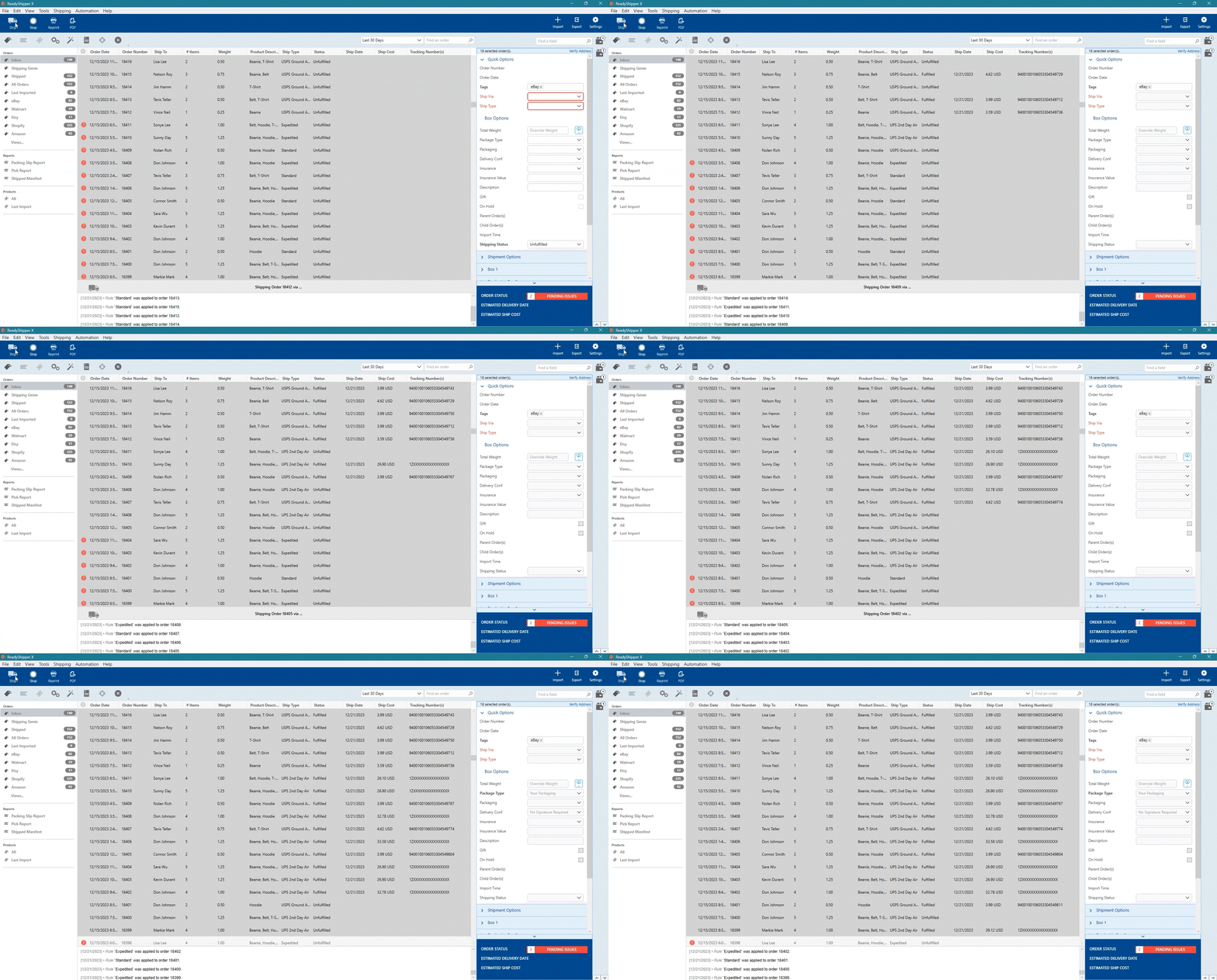
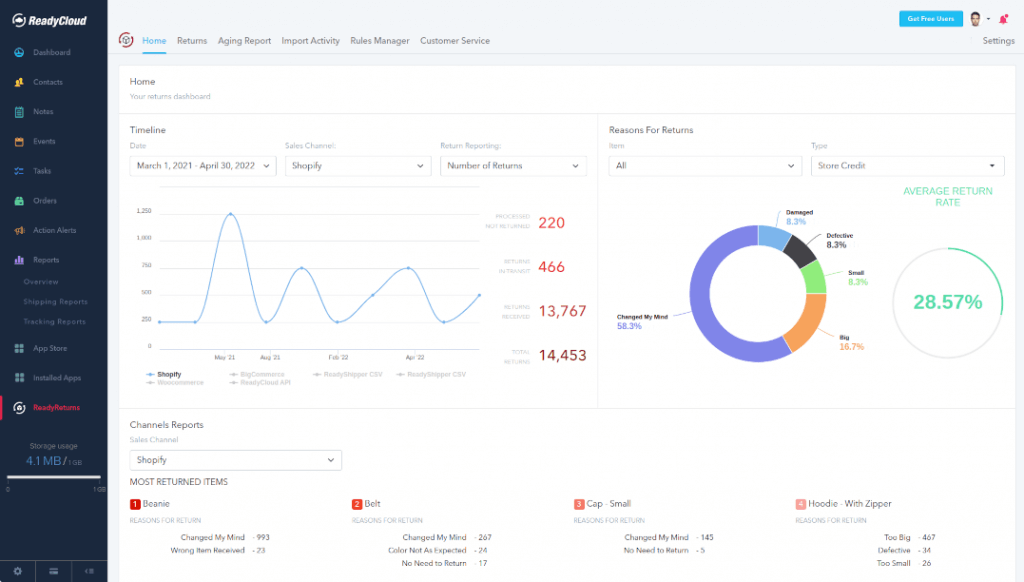
And when it comes to returns, ReadyReturns streamlines the entire process with an automated solution that boosts customer satisfaction and loyalty.
ReadyCloud is more than just a suite of systems—it’s your ticket to thriving in 2026 and beyond!
Start your journey to success today! Learn more and get started here.
Or contact our Sales Department at: 877-818-7447 ext. 1.
FAQs About Mobile Commerce Statistics for 2026
What Is Mobile Commerce?
Mobile commerce is the buying and selling of products through smartphones and tablets. That includes purchases made on mobile websites, shopping apps, and social platforms when the transaction happens on a mobile device.
What Are Mobile Commerce Statistics?
Mobile commerce statistics are the data points that show how people shop, browse, and buy on their phones. These numbers usually cover sales, traffic, cart abandonment, app usage, mobile checkout behavior, and digital wallet adoption.
Why Are Mobile Commerce Statistics Important For Ecommerce Brands?
These statistics help ecommerce brands see how customers actually behave on mobile devices. That matters because strong mobile traffic does not always lead to strong mobile sales if the shopping experience feels slow, cluttered, or frustrating.
How Big Is Mobile Commerce In 2026?
Mobile commerce is a major part of ecommerce in 2026 and continues to grow as shoppers rely more on smartphones for everyday purchases. It plays a central role in product discovery, repeat buying, and completed checkouts.
What Percentage of Ecommerce Sales Come From Mobile?
The percentage varies by source, market, and category, but mobile now drives a large share of online sales. In many cases, it accounts for more than half of ecommerce traffic and a growing portion of completed purchases.
Why Is Mobile Commerce Growing So Fast?
Mobile commerce keeps growing because smartphones are always close at hand, shopping apps are easier to use, and digital wallets make checkout faster. Shoppers are also more comfortable buying directly from their phones than they were a few years ago.
What Is The Difference Between Ecommerce And Mobile Commerce?
Ecommerce is the full category of online buying and selling. Mobile commerce is the part of ecommerce that happens specifically on smartphones and tablets. Every mobile commerce transaction is ecommerce, but not every ecommerce transaction happens on mobile.
Are Shopping Apps Better Than Mobile Websites?
Shopping apps can work especially well for repeat customers because they often load faster and feel more personalized. Mobile websites still matter because they are easier for first-time visitors to reach through search, email, and social links. Most brands benefit from having both perform well.
Why Do Shoppers Abandon Carts On Mobile Devices?
Mobile shoppers often leave their carts because checkout feels too complicated. Slow pages, forced account creation, long forms, hidden costs, and small-screen frustration can all push people away before they complete the purchase.
How Can Retailers Improve Mobile Conversion Rates?
Retailers can improve mobile conversion rates by making their sites faster, simplifying navigation, reducing the number of form fields, and offering quick payment methods like digital wallets. Clear product pages and transparent shipping details also help keep shoppers moving toward checkout.
What Role Do Digital Wallets Play In Mobile Commerce?
Digital wallets make mobile checkout easier and faster. They reduce the amount of typing required and help shoppers pay with saved information, which can lower friction and improve conversion.
How Does Mobile Commerce Affect Customer Expectations?
Mobile commerce raises expectations across the whole shopping journey. Customers want fast browsing, easy checkout, instant order updates, simple tracking, and convenient returns, all from the same device.
Does Mobile Commerce Matter For Small Ecommerce Businesses?
Yes, it does. Small ecommerce brands are competing with larger retailers for the same mobile shoppers. A smaller store can still perform extremely well if its mobile experience is clean, fast, and easy to use.
What Industries Benefit Most From Mobile Commerce?
Retail categories like fashion, beauty, electronics, home goods, and everyday consumer products often see strong results from mobile commerce. These are the kinds of purchases people frequently browse and make on the go.
Is Mobile Commerce Only About Buying Through Apps?
No. Apps are part of it, but mobile commerce also includes purchases made through mobile websites, social commerce flows, and mobile payment experiences tied to digital wallets.
How Does Mobile Commerce Connect To Social Commerce?
A lot of mobile shopping starts on social media. Someone might see a product on Instagram, TikTok, or Facebook, tap through to a product page, and complete the purchase on their phone. That makes mobile commerce and social commerce closely connected.
What Is A Good Mobile Commerce Strategy For 2026?
A strong mobile commerce strategy for 2026 should focus on speed, simple navigation, easy checkout, digital wallet support, and a smooth post-purchase experience. Brands should also think about how mobile connects with email, social media, support, and returns.
How Can Brands Tell If Their Mobile Experience Needs Work?
Brands can usually spot mobile issues through analytics and customer behavior. Common warning signs include high bounce rates on mobile, lower conversion rates compared to desktop, checkout drop-off, and abandoned carts.
Why Should Ecommerce Brands Care About Mobile Commerce Facts?
Mobile commerce facts help brands make better decisions about design, checkout, marketing, and customer experience. Instead of guessing what shoppers want, brands can use real patterns to improve performance and capture more revenue.
What Is The Future Of Mobile Commerce?
The future of mobile commerce looks faster, more connected, and more convenient. Expect more app-based buying, wider use of digital wallets, smoother cross-channel shopping, and even higher expectations for mobile-first experiences.