Shipping has moved from a back-office task to a conversion and margin lever. U.S. ecommerce sales reached $1.2337 trillion in 2025, up 5.4% year over year, and represented 16.4% of total retail sales. That growth creates pressure on fulfillment speed, carrier mix, and the post-purchase experience shoppers remember.
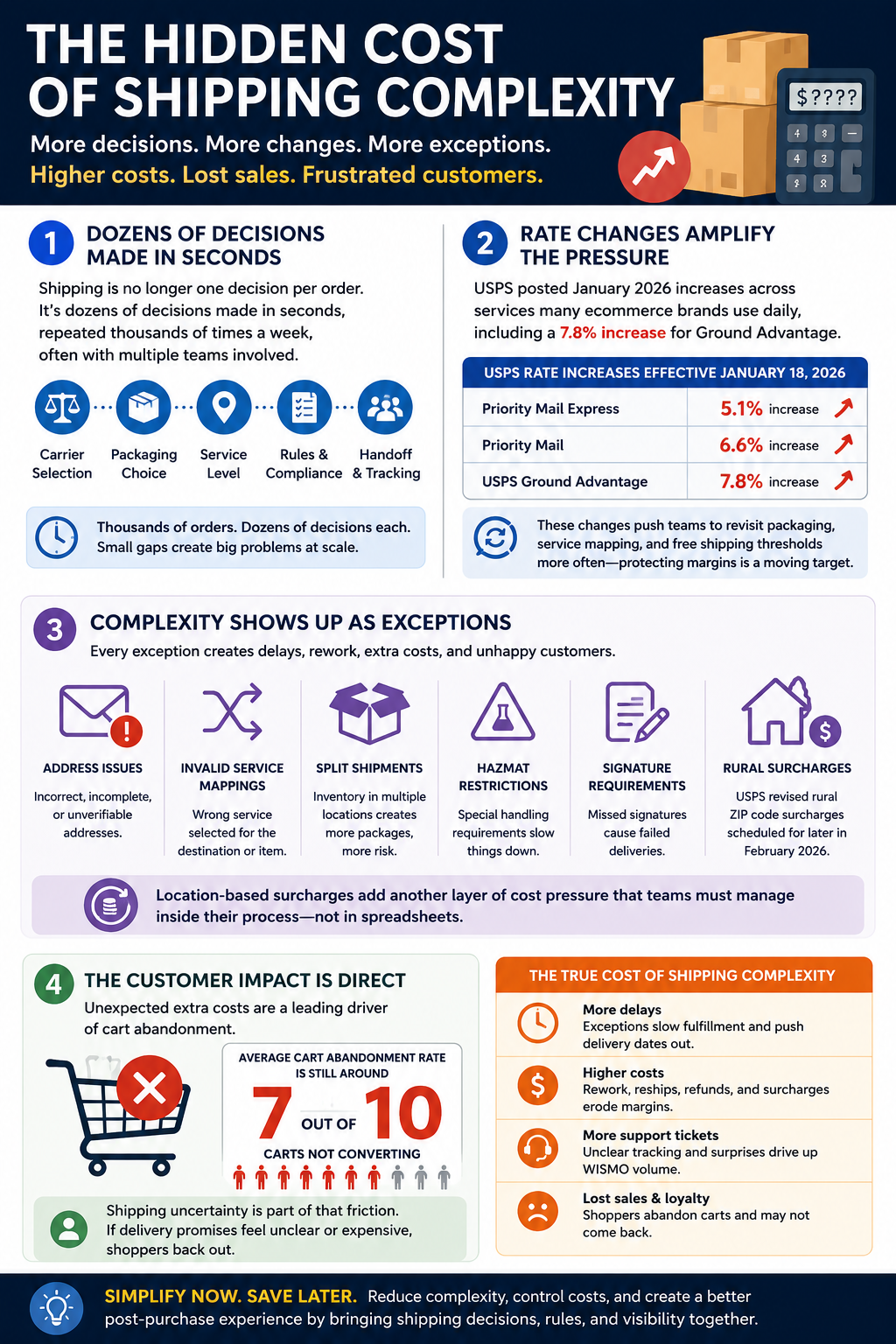
Cost pressure is rising at the same time. USPS introduced shipping rate and service updates effective January 18, 2026, including reported average retail increases of 5.1% for Priority Mail Express, 6.6% for Priority Mail, and 7.8% for USPS Ground Advantage.
Those are not small changes once they hit daily volume, free shipping thresholds, replacement orders, and delivery promises. Checkout friction compounds it. Mailchimp reported that as many as 70% of ecommerce shoppers abandon a cart before checking out, and our 2026 roundup also cites an average documented abandonment rate of 70.22% across studies. A big reason is familiar: unexpected extra costs, especially shipping and fees, show up too late and trigger hesitation.
For ecommerce teams, the reality is simple. Shipping costs are climbing, shoppers expect clarity and speed, and operations teams need systems that prevent exceptions instead of reacting to them after the fact.
This is where 3PL logistics software earns its keep: it connects order flow, warehouse execution, carrier selection, and tracking visibility into a repeatable process that scales without chaos.
“The post-purchase experience deserves a seat at the executive table because it affects both brand equity and margin. A better return process can reduce service volume while increasing customer confidence. Clearer shipping communication can lower inbound tickets while improving trust. Faster resolution can protect repeat purchases. Cleaner workflows can reduce stress on teams and make the business easier to scale.” Read Article on Forbes

What Modern 3PL Logistics Tools Need To Solve
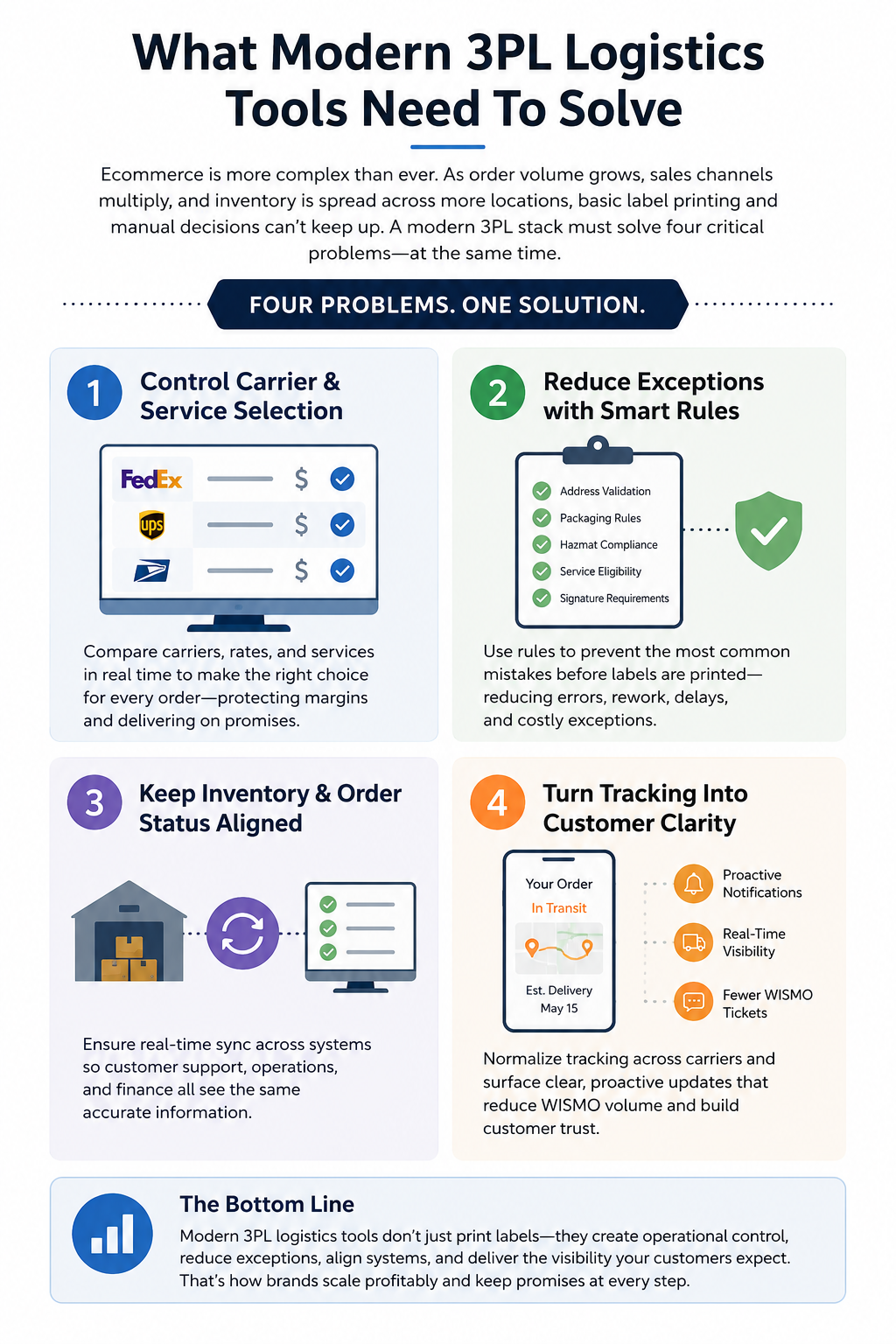
Most ecommerce brands start with basic label printing and manual decision-making. That approach breaks fast once volume rises, channels expand, and orders start splitting across inventory locations. A modern 3PL stack needs to solve four problems at once. First, it must control carrier and service selection so shipping choices stay consistent with margin and delivery promises.
Second, it must reduce exceptions by implementing rules that prevent the most common mistakes before labels are printed.
Third, it must keep inventory and order status aligned across systems so customer support, operations, and finance all see the same truth.
Fourth, it must turn tracking into customer clarity, not a carrier detail.
This highlights a common gap: many teams still treat tracking as a carrier artifact, even though unclear tracking drives more WISMO volume and higher support costs.

The Hidden Cost Of Shipping Complexity
Shipping is no longer one decision per order. It is dozens of decisions made in seconds, repeated thousands of times a week, often with multiple teams involved. Rate changes amplify the pressure. USPS posted January 2026 increases across services that many ecommerce brands use daily, including a 7.8% increase for Ground Advantage. That pushes teams to revisit packaging, service mapping, and free shipping thresholds more often.
Complexity also shows up as exceptions. Address issues, invalid service mappings, split shipments, hazmat restrictions, signature requirements, and rural surcharges turn into delays and rework. USPS also noted revised rural ZIP code surcharges scheduled for later in February 2026, which add another layer of location-based cost pressure that teams need to manage within their process, not in spreadsheets. The customer experience impact is direct.
Our recent cart abandonment analysis highlights that unexpected extra costs are a leading driver of abandonment, and that the average rate is still around 7 out of 10 carts not converting. Shipping uncertainty is part of that friction. If delivery promises feel unclear or expensive, shoppers back out.
“Cloud-based solutions are tethered to the uptime of the service provider, whereas hybrid-cloud solutions mean you can keep shipping packages even if your SaaS provider is experiencing a disruption of service.” – Read Article on Forbes

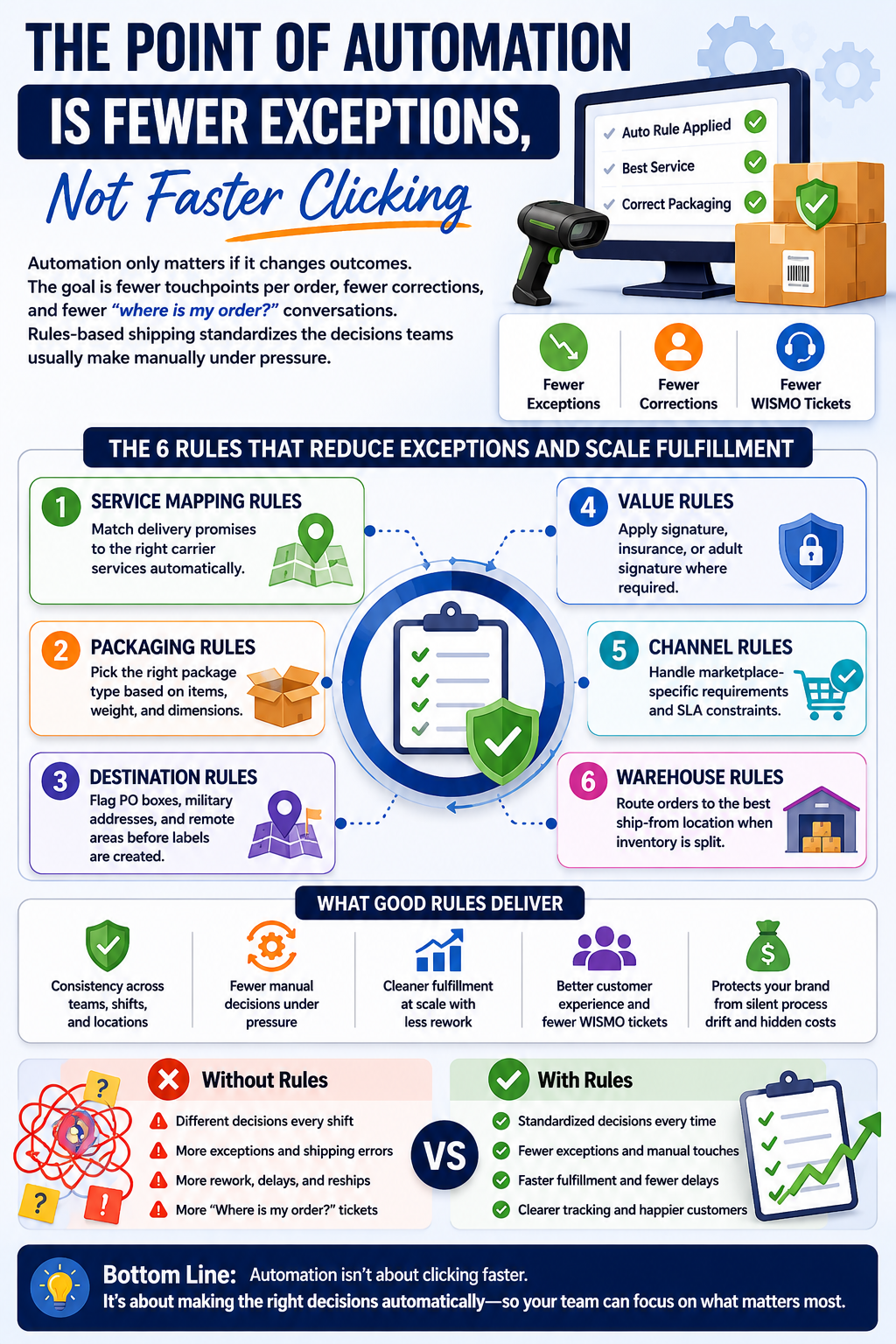
The Point Of Automation Is Fewer Exceptions, Not Faster Clicking
Automation only matters if it changes outcomes. The goal is fewer touchpoints per order, fewer corrections, and fewer conversations that start with “where is my order.” Rules-based shipping is one of the fastest ways to reduce exceptions, since it standardizes decisions that teams otherwise make manually under pressure.
The key is to build rules that reduce exceptions and scale fulfillment cleanly. A strong rule set usually covers these areas.
- Service mapping rules that match delivery promises to carrier services.
- Packaging rules that pick the right package type based on items, weight, and dimensions.
- Destination rules that flag PO boxes, military addresses, and remote areas.
- Value rules that apply to signature, insurance, or adult signature, where needed.
- Channel rules that handle marketplace-specific requirements and SLA constraints.
- Warehouse rules that route orders to the best ship-from location when inventory is split.
Done well, rules create consistency. They also protect the brand from silent process drift, where every shift runs shipping a little differently.
“The post-purchase experience shapes your brand just as much as what draws a customer to it before they buy. Branding or advertising begin to shape customer confidence, but the experience that follows checkout influences loyalty more.” Read Article on Fast Company
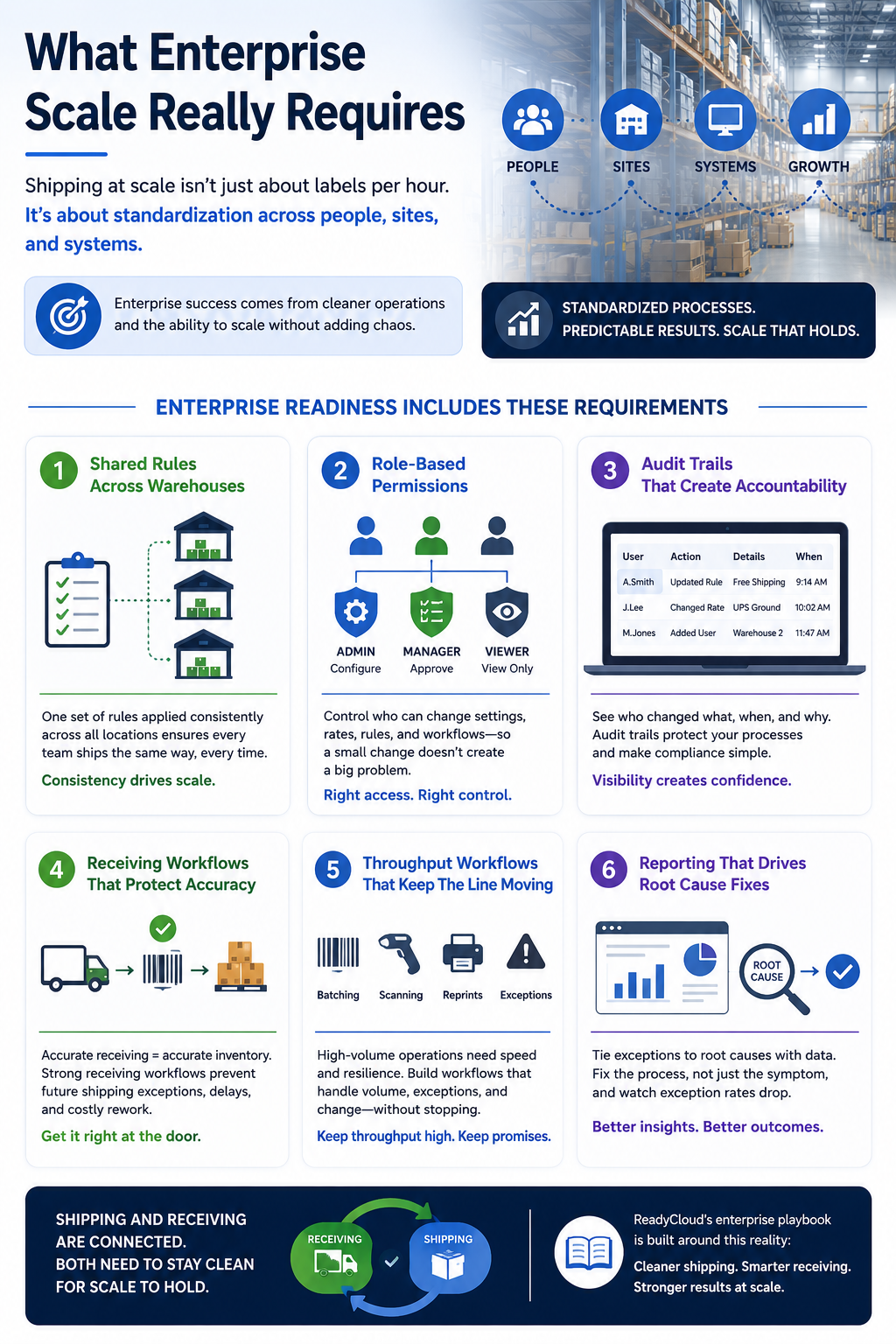
What Enterprise Scale Really Requires
Shipping at scale is not only about labels per hour. It is about standardization across people, sites, and systems. This is why growing ecommerce brands should focus on cleaner operations and scaling without adding chaos.
Enterprise readiness usually includes these requirements.
- Shared rules that apply consistently across warehouses.
- Role-based permissions so changes do not break processes silently.
- Audit trails that show who changed what and when.
- Receiving workflows that keep inventory accuracy tight, since bad receiving creates shipping exceptions later.
- Throughput workflows that support batching, scanning, reprints, and exception handling without stopping the line.
- Reporting that ties exceptions to root causes so teams can fix process issues, not chase symptoms.
ReadyCloud’s enterprise playbook for cleaner shipping and receiving operations is built around that reality: shipping and receiving are connected processes, and both need to stay clean for scale to hold.
A Practical Evaluation Checklist For Ecommerce Teams
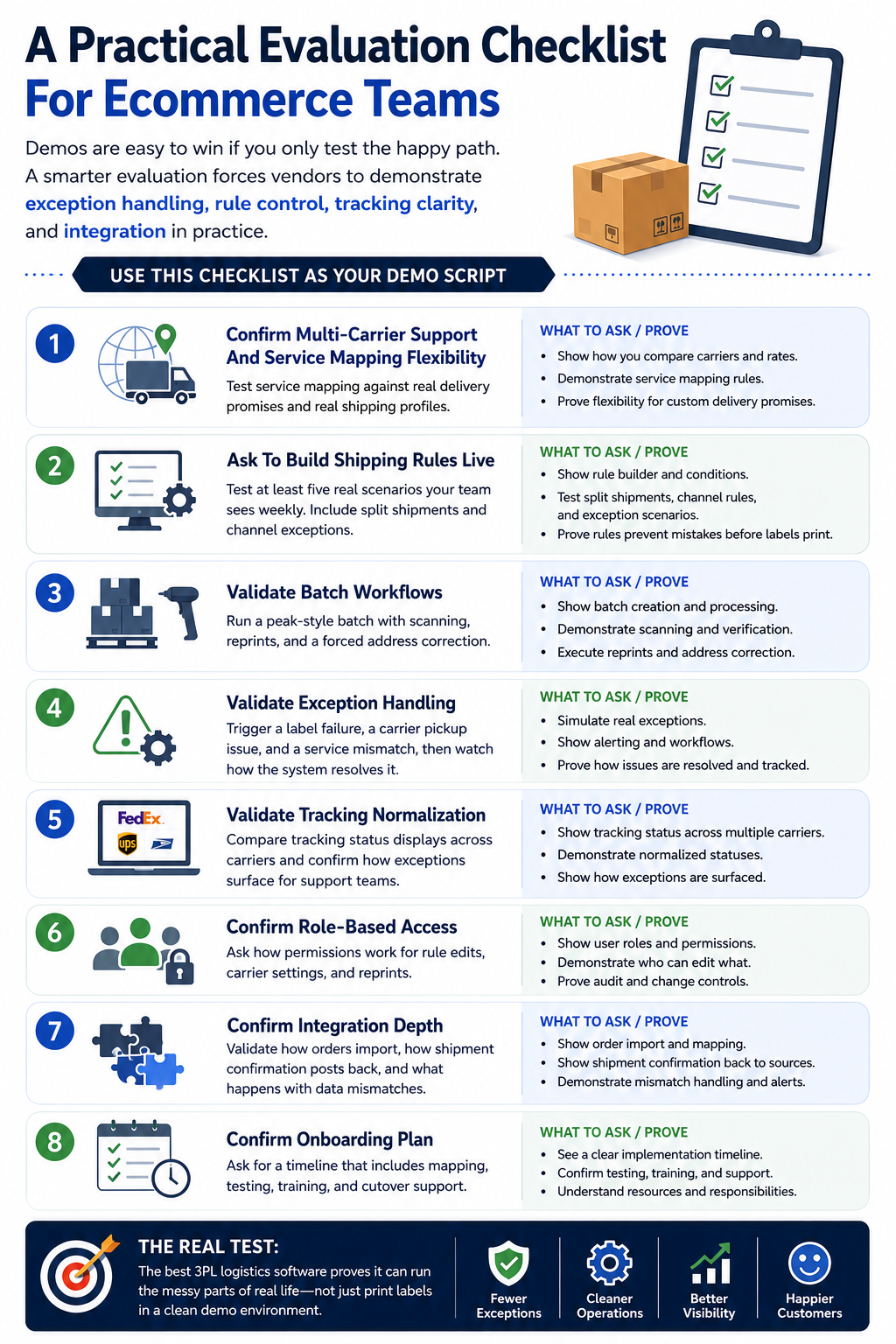
Demos are easy to win if you only test the happy path. A smarter evaluation of an enterprise shipping system, though, forces vendors to demonstrate exception handling, rule control, tracking clarity, and integration in practice. Use this checklist as a demo script.
- Confirm multi-carrier support and service mapping flexibility. Test service mapping against real delivery promises and real shipping profiles.
- Ask to build shipping rules live. Test at least five real scenarios your team sees weekly. Include split shipments and channel exceptions.
- Validate batch workflows. Run a peak-style batch with scanning, reprints, and a forced address correction.
- Validate exception handling. Trigger a label failure, a carrier pickup issue, and a service mismatch, then watch how the system resolves it.
- Validate tracking normalization. Compare tracking status displays across carriers and confirm how exceptions surface for support teams.
- Confirm role-based access. Ask how permissions work for rule edits, carrier settings, and reprints.
- Confirm integration depth. Validate how orders import, how shipment confirmation posts back, and what happens when there are data mismatches.
- Confirm onboarding plan. Ask for a timeline that includes mapping, testing, training, and cutover support.
This is also where 3PL logistics software needs to prove it can run the messy parts of real life, not just print labels in a clean demo environment.
“In a perfect world, you’d have the solution you needed in just a few clicks. In reality, not all software accommodates the specific needs of the individual retailer. When creating a balanced shipping strategy for your online business, it’s imperative that you ensure the feature sets you need are in place, so you can fulfill faster and go home early.” – Read Article on Forbes
“Post-purchase is a crucial part of the customer journey, but it often doesn’t get the attention it deserves, especially at the enterprise level. What’s interesting is how many growing e-commerce brands are outshining larger retailers when it comes to what happens after the “buy” button is clicked.” – Read Article on Forbes
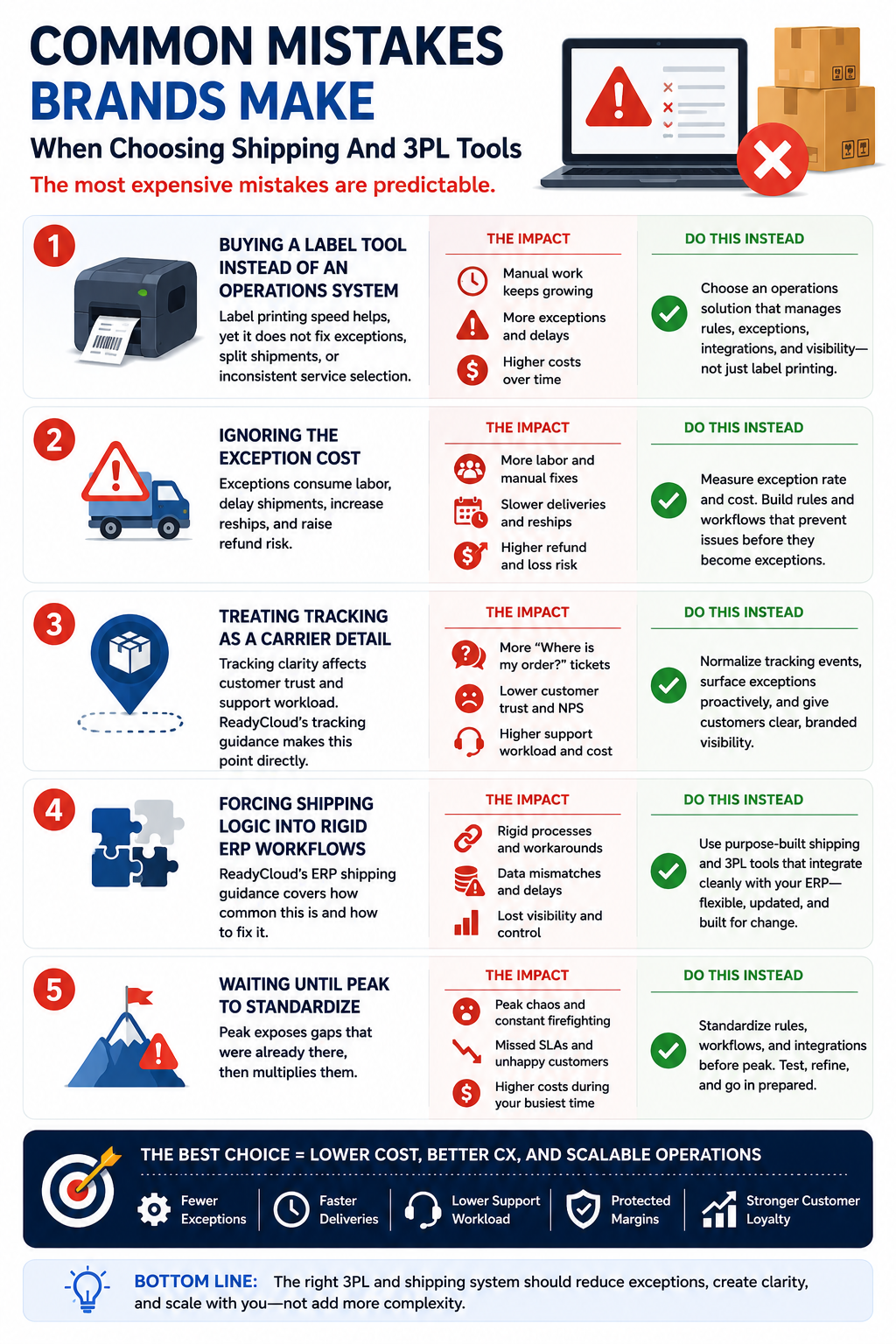
Common Mistakes Brands Make When Choosing Shipping And 3PL Tools
The most expensive mistakes are predictable:
- Buying a label tool instead of an operations system. Label printing speed helps, yet it does not fix exceptions, split shipments, or inconsistent service selection.
- Ignoring the exception cost. Exceptions consume labor, delay shipments, increase reships, and raise refund risk.
- Treating tracking as a carrier detail. Tracking clarity affects customer trust and support workload.
- Forcing shipping logic into rigid ERP workflows. ReadyCloud’s ERP shipping guidance covers how common this is and how to fix it.
- Waiting until peak to standardize. Peak exposes gaps that were already there, then multiplies them.
“Many retailers are simply not equipped to manage what’s coming. But some are. These are the brands already investing in technology, training and process optimization to turn what used to be a logistical nightmare into a competitive edge.” – Read Article on Forbes
Reduce Exceptions, Protect Margins, And Keep Delivery Promises Accurate At Scale
If shipping costs are rising and exceptions are eating time, start with two numbers: your exception rate and your WISMO volume. Then map the root causes back to service selection, shipping rules, and tracking clarity.
ReadyCloud brings shipping workflows and post-purchase visibility together so ecommerce teams can scale without adding chaos. Explore the resources linked above to see what cleaner shipping operations can look like in your environment.
“Modern consumers expect transparency. They don’t want to chase tracking links across different carriers or dig through their inbox to figure out when a package is supposed to arrive. They want real-time updates and branded communication that feels consistent with the rest of their shopping experience.
Brands that offer detailed order tracking, SMS updates or branded tracking pages are already ahead of the curve. These shipping intelligence touchpoints show customers that the brand is still involved … even after the sale is complete.” Read Article on Forbes
Where ReadyCloud Fits In The Shipping And 3PL Stack
ReadyCloud focuses on what happens after the buy button: shipping execution, operational control, tracking clarity, and the customer experience that follows the order. For teams that need fewer exceptions and cleaner scaling, ReadyCloud supports rule-based shipping workflows, high-volume execution, and visibility that reduces support friction. If your team wants deeper reading tied to the problems covered here, start with the ReadyCloud Suite.
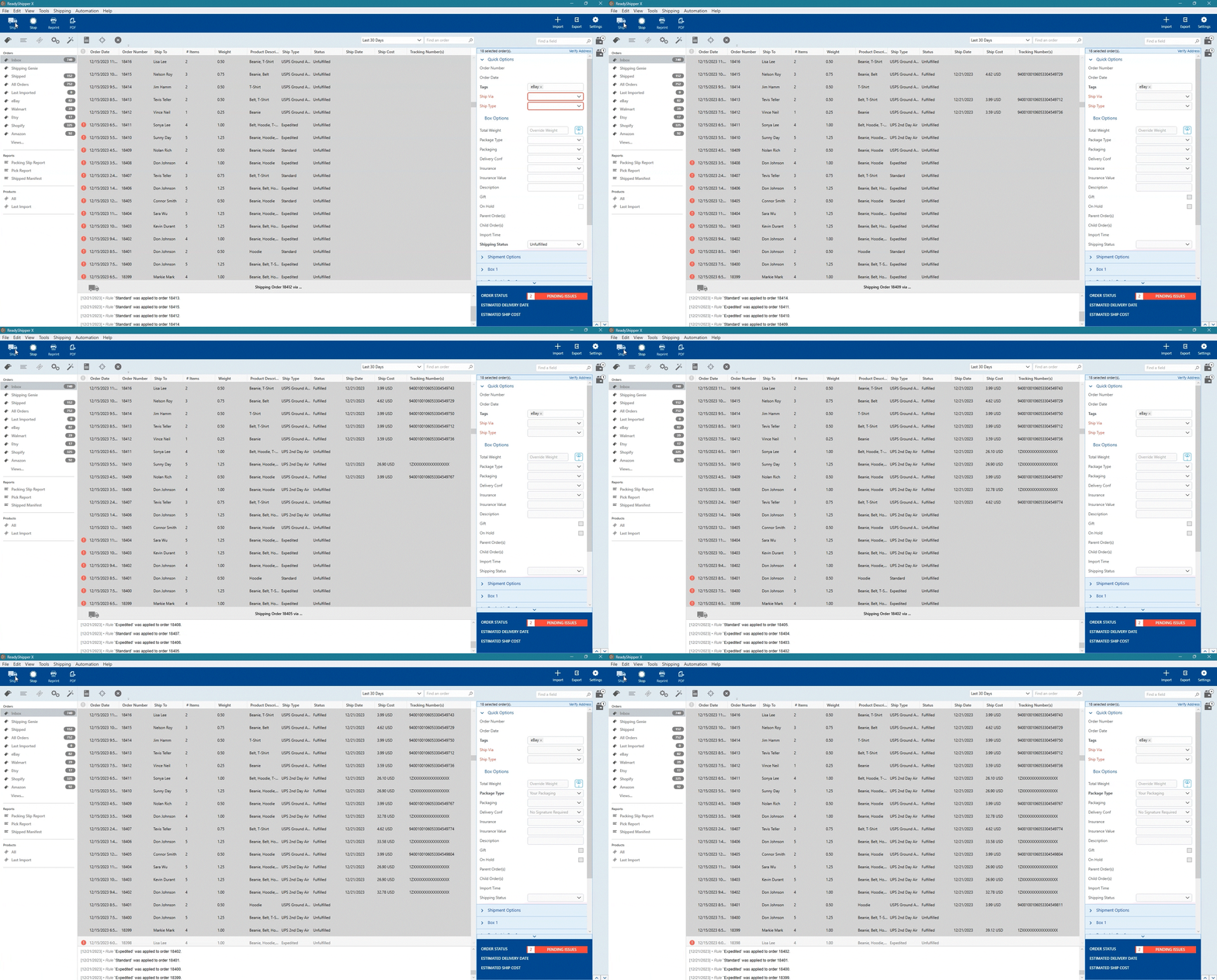
Shipping is easier than ever with ReadyShipper X, a multicarrier solution that simplifies your fulfillment process while saving time and money.
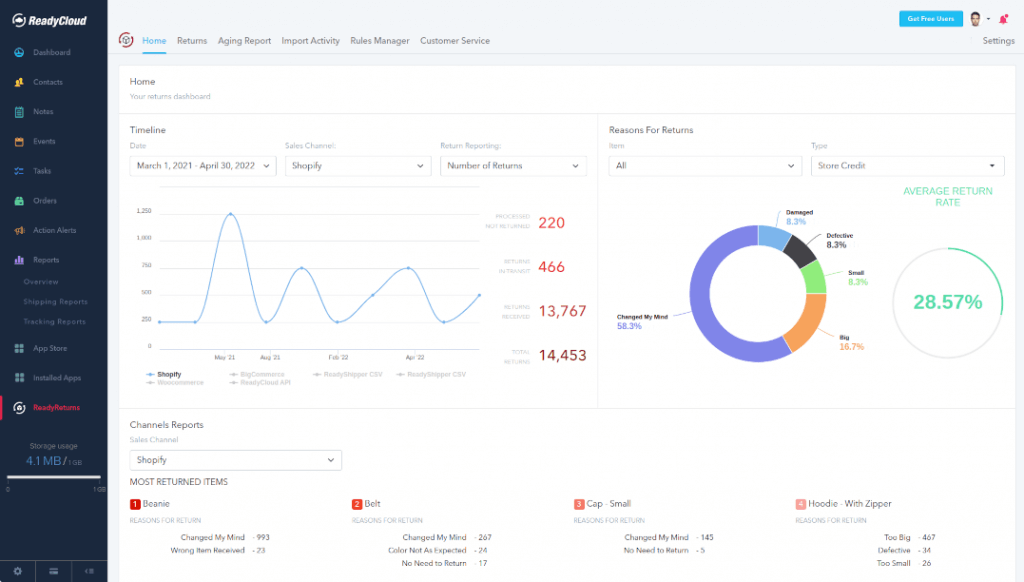
And when it comes to returns, ReadyReturns streamlines the entire process with an automated solution that boosts customer satisfaction and loyalty.
ReadyCloud is more than just a suite of systems—it’s your ticket to thriving in 2026 and beyond!
Start your journey to success today! Learn more and get started here.
Or contact our Sales Department at: 877-818-7447 ext. 1.
FAQs About 3PL Logistics Software
What Is A 3PL In Ecommerce?
A 3PL is a third-party logistics partner that stores inventory and handles picking, packing, and shipping on a brand’s behalf, usually integrated with the brand’s ecommerce platforms and order systems.
What Is The Difference Between A 3PL And A Fulfillment Center?
A fulfillment center can be the physical warehouse operation. A 3PL is the provider that runs fulfillment services and often includes transportation, systems, and operational support beyond the building.
What Should Ecommerce Brands Look For In Shipping Automation?
Look for rules that prevent exceptions, multi-carrier flexibility, batch workflows for peak, clear tracking events, and integrations that keep order and shipment status aligned across systems.
How Do Shipping Costs Affect Cart Abandonment?
ReadyCloud’s 2026 cart abandonment analysis notes that unexpected extra costs are a leading reason shoppers leave, and that cart abandonment remains around seven out of ten carts on average. Shipping costs shown late in checkout can trigger that surprise.
What Are The Biggest Causes Of Shipping Exceptions?
Common drivers include address issues, wrong service selection, packaging mismatches, split shipments, inventory inaccuracies, carrier pickup failures, and inconsistent processes across shifts or warehouses.
How Can Teams Reduce WISMO Tickets Without Hiring More Support Staff?
Improve tracking clarity and proactively surface exceptions. ReadyCloud’s tracking guidance emphasizes that visibility and clarity reduce confusion that often triggers WISMO contacts.
How Do USPS Price Increases Change Shipping Strategy?
USPS introduced shipping updates effective January 18, 2026, including reported average retail increases across Priority Mail Express, Priority Mail, and Ground Advantage. Many brands respond by revisiting carrier mix, packaging choices, service mapping, and free shipping thresholds.
Can Enterprise Teams Use Shipping Tools With SAP Or Other ERPs?
Yes, yet integration depth matters. Enterprise teams should validate order import, ship confirmation timing, service mapping flexibility, multi-warehouse logic, and how exceptions are handled when ERP data and warehouse reality diverge.
What Is A Reasonable Implementation Timeline For Shipping Operations Software?
Timelines depend on channel count, warehouse complexity, carrier mix, and rule depth. A solid implementation includes mapping, testing with real orders, label testing, user training, and a structured cutover plan, not just a quick install.