


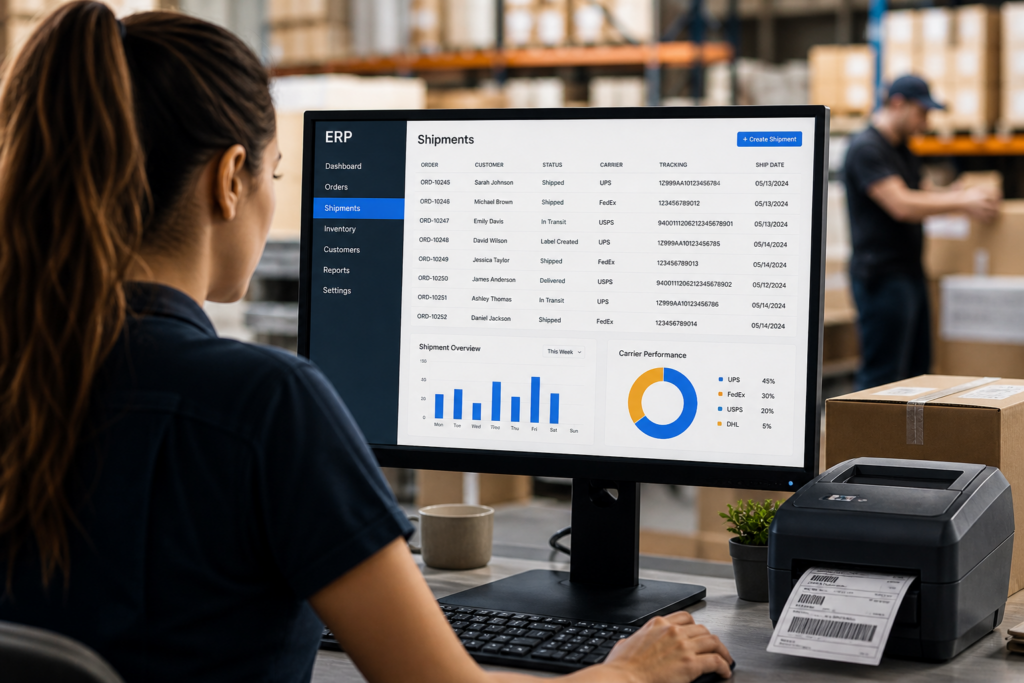
Most ecommerce teams start with a simple goal: ship orders quickly, keep costs under control, and provide clear updates to shoppers. Then the reality hits. Orders flow into an ERP, the warehouse needs labels, customer support needs tracking clarity, and finance needs clean records. The real friction shows up in the handoffs. Manual steps stack up. Exceptions multiply. Tracking gets messy. Support tickets rise. Repeat customers quietly disappear.
The bigger issue is that many ERPs were not built to run modern, high-volume ecommerce fulfillment. They can store orders and manage inventory effectively, yet shipping execution often becomes a patchwork of carrier portals, spreadsheets, and custom workarounds. That is how a shipping process becomes slow, expensive, and hard to trust.
Keep reading. We’ll break down the most common failure points, what strong shipping workflows look like for ecommerce, and how to connect shipping, tracking, and post-purchase communication… so teams move faster after checkout.



“The post-purchase experience deserves a seat at the executive table because it affects both brand equity and margin. A better return process can reduce service volume while increasing customer confidence. Clearer shipping communication can lower inbound tickets while improving trust. Faster resolution can protect repeat purchases. Cleaner workflows can reduce stress on teams and make the business easier to scale.” Read Article on Forbes


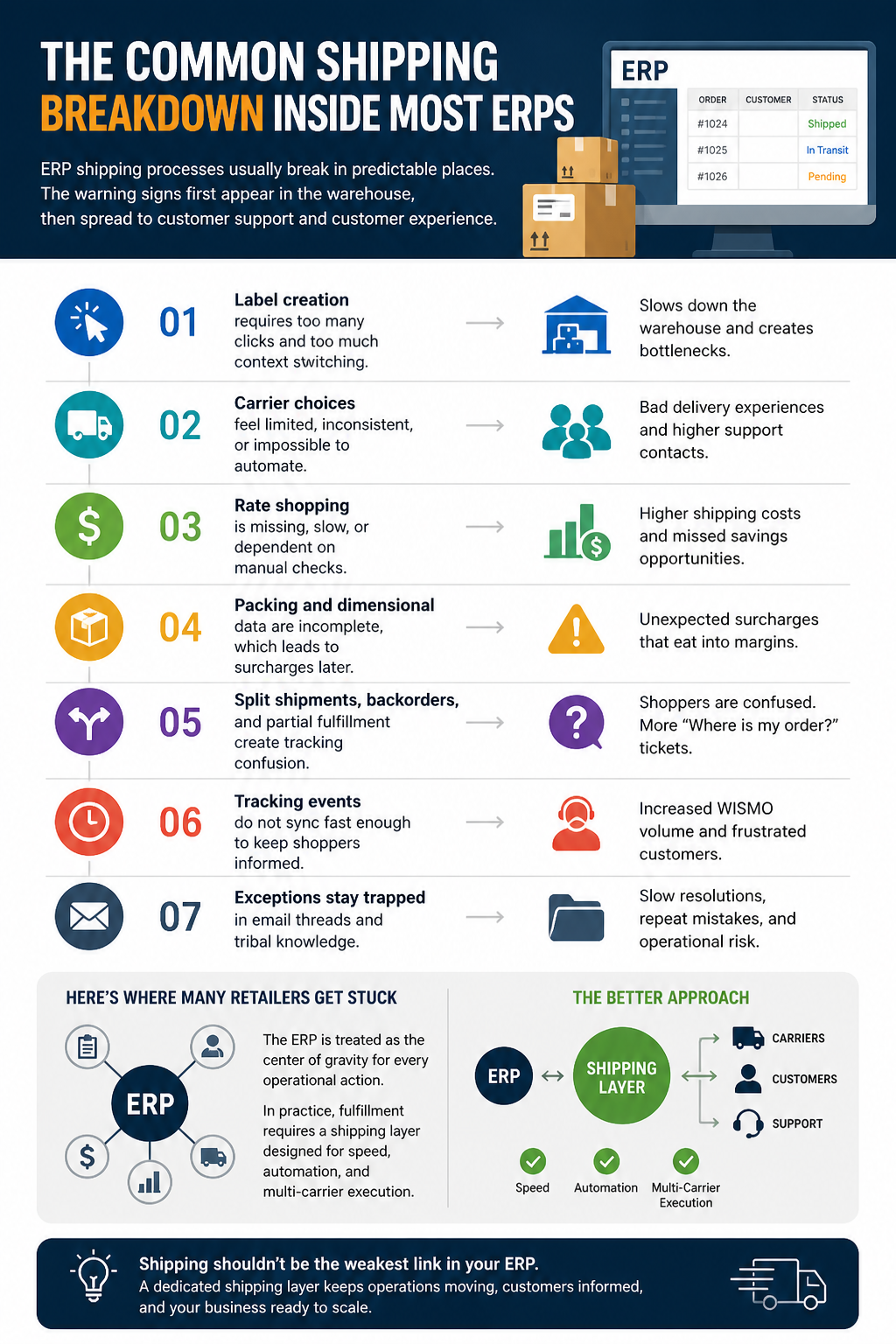
The Common Shipping Breakdown Inside Most ERPs
ERP shipping processes usually break in predictable places. The warning signs first appear in the warehouse, then spread to customer support and customer experience.
- Label creation requires too many clicks and too much context switching.
- Carrier choices feel limited, inconsistent, or impossible to automate.
- Rate shopping is missing, slow, or dependent on manual checks.
- Packing and dimensional data are incomplete, which leads to surcharges later.
- Split shipments, backorders, and partial fulfillment create tracking confusion.
- Tracking events do not sync fast enough to keep shoppers informed.
- Exceptions stay trapped in email threads and tribal knowledge.
Here’s where many retailers get stuck. The ERP is treated as the center of gravity for every operational action. In practice, fulfillment requires a shipping layer designed for speed, automation, and multi-carrier execution.

“Post-purchase is a crucial part of the customer journey, but it often doesn’t get the attention it deserves, especially at the enterprise level. What’s interesting is how many growing e-commerce brands are outshining larger retailers when it comes to what happens after the “buy” button is clicked.” Read Article on Forbes


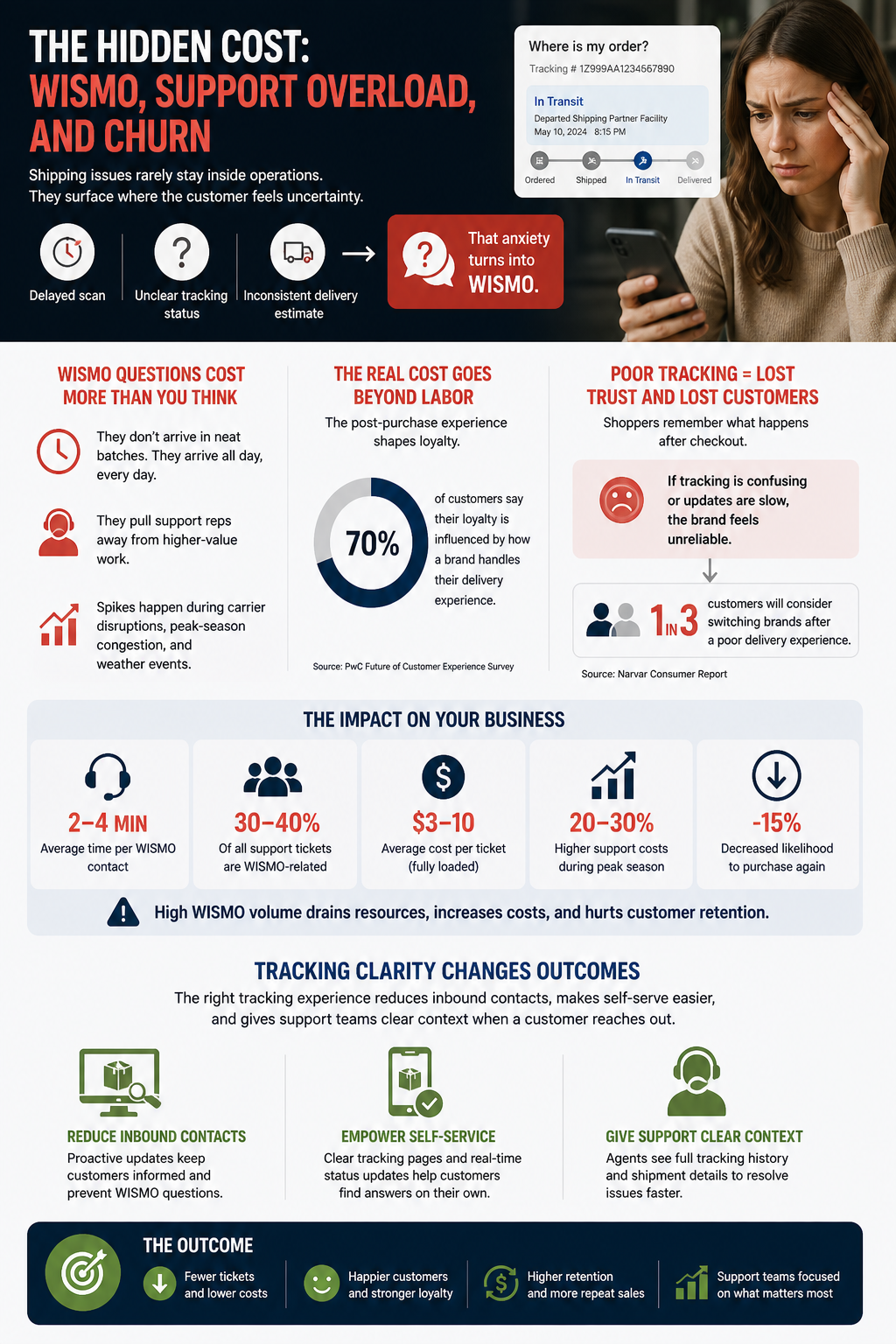
The Hidden Cost: WISMO, Support Overload, And Churn
Shipping issues rarely stay inside operations. They surface where the customer feels uncertainty. A delayed scan, unclear tracking status, or inconsistent delivery estimate is enough to trigger anxiety. That anxiety turns into WISMO.
WISMO questions cost more than most teams expect because they do not arrive in neat batches. They arrive all day, every day, and they pull support reps away from higher-value work. Many brands also see spikes in WISMO during carrier disruptions, peak-season congestion, and weather events, even if their internal fulfillment performance remains steady.
WISMO, or “Where Is My Order,” is far more than a simple support question. It’s one of the most common types of inbound inquiries ecommerce teams deal with, and it directly impacts labor costs, efficiency, and customer retention. In many cases, WISMO signals a breakdown in post-purchase visibility or communication, not just a delayed shipment.
Each inquiry pulls time from support teams, increases operational costs, and can weaken customer trust if answers aren’t clear or immediate. That’s why leading brands now treat WISMO as a core performance metric, not just a support issue, especially as more than 68% of mid-to-large retailers are adopting dedicated post-purchase or WISMO platforms to reduce these inquiries and improve the overall delivery experience.
What’s more, the cost is not only labor. The post-purchase experience shapes loyalty. Shoppers remember what happens after checkout, especially when something goes wrong. If tracking is confusing or updates are slow, the brand feels unreliable, even if the warehouse shipped quickly.
That’s where tracking clarity changes outcomes. The right tracking experience reduces inbound contacts, makes self-serve status checks easier, and gives support teams clear context when a customer reaches out.
“Cloud-based solutions are tethered to the uptime of the service provider, whereas hybrid-cloud solutions mean you can keep shipping packages even if your SaaS provider is experiencing a disruption of service.” – Read Article on Forbes
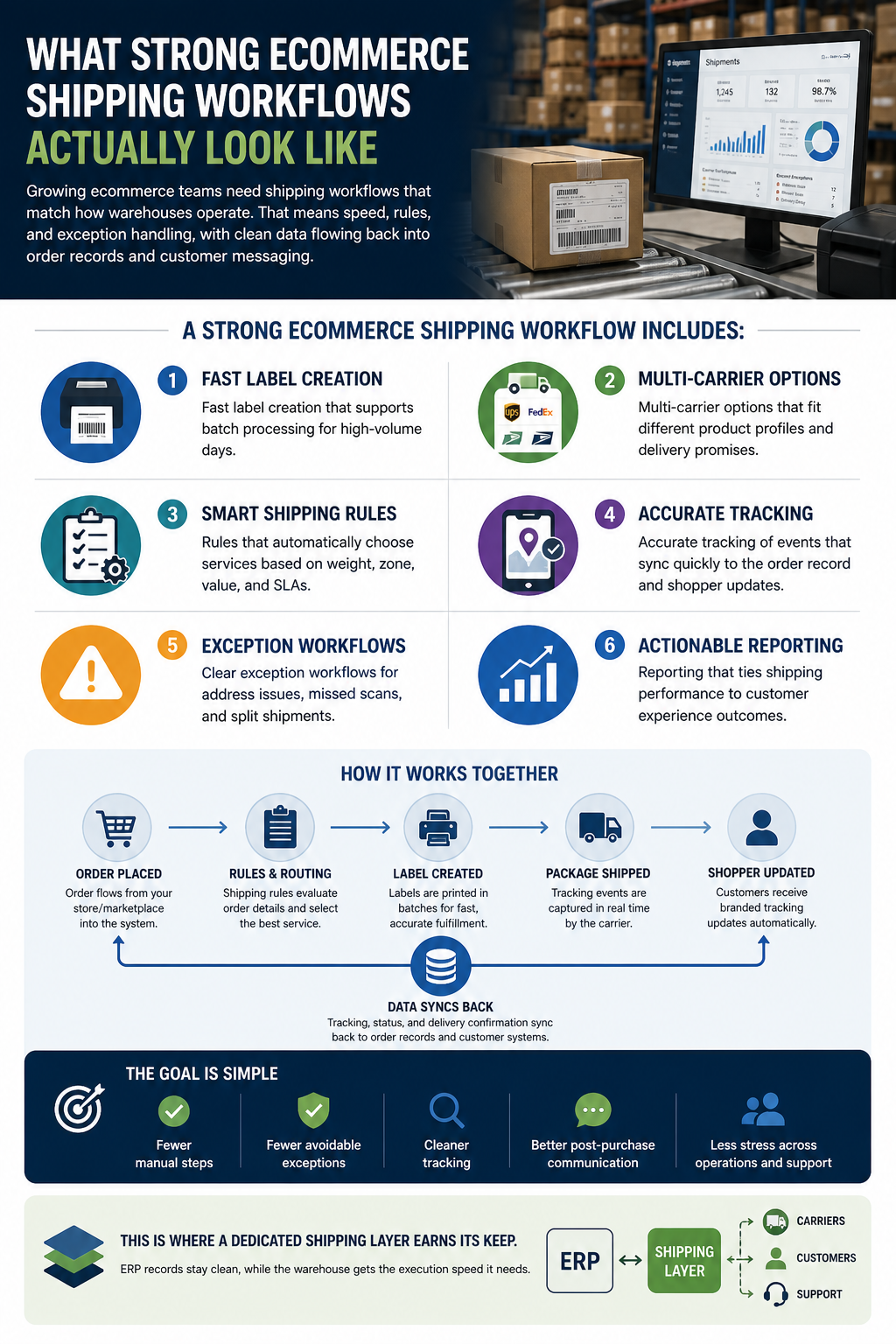
What Strong Ecommerce Shipping Workflows Actually Look Like
Growing ecommerce teams need shipping workflows that match how warehouses operate. That means speed, rules, and exception handling, with clean data flowing back into order records and customer messaging.
A strong SAP shipping workflow usually includes:
- Fast label creation that supports batch processing for high-volume days.
- Multi-carrier options that fit different product profiles and delivery promises.
- Rules that automatically choose services based on weight, zone, value, and SLAs.
- Accurate tracking of events that sync quickly to the order record and shopper updates.
- Clear exception workflows for address issues, missed scans, and split shipments.
- Reporting that ties shipping performance to customer experience outcomes.
The goal is simple: Fewer manual steps. Fewer avoidable exceptions. Cleaner tracking. Better post-purchase communication. Less stress across operations and support.
This is where a dedicated shipping layer earns its keep. ERP records stay clean, while the warehouse gets the execution speed it needs.

What To Expect From ERP Shipping Software
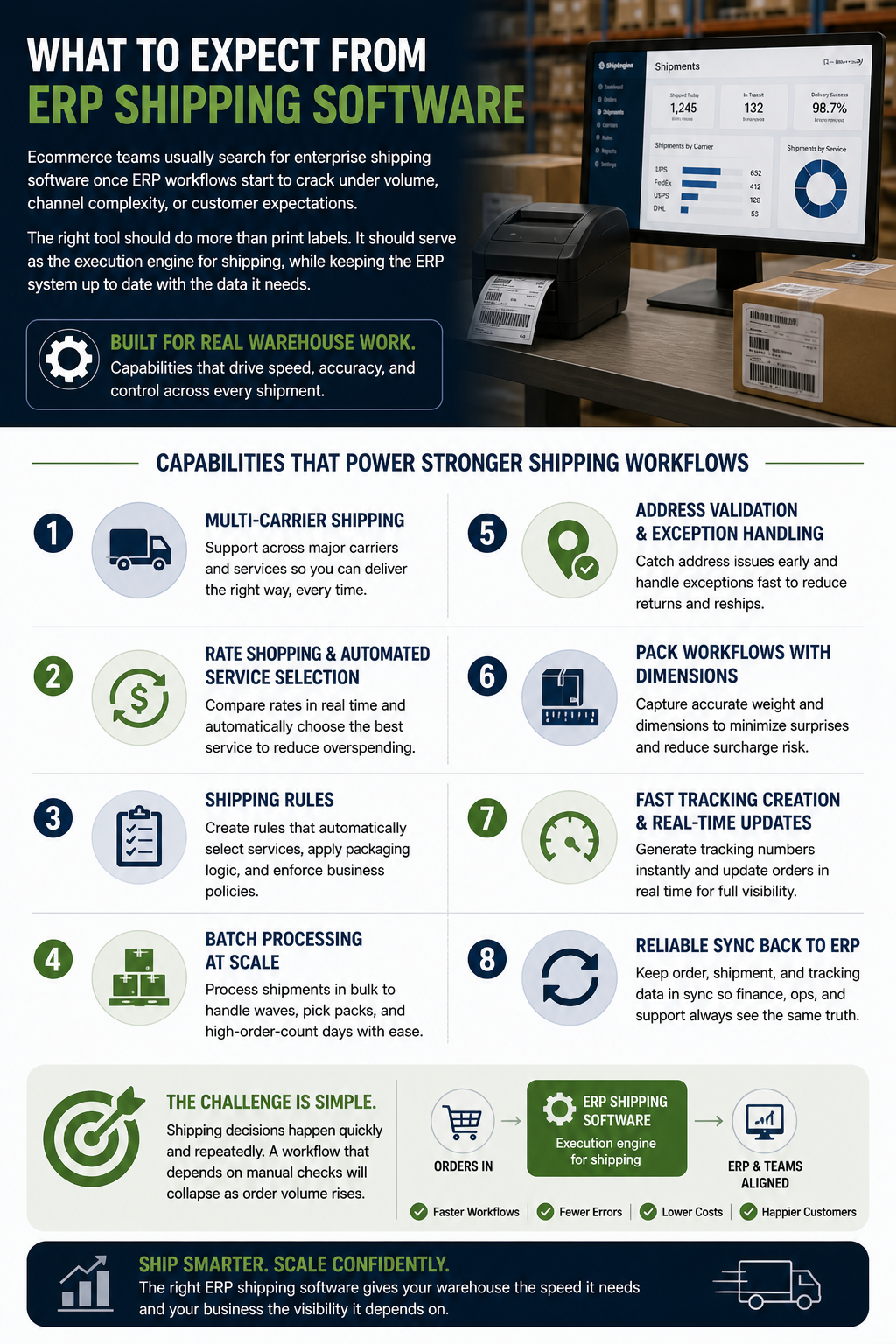
Ecommerce teams usually search for enterprise shipping software once ERP workflows start to crack under volume, channel complexity, or customer expectations. The right tool should do more than print labels. It should serve as the execution engine for shipping, while keeping the ERP system up to date with the data it needs.
Look for capabilities that fit real warehouse work:
- Multi-carrier shipping support across major carriers and services.
- Rate shopping and automated service selection that reduces overspending.
- Shipping rules that remove repetitive decision-making from daily work.
- Batch processing that supports waves, pick packs, and high-order-count days.
- Address validation and exception handling to reduce returns and reships.
- Pack workflows that capture dimensions and reduce surprise surcharges.
- Fast tracking number creation and immediate order updates.
- Reliable sync back to the ERP so finance and ops see the same truth.
For ecommerce teams, the challenge is simple. Shipping decisions happen quickly and repeatedly. A workflow that depends on manual checks will collapse as order volume rises.
The Tracking Layer That Reduces WISMO Fast
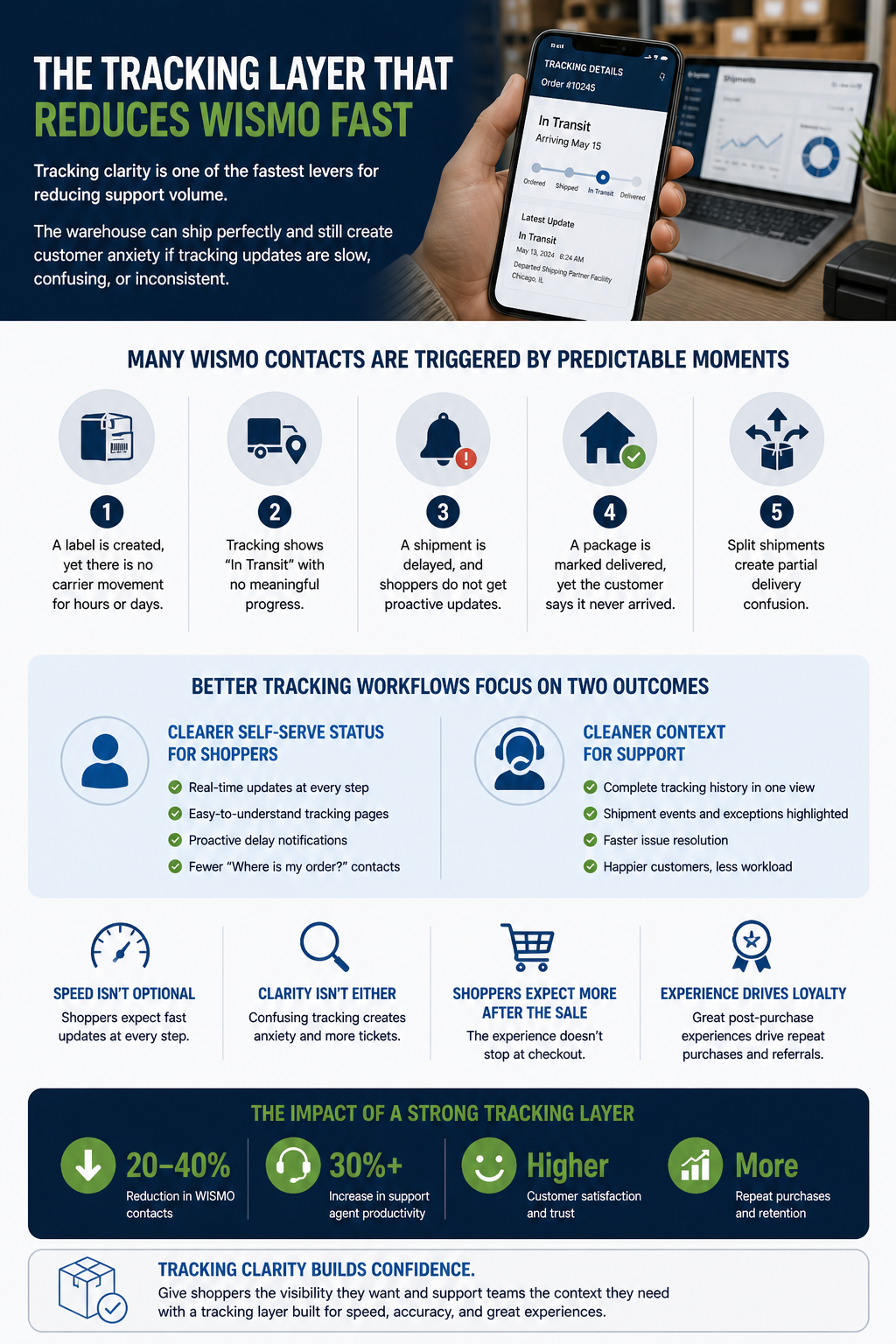
Tracking clarity is one of the fastest levers for reducing support volume. The warehouse can ship perfectly and still create customer anxiety if tracking updates are slow, confusing, or inconsistent.
Many WISMO contacts are triggered by predictable moments:
- A label is created, yet there is no carrier movement for hours or days.
- Tracking shows “In Transit” with no meaningful progress.
- A shipment is delayed, and shoppers do not get proactive updates.
- A package is marked delivered, yet the customer says it never arrived.
- Split shipments create partial delivery confusion.
Better tracking workflows focus on two outcomes: clearer self-serve status for shoppers and cleaner context for support. For online retailers, speed isn’t optional, and clarity isn’t either. Shoppers expect more after the sale. The customer experience doesn’t stop at checkout.
“In a perfect world, you’d have the solution you needed in just a few clicks. In reality, not all software accommodates the specific needs of the individual retailer. When creating a balanced shipping strategy for your online business, it’s imperative that you ensure the feature sets you need are in place, so you can fulfill faster and go home early.” – Read Article on Forbes
Carrier Price Increases Make Weak Workflows More Expensive
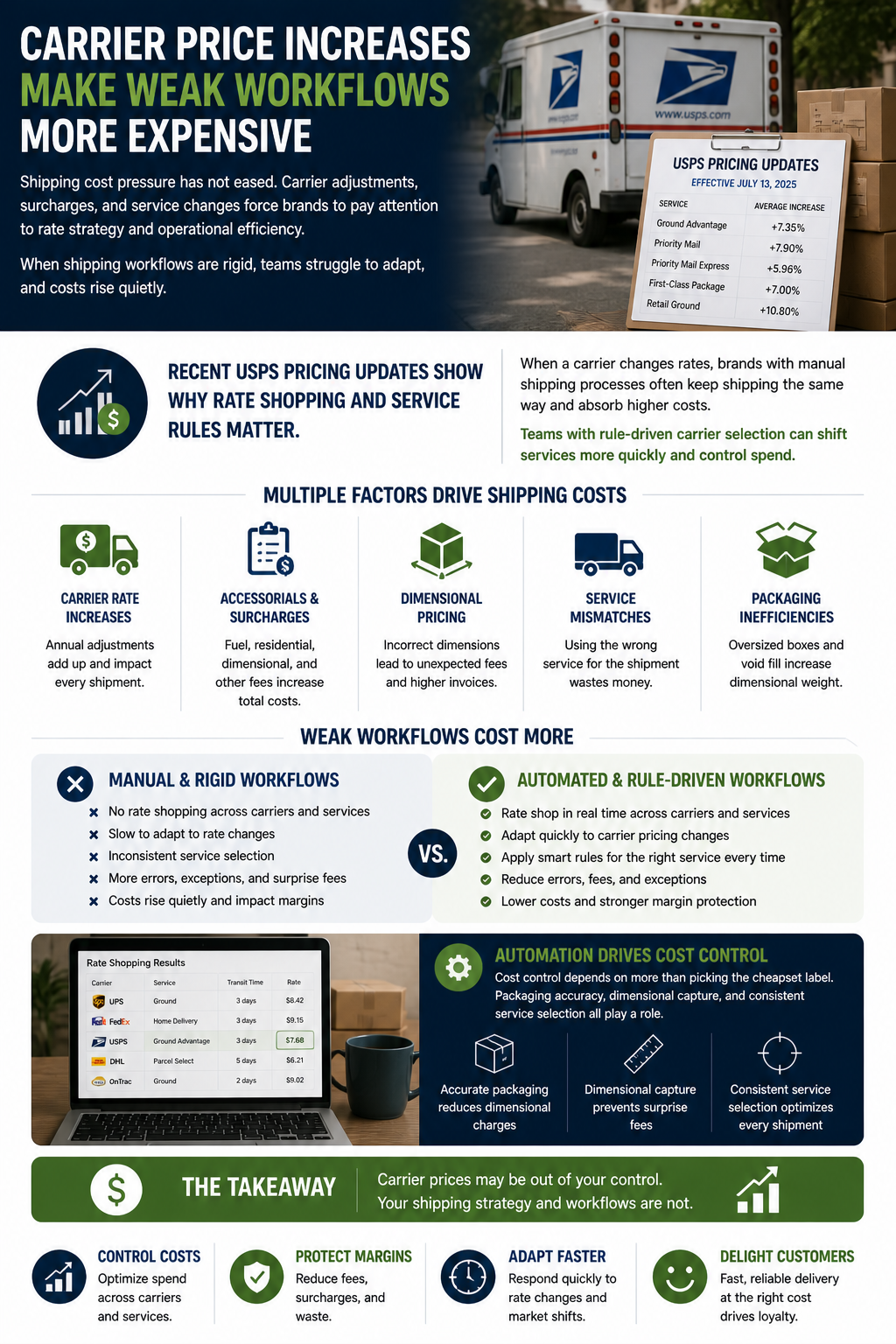
Shipping cost pressure has not eased. Carrier adjustments, surcharges, and service changes force brands to pay attention to rate strategy and operational efficiency. When shipping workflows are rigid, teams struggle to adapt, and costs rise quietly.
Recent USPS pricing updates are a good example of why rate shopping and service rules matter. When a carrier changes rates, brands with manual shipping processes often keep shipping the same way and absorb higher costs. Teams with rule-driven carrier selection can shift services more quickly and control spend.
Cost control depends on more than picking the cheapest label. Packaging accuracy, dimensional capture, and consistent service selection all play a role. That’s where automation helps. It reduces decision fatigue and keeps shipping choices consistent.
“Modern consumers expect transparency. They don’t want to chase tracking links across different carriers or dig through their inbox to figure out when a package is supposed to arrive. They want real-time updates and branded communication that feels consistent with the rest of their shopping experience.
Brands that offer detailed order tracking, SMS updates or branded tracking pages are already ahead of the curve. These shipping intelligence touchpoints show customers that the brand is still involved … even after the sale is complete.” Read Article on Forbes
Shipping Issues Often Turn Into Returns And Reship Costs
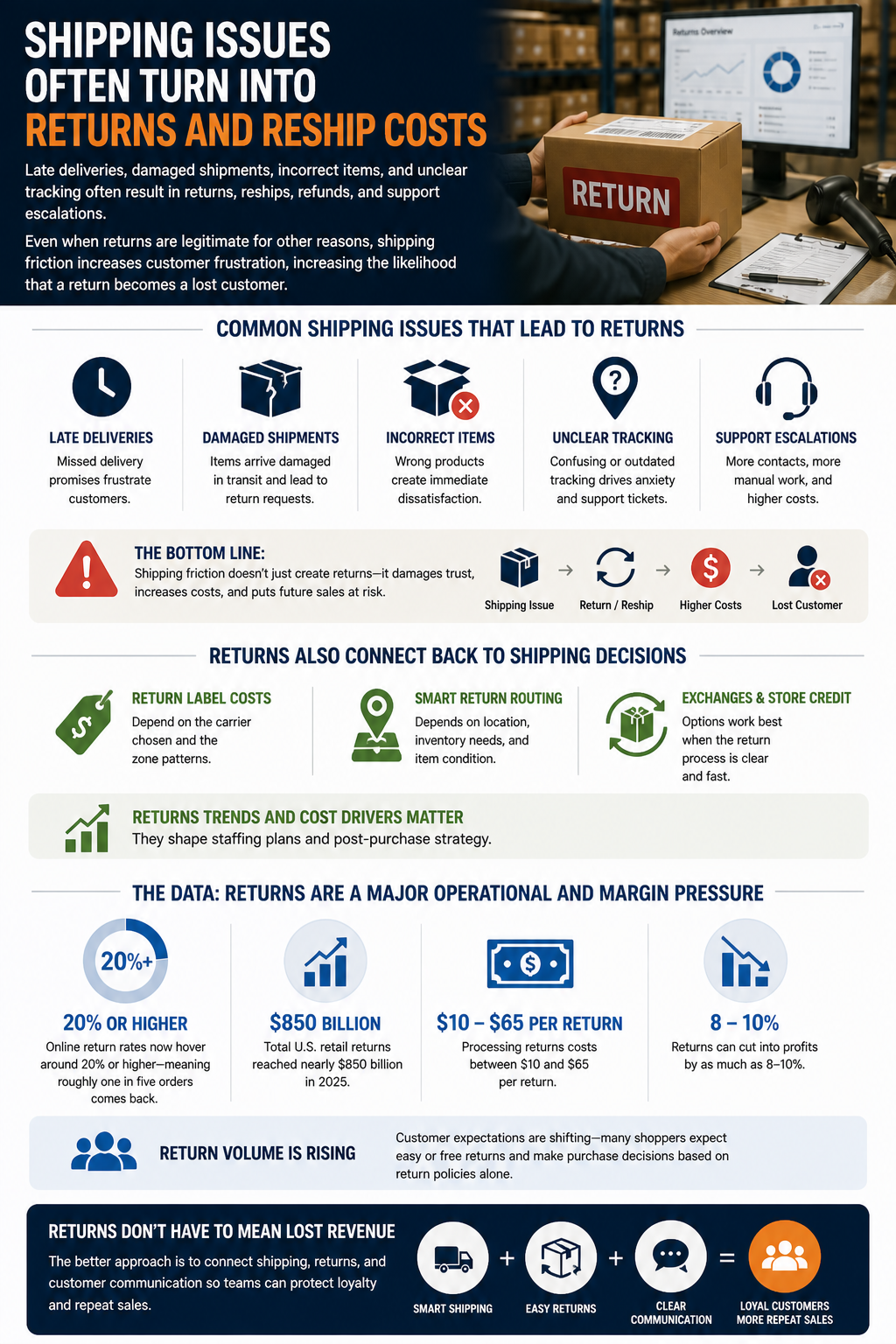
Late deliveries, damaged shipments, incorrect items, and unclear tracking often result in returns, reships, refunds, and support escalations. Even when returns are legitimate for other reasons, shipping friction increases customer frustration, increasing the likelihood that a return becomes a lost customer.
Returns also connect back to shipping decisions:
- Return label costs depend on the carrier chosen and the zone patterns.
- Smart return routing depends on location, inventory needs, and item condition.
- Exchanges and store credit options work best when the return process is clear and fast.
Returns trends and cost drivers matter because they shape staffing plans and post-purchase strategy.
Returns are becoming one of the biggest operational and margin pressures in ecommerce, and the data makes that clear. Online return rates now hover around 20% or higher, meaning roughly one in five orders comes back, while total U.S. retail returns reached nearly $850 billion in 2025. Processing those returns isn’t cheap either, with costs ranging from $10 to $65 per return and cutting into profits by as much as 8–10%.
What’s more, return volume continues to rise as customer expectations shift, with many shoppers expecting easy or free returns and making purchase decisions based on return policies alone. Returns don’t have to mean lost revenue. The better approach is to connect shipping, returns, and customer communication so teams can protect loyalty and repeat sales.
Benchmarks And Trends That Help Teams Set Realistic Shipping Goals
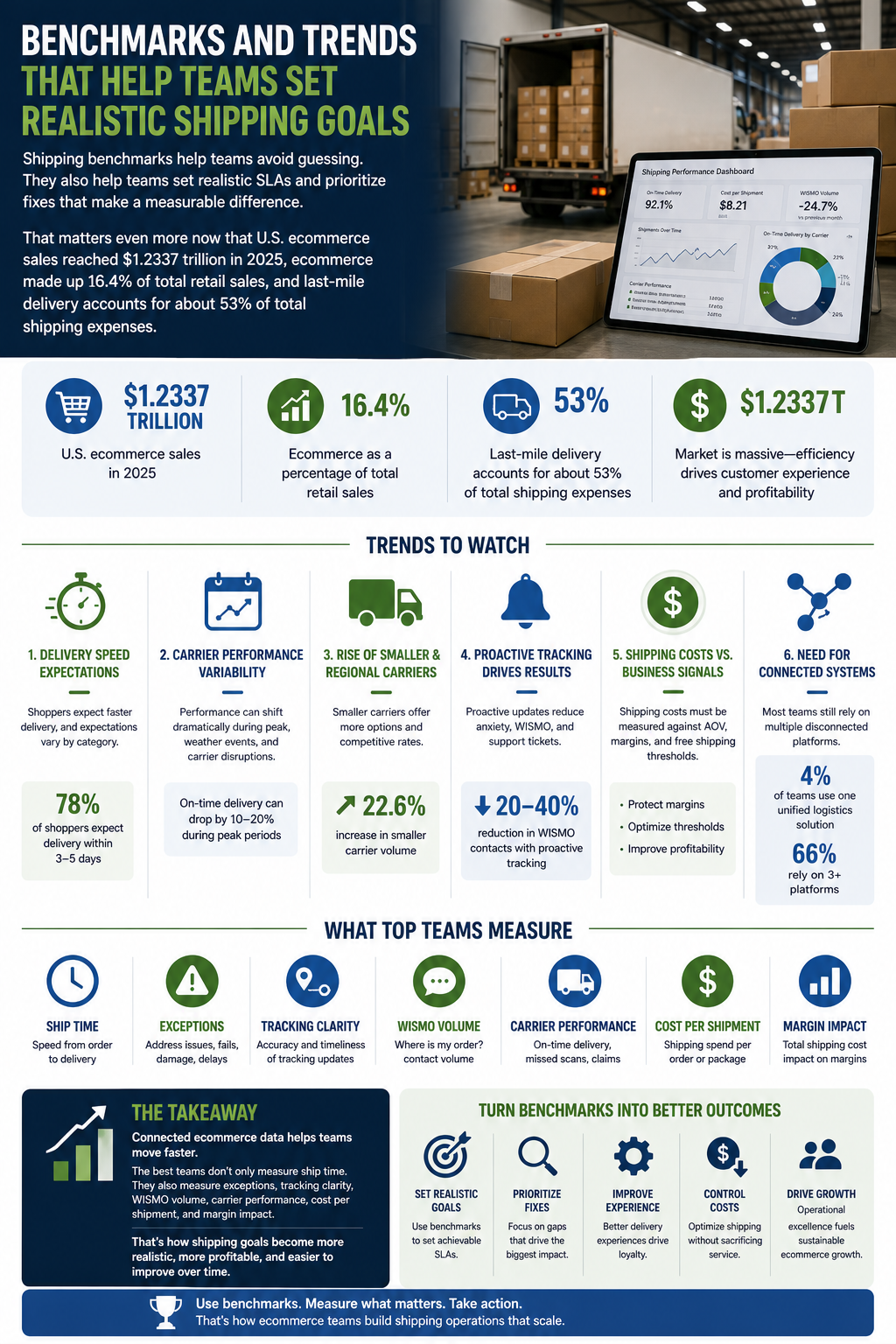
Shipping benchmarks help teams avoid guessing. They also help teams set realistic SLAs and prioritize fixes that make a measurable difference. That matters even more now that U.S. ecommerce sales reached $1.2337 trillion in 2025, ecommerce made up 16.4% of total retail sales, and last-mile delivery accounts for about 53% of total shipping expenses.
Trends to pay attention to include:
- Delivery speed expectations and how they vary by category.
- Carrier performance variability during peak and disruption periods.
- The growing value of smaller and regional carriers, especially as smaller carrier volume rose 22.6%.
- The role of proactive tracking updates in reducing support load.
- How shipping costs trend against AOV, margins, and free shipping thresholds.
- The need for connected systems, since only 4% of teams use one unified logistics solution while 66% rely on three or more platforms.
Connected ecommerce data helps teams move faster. The best teams don’t only measure ship time. They also measure exceptions, tracking clarity, WISMO volume, carrier performance, cost per shipment, and margin impact. That’s how shipping goals become more realistic, more profitable, and easier to improve over time.
| What To Evaluate | What “Good” Looks Like |
|---|---|
| Warehouse-Ready Parcel Execution | Performs at scale in real warehouse conditions, not just in a “connected” system design. |
| Label Speed | Generates labels and required documents quickly, even during peak-volume shipping windows. |
| Rule Consistency | Applies shipping rules reliably so service selection stays consistent across users and shifts. |
| Carrier Flexibility | Supports multi-carrier visibility and rate comparisons inside the workflow where decisions are made. |
| Tracking Clarity | Maintains clean tracking flow that reduces confusion for support and creates a clear shipment timeline. |
| Shipment Data Alignment | Ties shipment creation cleanly to SAP delivery and order data without duplicate entry or reconciliation work. |
Shipping Impacts Cart Abandonment Before The Order Exists
Shipping issues are not only post-purchase problems. Shipping cost, delivery timing, and trust signals shape conversion. Shoppers abandon carts when shipping feels too expensive, too slow, or uncertain.
Operational improvements support better checkout promises:
- More accurate delivery expectations because services are selected consistently.
- Better shipping cost control, which protects free shipping strategies.
- Fewer shipping surprises that lead to complaints and refund pressure.
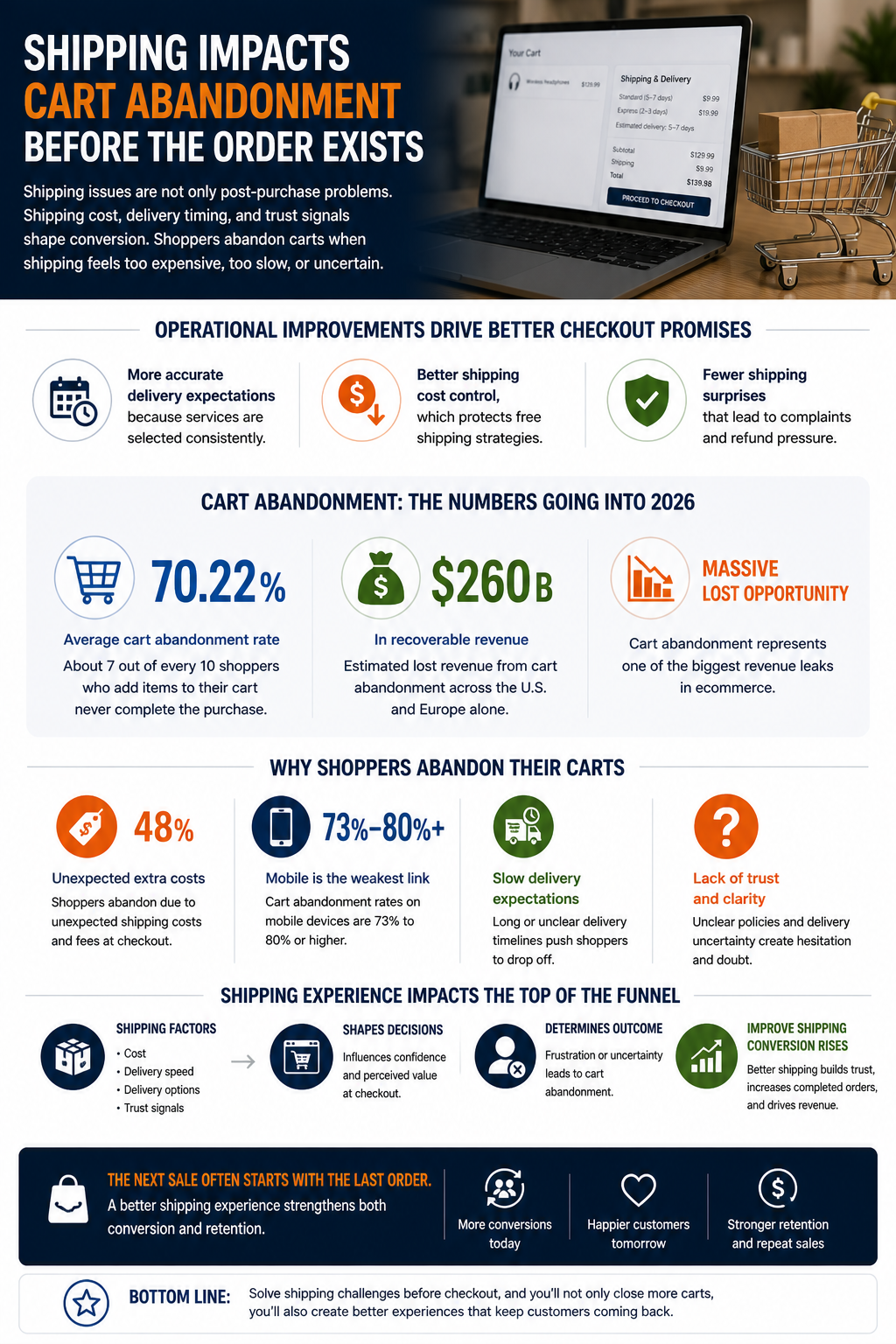
Cart abandonment remains one of the biggest revenue leaks in ecommerce, and the numbers going into 2026 make that hard to ignore. The average cart abandonment rate sits at roughly 70.22%, meaning about 7 out of every 10 shoppers who add items to their cart never complete the purchase. That gap represents massive lost opportunity, with an estimated $260 billion in recoverable revenue across the U.S. and Europe alone.
The reasons are also clear and actionable, with 48% of shoppers abandoning due to unexpected extra costs like shipping and fees, while mobile continues to be the weakest point in the funnel with abandonment rates reaching 73% to 80% or higher. The next sale often starts with the last order. A better shipping experience strengthens both conversion and retention.
| Tracking Capability | How It Creates Order Clarity |
|---|---|
| Branded Shipment Timeline | Gives customers a clear, consistent tracking story instead of vague carrier-only updates. |
| Shared View For Support And Customers | Shows support the same shipment status customers see, cutting down on back-and-forth and repeat contacts. |
| Early Exception Visibility | Surfaces delays and exceptions quickly so operations can act before issues turn into escalations. |
| Proactive Shipping Updates | Sends timely status notifications that reduce the need for customers to check tracking repeatedly. |
| Fewer Ticket Drivers | Reduces repeated WISMO tickets and keeps warehouse teams focused on shipping packages, not answering status questions. |
“Post-purchase is a crucial part of the customer journey, but it often doesn’t get the attention it deserves, especially at the enterprise level. What’s interesting is how many growing e-commerce brands are outshining larger retailers when it comes to what happens after the “buy” button is clicked.” – Read Article on Forbes
How ERP Shipping Integrations Usually Work
ERP and shipping systems can connect in a few common ways. The best option depends on your ERP, your ecommerce platform, and your operational complexity.
Common integration patterns include:
- Direct API integrations that sync orders, shipments, and tracking events.
- Connector-based integrations designed for common ERP and ecommerce setups.
- Middleware workflows that map data between systems and enforce rules.
- File-based workflows used in legacy environments are often less reliable at scale.
Regardless of approach, a few data points must stay consistent:
- Order IDs and line item mapping across channels.
- Ship-from location and warehouse assignment logic.
- Carrier, service, and package details, including weights and dimensions.
- Tracking numbers and shipment status updates are synced quickly.
- Split shipment logic, including partial fulfillment and backorders.
That’s a problem worth fixing early. Integration mistakes lead to duplicate shipments, incorrect status updates, and messy reporting.
| Phase | Primary Focus | What To Do |
|---|---|---|
| Phase 1 | Map The Current Workflow. | Document each step from order release to label creation, then pinpoint retyping, label reprints, and cross-system status mismatches. |
| Phase 2 | Audit Shipping Decisions. | Track where service choices are made, who makes them, and how often decisions get overridden during daily operations. |
| Phase 3 | Build Shipping Rules That Match Reality. | Set rules for service selection, packaging logic, destination-based routing, and carrier preferences aligned to your delivery promises. |
| Phase 4 | Standardize Tracking Visibility. | Create a consistent shipment timeline with clear status meaning that customers and support can rely on across every carrier. |
| Phase 5 | Add Proactive Event-Based Updates. | Trigger notifications from real shipment events to reduce uncertainty, limit repeated tracking checks, and lower ticket volume. |
A Practical Rollout Plan For Faster Shipping In 30 To 60 Days
A rollout succeeds when teams treat it as an operational change rather than a software install. Clarity on workflows and exceptions matters as much as carrier setup.
Weeks 1 And 2: Map The Current Shipping Reality
- Document every shipping step from order release to label print to handoff.
- Capture the top exception types and how they get resolved today.
- Pull baseline metrics, including average time to ship, reprint rates, and WISMO volume.
Weeks 2 And 3: Define Rules And Packaging Standards
- Decide on service selection rules based on zone, weight, value, and SLA.
- Standardize packaging types and dimensional capture processes.
- Create clear exception playbooks to address issues and missed scans.
Weeks 3 And 4: Connect Data And Validate Sync
- Validate order mapping and field consistency between systems.
- Test label creation for core shipping scenarios, including split shipments.
- Confirm that tracking events appear quickly in order records and shopper updates.
Weeks 4 And 6: Roll Out Warehouse Workflows
- Train on batch processing and daily shipping routines.
- Monitor exceptions daily and refine rules based on real outcomes.
- Audit surcharge patterns and fix packaging data gaps.
Weeks 6 And 8: Improve Tracking, Communication, and Reporting
- Add proactive updates triggered by shipping events.
- Build reporting around exceptions, delivery performance, and support ticket trends.
- Align operations and support on shared definitions of “shipped,” “in transit,” and “delivered.”
A better shipping workflow does not require more manual work. It is a clearer process backed by automation and cleaner data.
Mistakes That Create Repeat Problems
Most shipping improvement projects fail for a few consistent reasons.
- Teams focus only on label speed and ignore tracking event quality.
- Exceptions are treated as edge cases, even though they happen every day.
- Packaging standards stay loose, which keeps surcharge risk high.
- Support teams are not included, so the WISMO context remains fragmented.
- Reporting focuses on shipping volume, not on exceptions and customer impact.
The strongest ecommerce brands focus beyond the Buy button. Shipping, returns, and communication work best together.
Where ReadyCloud Fits In A Connected Post-Purchase Stack
ReadyCloud helps ecommerce teams improve the post-sale experience. Shipping execution, tracking clarity, returns workflows, and customer communication all connect back to retention. A connected system gives retailers more control across operations and customer experience.
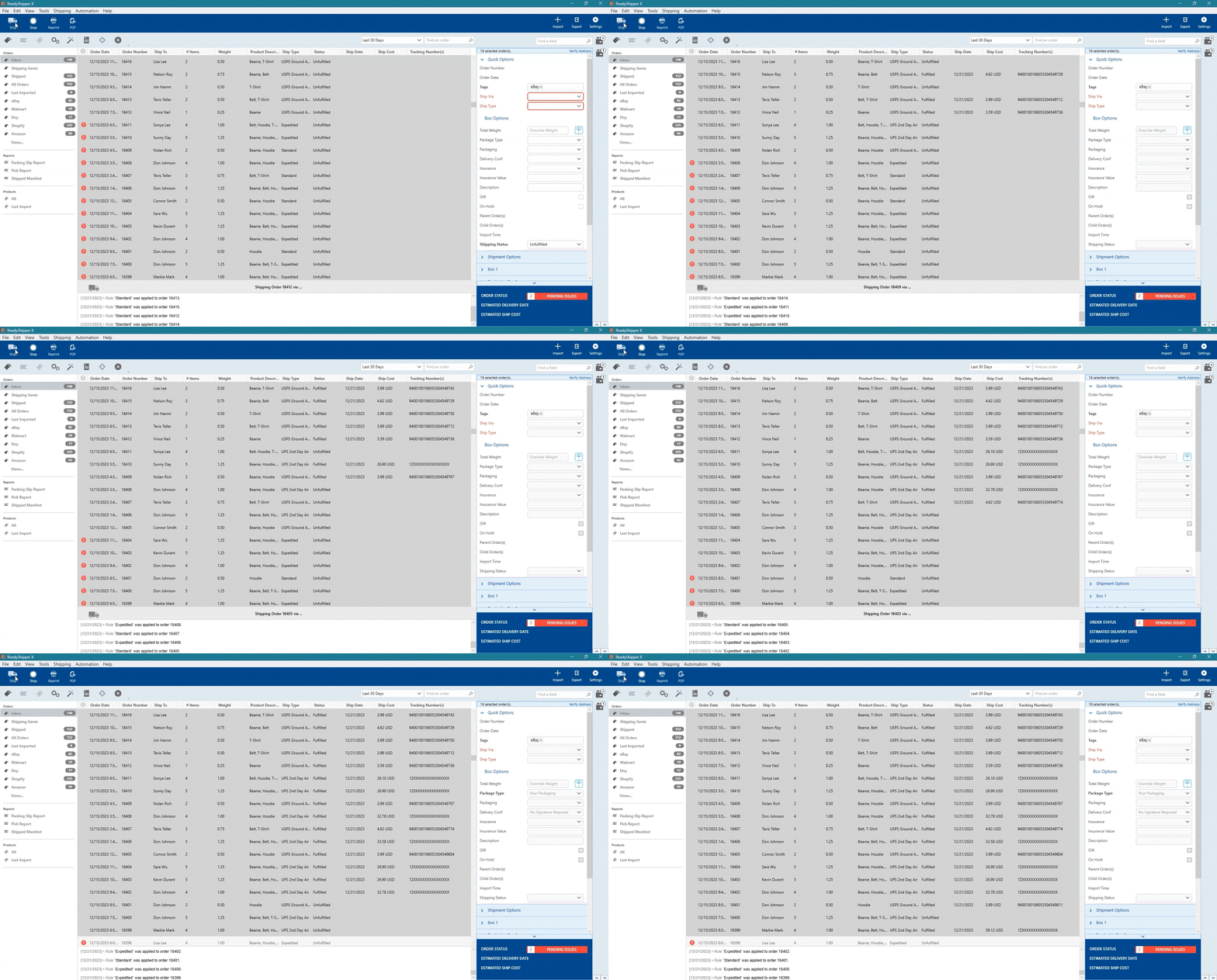
ReadyShipper X helps ecommerce teams ship faster with multi-carrier shipping tools, rule-driven workflows, and high-volume label output. Tracking events can also provide clearer post-purchase updates, reducing WISMO and giving support teams better context.
ReadyReturns helps retailers create easier returns experiences that support exchanges and store credit, with policies and workflows that fit real ecommerce needs.
The Future of Ecommerce is Now
Staying ahead in the ecommerce industry means embracing innovation and anticipating changes before they arrive. The ecommerce trends shaping 2025 provide valuable insights into what’s next, but the future also brings exciting new possibilities. Businesses that adapt quickly and leverage the right tools will thrive in this dynamic landscape.
Ready for 2026? ReadyCloud Has You Covered!
Success in 2026 starts with the right tools, and ReadyCloud’s suite of solutions is designed to propel your ecommerce business to new heights. With ReadyCloud, you’ll have all your data centralized in one place, offering insights that drive smarter decisions. Take your marketing to the next level with Action Alerts, delivering growth-focused, automated campaigns that keep your customers engaged.
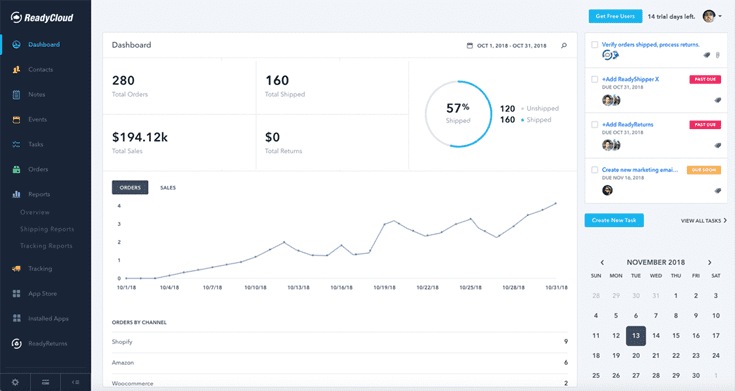

Shipping is easier than ever with ReadyShipper X, a multicarrier solution that simplifies your fulfillment process while saving time and money.

And when it comes to returns, ReadyReturns streamlines the entire process with an automated solution that boosts customer satisfaction and loyalty.
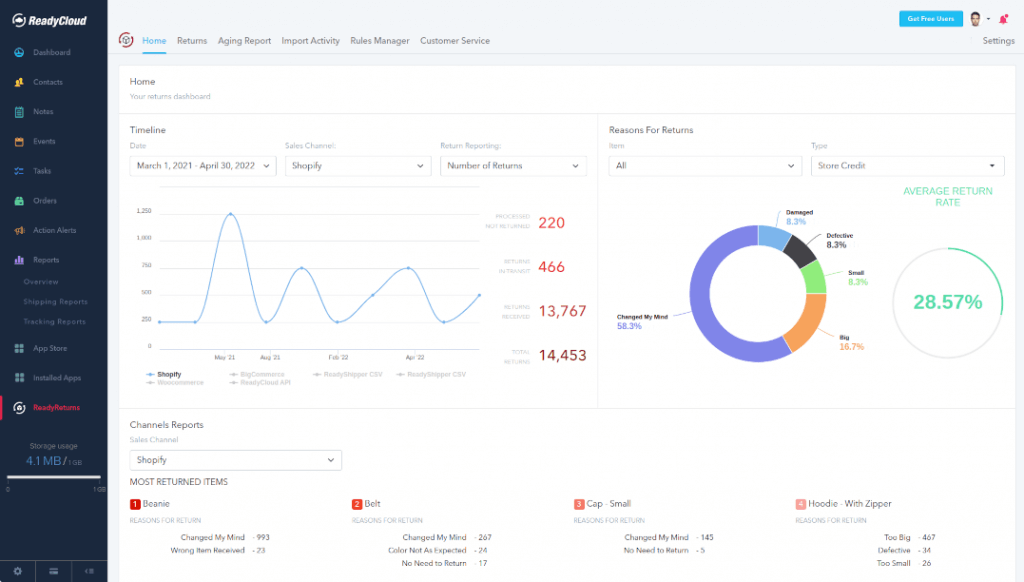

ReadyCloud is more than just a suite of systems—it’s your ticket to thriving in 2026 and beyond!
Start your journey to success today! Learn more and get started here.
Or contact our Sales Department at: 877-818-7447 ext. 1.
Frequently Asked Questions About ERP Shipping Software
What Is ERP Shipping Software?
ERP shipping software is a shipping execution layer that connects to your ERP, prints labels, applies shipping rules, supports multi-carrier fulfillment, and syncs shipment data back to the order record.
How Does ERP Shipping Software Integrate With An ERP System?
Most integrations sync orders from the ERP into the shipping workflow, then sync tracking numbers, carrier services, and shipment status back to the ERP so finance, operations, and support stay aligned.
What Features Should I Look For In ERP Shipping Software?
Look for multi-carrier support, rate shopping, automation rules, batch label printing, address validation, dimensional handling, exception workflows, and fast tracking event sync.
Can ERP Shipping Software Reduce WISMO Tickets?
Yes, better tracking event capture and proactive shipping updates reduce order anxiety and lower WISMO volume, especially during peak season and carrier disruption.
Does ERP Shipping Software Support Multi-Carrier Rate Shopping?
Many platforms support rate shopping and service rules, so teams can automatically choose the right delivery speed and cost instead of checking carrier portals manually.
How Does ERP Shipping Software Improve Shipment Tracking Accuracy?
Tracking accuracy improves when shipment details are generated consistently, tracking numbers sync immediately to the order record, and status events update in near real time for shoppers and support.
Can ERP Shipping Software Help Lower Shipping Costs After Carrier Price Increases?
Yes, shipping rules, rate shopping, packaging standards, and dimensional capture help control cost increases and reduce avoidable surcharges as rates change.
How Long Does It Take To Implement ERP Shipping Software?
Many ecommerce teams can roll out core shipping workflows in 30 to 60 days, depending on ERP complexity, channel count, warehouse processes, and exception handling needs.
What Are The Most Common ERP Shipping Software Implementation Mistakes?
Common mistakes include ignoring exception workflows, skipping packaging standards, failing to validate field mapping, and rolling out without tracking clarity goals tied to support outcomes.