
Your shipping software should make fulfillment faster, easier, and more affordable. But what happens when the system you pay hundreds of dollars for every month doesn’t deliver the value your business needs?
That’s a question more ecommerce businesses should be asking when comparing ShipWorks with ReadyShipper X.
Both platforms offer desktop shipping software, multi-carrier support, automation, and features designed for demanding fulfillment operations. But there’s a significant difference between managing shipments and building a complete ecommerce shipping, returns, and customer management operation.
That’s where ReadyShipper X comes in, one of the best modern ShipWorks alternatives.
Today, we’re breaking down the differences between ShipWorks and ReadyShipper X, including pricing, integrations, ODBC connectivity, warehouse workflows, shipping automation, and overall value. If you’re evaluating your current shipping software, here’s what you need to know before making your next investment.
“The post-purchase experience deserves a seat at the executive table because it affects both brand equity and margin. A better return process can reduce service volume while increasing customer confidence. Clearer shipping communication can lower inbound tickets while improving trust. Faster resolution can protect repeat purchases. Cleaner workflows can reduce stress on teams and make the business easier to scale.” Read Article on Forbes

The Evolution of High-Volume Ecommerce Shipping
Ecommerce fulfillment has changed dramatically over the past decade.
Retailers no longer just print shipping labels. They’re managing multiple storefronts, warehouses, shipping carriers, customer accounts, inventory systems, and increasingly complex order fulfillment processes.
That means shipping software must do more than process packages.
Businesses need technology that can:
- Automate repetitive shipping tasks and reduce manual data entry.
- Connect with ecommerce platforms, marketplaces, and ERP systems.
- Compare carrier rates to reduce fulfillment expenses.
- Process large batches of orders efficiently.
- Support database connections and custom business workflows.
- Improve visibility into customer orders, shipments, and returns.
- Scale without introducing unnecessary operational expenses.
ShipWorks and ReadyShipper X both address several of these requirements.
However, the real question isn’t whether your shipping software can handle your orders. It’s whether you’re getting enough functionality, flexibility, and value for what you’re paying.

ShipWorks vs. ReadyShipper X: Two Different Approaches to Shipping
ShipWorks is an established desktop shipping platform designed for ecommerce sellers, warehouses, and fulfillment operations.
Its capabilities include order management, warehouse routing, shipping automation, carrier integrations, and high-volume shipping support.
ReadyShipper X takes a different approach.
Our hybrid-cloud shipping platform combines desktop processing with cloud connectivity, multi-carrier shipping, advanced automation, and the broader ReadyCloud ecosystem.
Instead of viewing shipping as an isolated process, ReadyShipper X can work alongside ReadyReturns and Action Alerts, connecting fulfillment operations with customer information and post-purchase experiences.
Businesses evaluating both solutions should consider the complete operational picture, not simply the number of labels each platform can print.
Both platforms offer serious shipping functionality. The differences become more important when considering ongoing expenses, integrations, and whether shipping is connected to the rest of your ecommerce business.
“In my experience, the most effective enterprise organizations are the ones that make it easy for people to understand what needs to happen next. This is because simplicity isn’t about removing capability. On the contrary, it’s about removing unnecessary friction.” Read Article on Forbes

ShipWorks Pricing: Are You Paying More Than You Need To?
Shipping software is an operational expense that directly influences profitability.
When you’re processing thousands of orders every month, unnecessary software costs can add up quickly.
ShipWorks offers multiple subscription tiers for ecommerce businesses and warehouses, with pricing varying by shipment volume and operational needs.
ShipWorks publishes tiered ecommerce and warehouse subscriptions. Its official pricing pages currently display differing prices for some plans, with Warehouse Elite listed at $799 per month. Confirm the applicable rate, shipment allowances, user seats, and included features when requesting a quote.
ReadyShipper X offers a different pricing proposition.
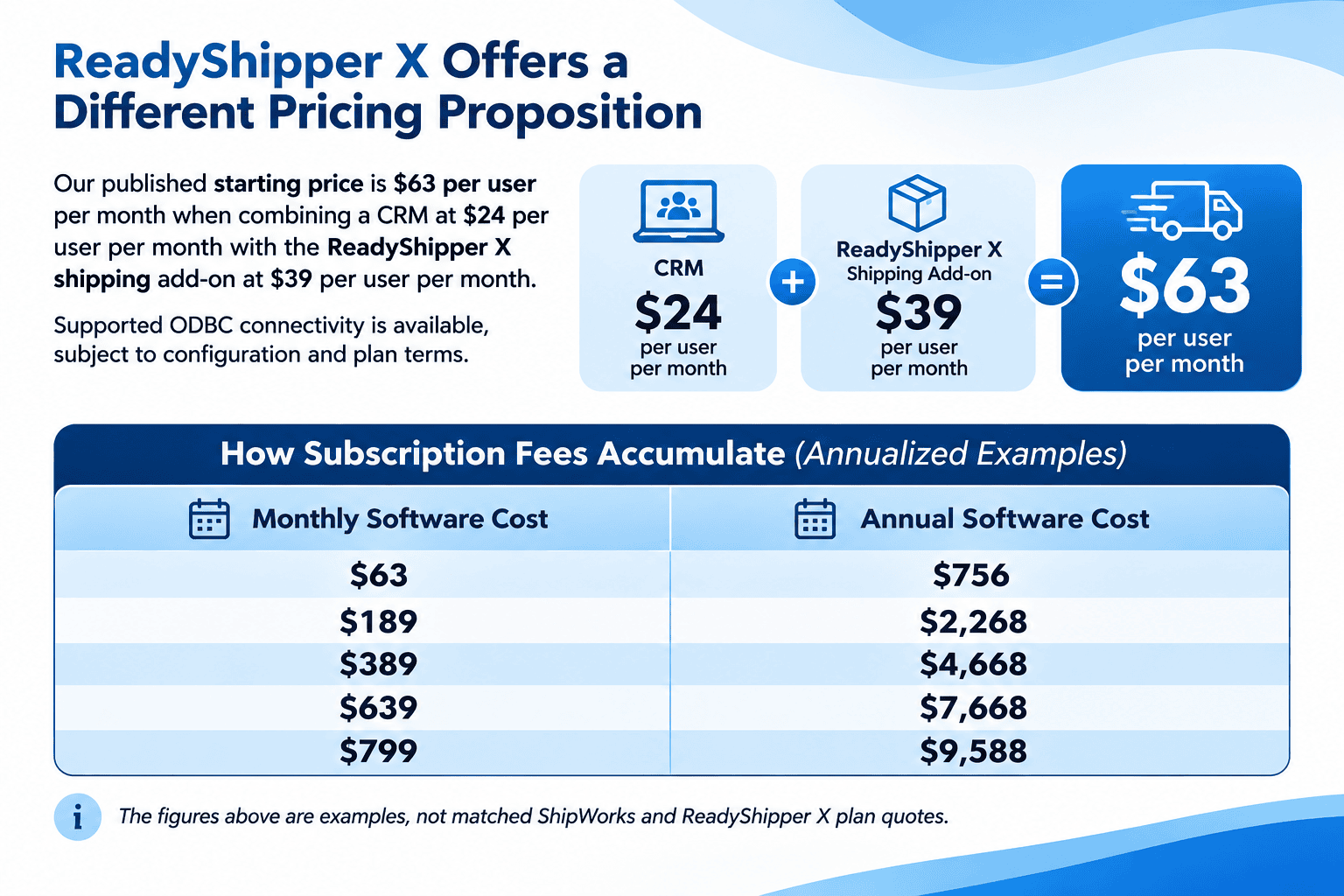
Our published starting price is $63 per user per month when combining ReadyCloud CRM at $24 per user per month with the ReadyShipper X shipping add-on at $39 per user per month. Supported ODBC connectivity is available, subject to configuration and plan terms.
These figures are illustrative subscription expenses, not equivalent plan-to-plan quotes or guaranteed savings. In particular, ReadyCloud’s $63 starting price is per user and combines CRM and shipping. ShipWorks displays different prices across its official pricing pages. Compare current quotes, users, shipment allowances, support, integrations, and warehouse requirements before calculating total cost.
The point is simple.
Businesses shouldn’t assume that spending more on shipping software automatically means getting more value.
Before committing to a higher-priced platform, determine which features you actually need, which are included in your subscription, and which require additional configuration or expense.
ReadyShipper X gives growing businesses a chance to explore powerful shipping functionality without assuming a premium warehouse subscription is their only option.
“The post-purchase experience shapes your brand just as much as what draws a customer to it before they buy. Branding or advertising begin to shape customer confidence, but the experience that follows checkout influences loyalty more.” Read Article on Fast Company

ODBC Connectivity: A Major Difference Worth Understanding
One of the most important considerations in the ShipWorks vs. ReadyShipper X comparison is ODBC connectivity.
ODBC stands for Open Database Connectivity. It allows shipping software to communicate with supported database systems, including SQL-based platforms and custom business applications.
For ecommerce businesses with established ERP systems, inventory databases, or proprietary ordering tools, ODBC can be essential.
Instead of manually exporting orders to spreadsheets and importing them into shipping software, database connectivity can automate much of the process.
ShipWorks also offers ODBC-based workflows for importing orders and updating shipment information, along with extensive configuration options for complex shipping environments. Both products support ODBC, so it isn’t exclusive to ReadyShipper X.
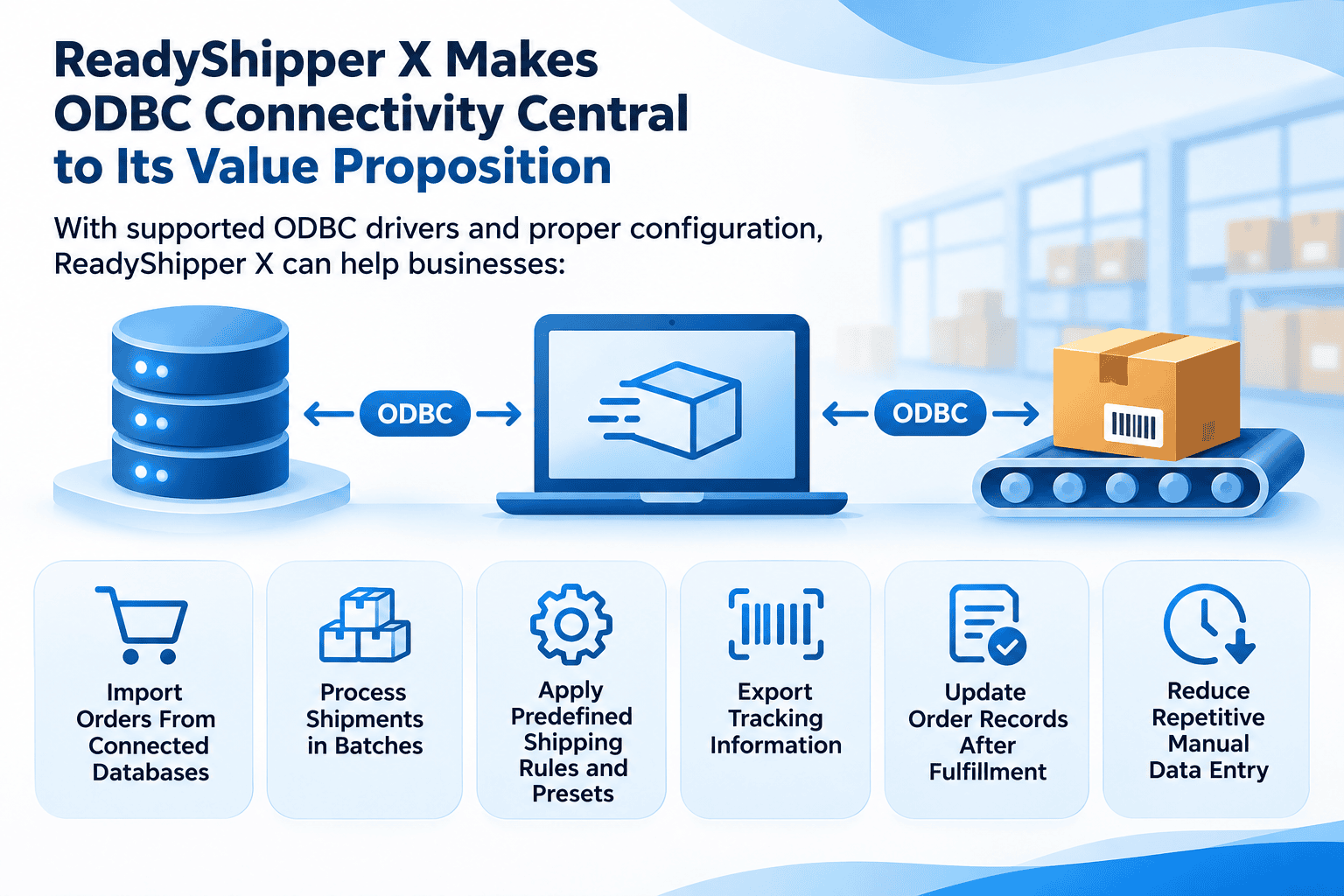
However, ReadyShipper X makes ODBC connectivity central to its value proposition.
With supported ODBC drivers and proper configuration, ReadyShipper X can help businesses:
- Import orders from connected databases.
- Process shipments in batches.
- Apply predefined shipping rules and presets.
- Export tracking information.
- Update order records after fulfillment.
- Reduce repetitive manual data entry.
For businesses using SQL Server, MySQL, or other compatible database systems, these features can help modernize shipping without rebuilding their underlying business applications.
Because ReadyShipper X advertises ODBC connectivity with its entry-level shipping offering, businesses can evaluate database-driven shipping alongside the combined CRM and shipping subscription. Before comparing costs, confirm database compatibility, driver requirements, implementation effort, and the number of licensed users.
“System failure often shows up in other ways. For example, a customer service employee may not be able to answer a basic question without opening four systems and four tabs. The warehouse team may be unable to reach the right person. Or a shipment delay can create five internal messages to five different people, each with multiple support tickets attached.” Read Article on Fast Company
Shipping Automation: Which Platform Helps You Work Smarter?
Every unnecessary click in a warehouse costs time.
Multiply that across hundreds or thousands of daily orders, and inefficient processes can become a serious operational problem.
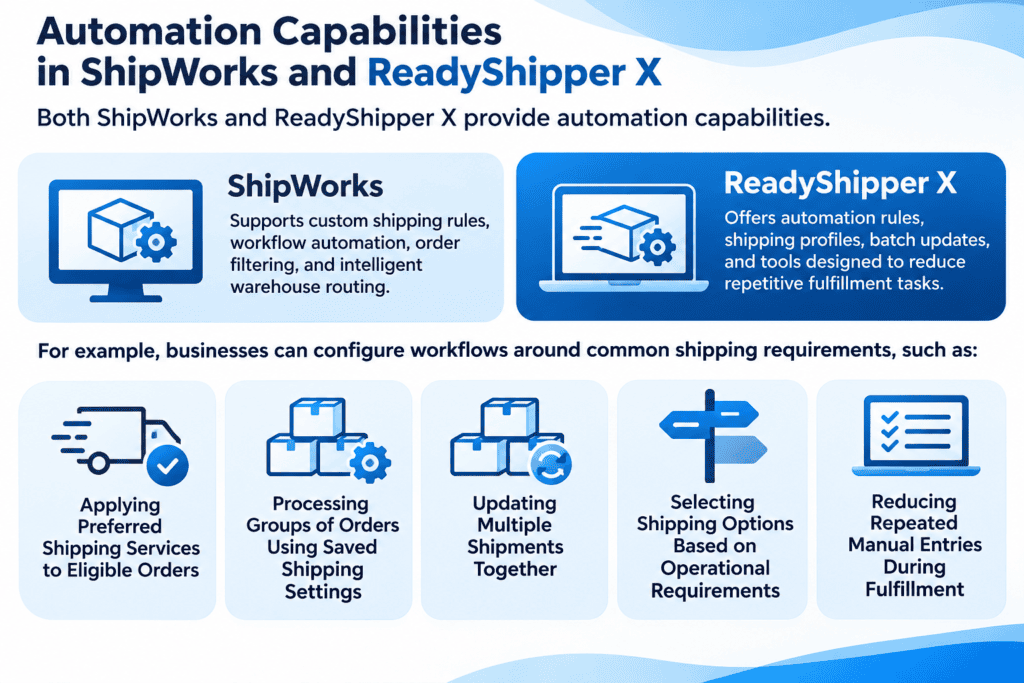
Both ShipWorks and ReadyShipper X provide automation capabilities.
ShipWorks supports custom shipping rules, workflow automation, order filtering, and intelligent warehouse routing.
ReadyShipper X offers automation rules, shipping profiles, batch updates, and tools designed to reduce repetitive fulfillment tasks.
For example, businesses can configure workflows around common shipping requirements, such as:
- Applying preferred shipping services to eligible orders.
- Processing groups of orders using saved shipping settings.
- Updating multiple shipments together.
- Selecting shipping options based on operational requirements.
- Reducing repeated manual entries during fulfillment.
The real difference is how effectively the software fits your existing process.
A shipping platform shouldn’t require your warehouse team to redesign every procedure simply to take advantage of automation.
ReadyShipper X emphasizes configurable workflows that allow businesses to streamline fulfillment while maintaining control over their shipping operations.
Hybrid-Cloud Shipping: Why Operational Continuity Matters
Warehouse productivity depends on reliable software.
When systems slow down, orders accumulate. When shipping processes stop, fulfillment deadlines become harder to meet.
Both ShipWorks and ReadyShipper X use desktop software, which distinguishes them from purely browser-based shipping applications.
ReadyShipper X adds a hybrid-cloud architecture that combines desktop processing with cloud-connected order information and supporting services.
ReadyShipper X advertises hybrid-cloud and offline workflow capabilities, but the precise operations available without connectivity depend on configuration. ShipWorks also uses locally installed desktop software, so test offline resilience rather than assume it favors either platform.
That doesn’t mean every shipping function operates independently of the internet. Carrier authentication, live shipping rates, label purchases, and synchronization can still require connectivity.
The practical question is which tasks each platform can complete during a network interruption and how pending data synchronizes when connectivity returns.
For high-volume businesses, that distinction matters, along with overall software stability, workstation requirements, and network infrastructure.
Ecommerce Integrations: Connecting More Than Your Storefront
Modern ecommerce businesses rarely sell through just one channel.
A growing retailer may manage orders from Shopify, WooCommerce, BigCommerce, Amazon, Walmart, and additional marketplaces while maintaining inventory and financial records through a separate ERP platform.
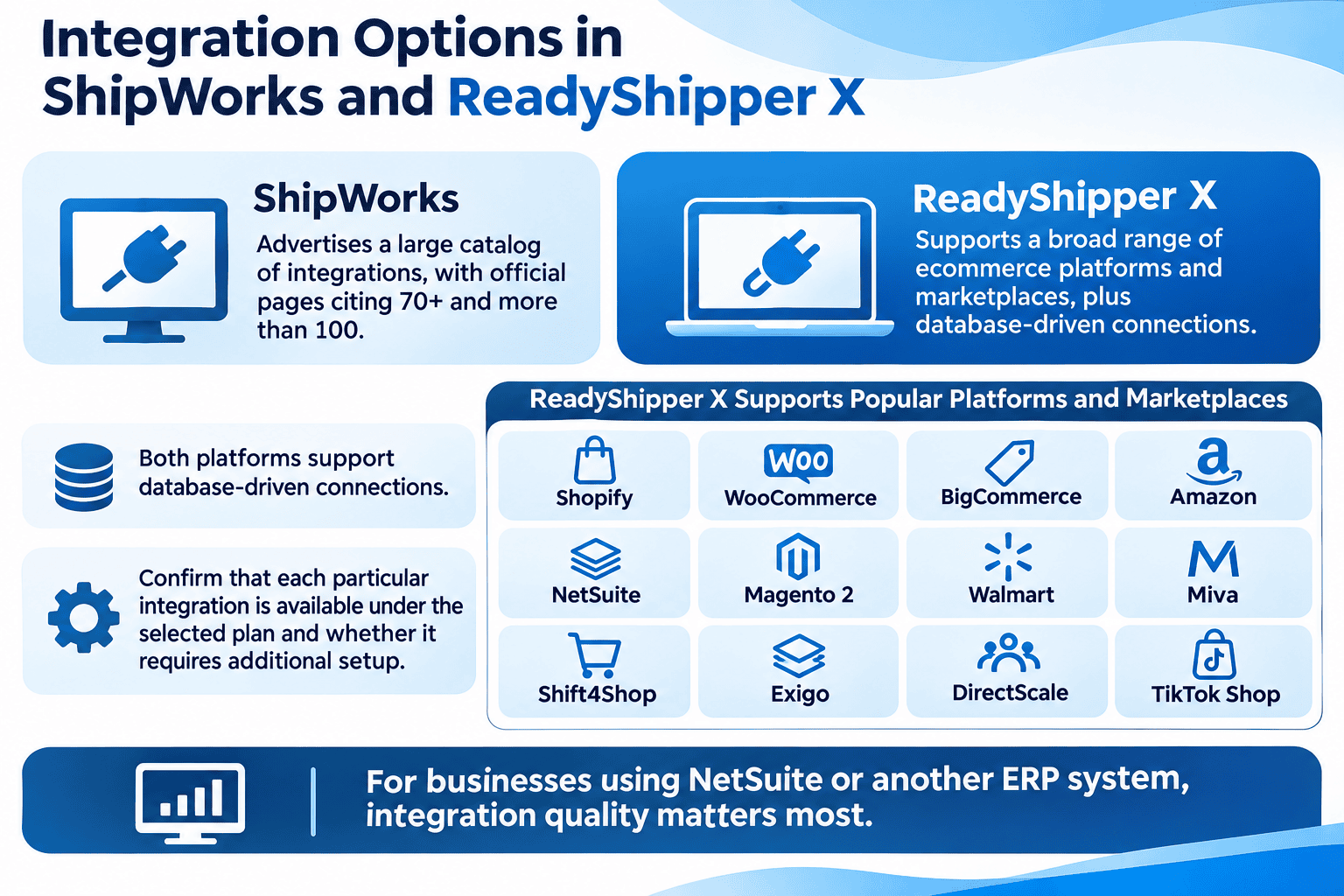
ShipWorks advertises a large catalog of integrations, although official pages give different totals, including 70+ and more than 100. Both platforms also support database-driven connections. Confirm that each particular integration is available under the selected plan and whether it requires additional setup.
ReadyShipper X also supports a broad range of ecommerce platforms and marketplaces, including:
- Shopify
- WooCommerce
- BigCommerce
- Amazon
- NetSuite
- Magento 2
- Walmart
- Miva
- Shift4Shop
- Exigo
- DirectScale
- TikTok Shop
For businesses using NetSuite or another ERP system, integration quality matters most.
The objective isn’t simply importing orders. It’s maintaining a dependable flow of shipping information across sales channels, warehouse operations, and business systems.
ReadyShipper X offers supported platform integrations and database connectivity, but implementation complexity depends on each store, ERP system, connector, and workflow. Confirm the exact integration method and any associated fees before choosing a platform.
When combined with ReadyCloud CRM, that information becomes even more valuable after the package leaves the warehouse.
How ReadyCloud Connects Shipping, CRM, and Returns
Printing a label is only one part of the ecommerce customer journey.
Customers also expect tracking information, timely support, efficient returns, and consistent communication after making a purchase.
This is where the larger ReadyCloud ecosystem becomes an important differentiator.
ReadyShipper X operates within our ReadyCloud ecosystem, which also offers CRM functionality and the separately subscribed ReadyReturns solution. This connected offering matters in the comparison, though businesses should evaluate the combined subscription cost.
That means businesses can build a more connected approach to the entire post-purchase experience.
ReadyCloud CRM Connects Shipping With Customer Information
When a customer contacts your business about an order, your support team shouldn’t have to search through multiple disconnected applications to understand what happened.
ReadyCloud CRM helps centralize customer, order, and shipping information.
This provides opportunities to improve:
- Order history visibility.
- Customer service workflows.
- Shipment tracking access.
- Internal collaboration.
- Post-purchase communication.
- Customer retention initiatives.
Instead of treating shipping as a separate warehouse function, ecommerce teams can connect fulfillment information with broader customer relationship management.
ReadyReturns Simplifies Ecommerce Returns
Returns are another major consideration.
A business may have excellent outbound shipping processes but still lose time and money handling returns manually.
ReadyReturns helps retailers create a more organized returns experience through self-service options, configurable return rules, and automated workflows.
These capabilities can help businesses manage:
- Customer return requests.
- Return shipping labels.
- Return eligibility rules.
- Approval requirements.
- Return shipment tracking.
- Post-purchase customer experiences.
ReadyReturns is a separate, paid part of the ReadyCloud ecosystem; its functionality is not included automatically in the $63 per-user monthly CRM-and-shipping starting price. Confirm the current ReadyReturns subscription and configuration requirements.
But its availability lets businesses connect shipping and returns instead of managing them through disconnected processes.
For retailers focused on retention and repeat purchases, this broader integration can be more valuable than comparing label-printing features alone.
“Customers don’t separate departments. They don’t care whether a delay came from the carrier, the warehouse, the support team or the return platform. They only know whether the brand made the experience easy or painful.” Read Article on Forbes
Multi-Warehouse Shipping: Is ShipWorks or ReadyShipper X Better?
ShipWorks has well-developed multi-warehouse capabilities.
Its Intelligent Order Routing supports workflows involving warehouse location, inventory availability, product SKUs, and split orders.
That makes ShipWorks a legitimate option for businesses operating sophisticated fulfillment networks.
ReadyShipper X supports multiple ship-from settings, shipping profiles, batch workflows, and order-splitting scenarios. However, those documented features don’t match every inventory-based Intelligent Order Routing capability ShipWorks offers.
The key is identifying what your business actually requires.
For example, a retailer operating two fulfillment centers may have very different needs from a 3PL managing dozens of clients across multiple warehouses.
Before selecting either platform, consider:
- How orders are assigned to fulfillment locations.
- Whether shipment splitting is necessary.
- How inventory data reaches the shipping system.
- How shipping accounts are managed.
- Whether custom routing rules are required.
- How easily warehouse employees can manage daily tasks.
If your operation depends on highly specialized inventory-based routing, evaluate each platform’s capabilities during a demonstration.
ReadyShipper X deserves consideration for businesses that want efficient multi-location shipping, direct ecommerce integrations, and access to the broader ReadyCloud platform.
The Hidden Cost of Shipping Software Isn’t Always the Subscription
Monthly pricing matters, but it’s only part of the equation.
The true cost of shipping software includes employee time, system maintenance, integration work, training, errors, and the operational consequences of inefficient fulfillment.
Consider a warehouse processing 1,000 orders daily.
If an inefficient shipping process adds just 15 seconds of unnecessary work per order, that’s more than four additional labor hours per day.
Over a 22-day operating month, that’s about 92 hours of lost productivity.
At an illustrative labor cost of $20 per hour, that’s roughly $1,833 in monthly labor expense.
This is a hypothetical efficiency scenario, not a measured performance difference between ShipWorks and ReadyShipper X.
But it demonstrates why businesses should test actual shipping workflows instead of making decisions based solely on feature lists.
Batch processing, automation, fewer manual entries, and reliable integrations can all affect total fulfillment cost.
ReadyShipper X is built around helping businesses find those efficiencies.
Who Should Choose ShipWorks?
ShipWorks may be a strong fit for businesses that:
- Already have established ShipWorks workflows.
- Depend on its specific Intelligent Order Routing capabilities.
- Need advanced customization for warehouse operations.
- Rely on integrations and infrastructure already configured for ShipWorks.
- Have evaluated the subscription costs and determined that the features justify the investment.
There are legitimate reasons to stay with a shipping platform that is meeting your needs.
But there are equally good reasons to reconsider an expensive system when another solution can provide the functions your business actually uses.
Who Should Choose ReadyShipper X?
ReadyShipper X is worth evaluating if your business:
- Wants to evaluate potential subscription savings based on its actual shipment volume, users, and required functionality.
- Needs ODBC connectivity for database-driven shipping.
- Uses Shopify, WooCommerce, BigCommerce, Amazon, or NetSuite.
- Wants powerful desktop shipping and batch-processing tools.
- Needs configurable shipping automation.
- Prefers a hybrid-cloud shipping architecture.
- Wants to connect shipping with CRM and returns management.
- Is looking for a scalable system that supports long-term ecommerce growth.
Our goal isn’t to complicate shipping.
It’s to give businesses the capabilities they need to ship orders efficiently while managing the broader customer experience.
How to Switch From ShipWorks to ReadyShipper X
Switching shipping software shouldn’t disrupt your entire fulfillment operation.
Before switching, clearly understand your existing systems and daily shipping requirements.
Here are five steps to consider:
- Audit your current setup. Document shipping carriers, warehouse locations, automation rules, integrations, printers, and daily shipment volumes.
- Identify essential features. Determine which ShipWorks functions are critical and which workflows you can simplify.
- Review your integrations. Confirm that ReadyShipper X supports your required ecommerce platforms, marketplaces, and database connections.
- Test real shipping scenarios. Evaluate batch processing, label printing, carrier selection, and data synchronization with representative orders.
- Plan a controlled transition. Configure users, shipping accounts, and operational workflows before moving your full shipment volume.
A demonstration with our team can help you determine whether ReadyShipper X supports your existing requirements and where you can simplify your shipping processes.
The Bottom Line: Is ShipWorks Worth the Cost?
ShipWorks is capable shipping software.
But capability alone doesn’t determine whether it’s the best investment for your business.
When comparing ShipWorks vs. ReadyShipper X, look beyond label printing and warehouse automation.
Consider the complete picture: subscription costs, integrations, database connectivity, workflow efficiency, returns management, customer visibility, and long-term scalability.
ReadyShipper X brings these priorities together through a powerful hybrid-cloud shipping platform and the ReadyCloud ecosystem.
If you’re paying for a premium shipping solution but questioning the return on your investment, it may be time to explore what ReadyShipper X can offer.
Ready to See What ReadyShipper X Can Do?
Here are three ways we can help you build a more efficient ecommerce shipping operation.
- Schedule a ReadyShipper X Demo
See how ReadyShipper X handles multi-carrier shipping, automation, batch processing, and ecommerce integrations. We’ll help you evaluate how the platform fits your current fulfillment workflows.
- Start Your Free Trial of ReadyShipper X
Try our desktop shipping software and explore tools that streamline order processing, compare shipping services, and reduce repetitive tasks.
- Explore the Complete ReadyCloud Ecosystem
Shipping is only the beginning. Discover how ReadyShipper X, ReadyReturns, and ReadyCloud CRM can work together to support more efficient fulfillment and better post-purchase experiences.
Explore ReadyCloud and Get Started Today
Your shipping software should support your growth, not consume more of your operating budget than necessary.
FAQs About ShipWorks vs. ReadyShipper X
What is the main difference between ShipWorks and ReadyShipper X?
Both are desktop shipping platforms designed for ecommerce fulfillment. ShipWorks emphasizes warehouse routing and customizable shipping workflows, while ReadyShipper X combines multi-carrier shipping, automation, ODBC connectivity, and integration with the broader ReadyCloud CRM and returns ecosystem.
Is ReadyShipper X cheaper than ShipWorks?
ReadyCloud advertises a combined starting price of $63 per user per month: $24 for ReadyCloud CRM and $39 for the ReadyShipper X shipping add-on. ShipWorks offers ecommerce and warehouse tiers, but its official pricing pages currently show different amounts for certain plans. Compare current quotes with the same user count, shipment volume, and required features before concluding which costs less.
Does ShipWorks support ODBC connections?
Yes. ShipWorks supports ODBC-based order and shipment workflows. ReadyShipper X also offers ODBC order import and export functionality, with connectivity advertised at its entry-level combined CRM-and-shipping pricing. Verify the database, driver, and configuration requirements for either platform.
Can ReadyShipper X handle high-volume ecommerce shipping?
Yes. ReadyShipper X is designed for businesses that need batch shipping, automation, multiple carriers, and efficient desktop fulfillment workflows.
Does ShipWorks support multiple warehouses?
Yes. ShipWorks provides Intelligent Order Routing and other features for multi-warehouse fulfillment. Businesses should compare their particular routing requirements against ReadyShipper X before selecting a platform.
Does ReadyShipper X work with NetSuite?
Yes. ReadyShipper X supports NetSuite integration, allowing businesses to connect shipping workflows with their ERP operations.
Can ReadyShipper X process orders offline?
ReadyShipper X advertises offline workflow capabilities, but the available functions vary by setup. ShipWorks is also desktop-based. Live carrier rates, authentication, label transactions, and synchronization may require connectivity, so test your specific workflow with each vendor.
Does ReadyShipper X include returns management?
ReadyShipper X is part of the ReadyCloud ecosystem, which also offers ReadyReturns for dedicated returns management. ReadyReturns requires a separate subscription and configuration; it is not automatically included in the $63 per-user CRM-and-shipping starting price.
Is it difficult to migrate from ShipWorks?
Migration complexity depends on your current integrations, custom workflows, warehouse configuration, and data requirements. Our team can help you evaluate compatibility and plan a transition.
Which shipping software is better for a growing ecommerce business?
The answer depends on your fulfillment requirements. ShipWorks offers extensive warehouse functionality, while ReadyShipper X provides a strong combination of desktop shipping, database integration, automation, and broader ecommerce customer management.