Ecommerce can look healthy on paper while the profit line stays flat. A store can be “growing” and still bleeding margin through refunds, support tickets, abandoned carts, and one-time buyers who never come back. That’s the part most teams feel but don’t always measure cleanly, especially once you add marketplaces and social commerce into the mix.
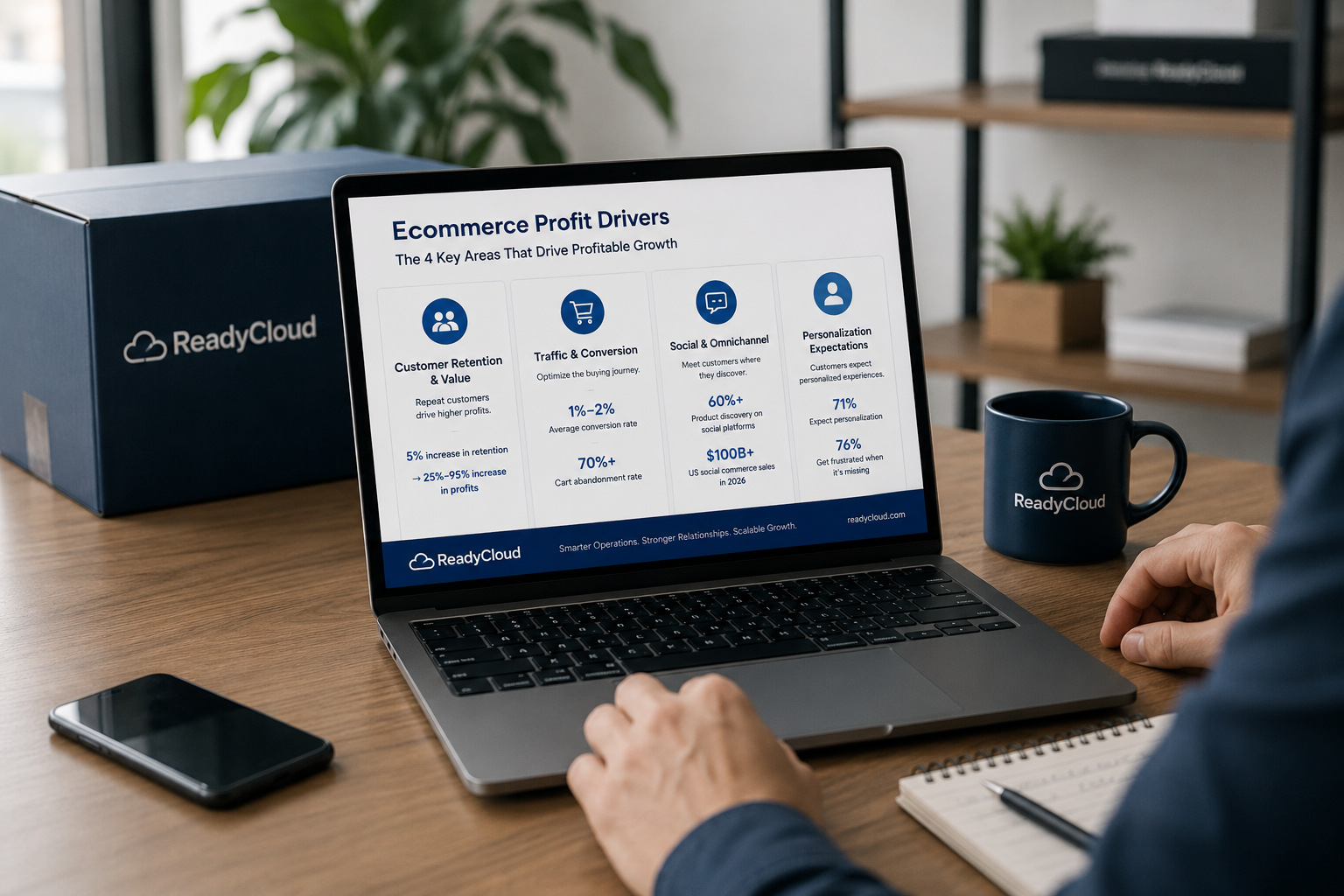
We think about ecommerce profit as four connected drivers: retention and customer value, conversion experience, social and omnichannel discovery, and personalization. You can improve any one of these in isolation, but the biggest gains come when the store experience and the operations behind it work together. Customers don’t separate marketing from fulfillment. They only remember whether buying felt easy and whether the brand handled the post-purchase phase like pros.
“Growing e-commerce brands have set a new standard. They’re demonstrating that, with the right strategy in place, the post-purchase experience can be elevated. And customers are noticing it. For the larger retailers in the pond, this represents a monumental shift that swings from traditional customer acquisition to long-term retention.” Read Article on Forbes


Profit Driver 1: Customer Retention And Customer Value
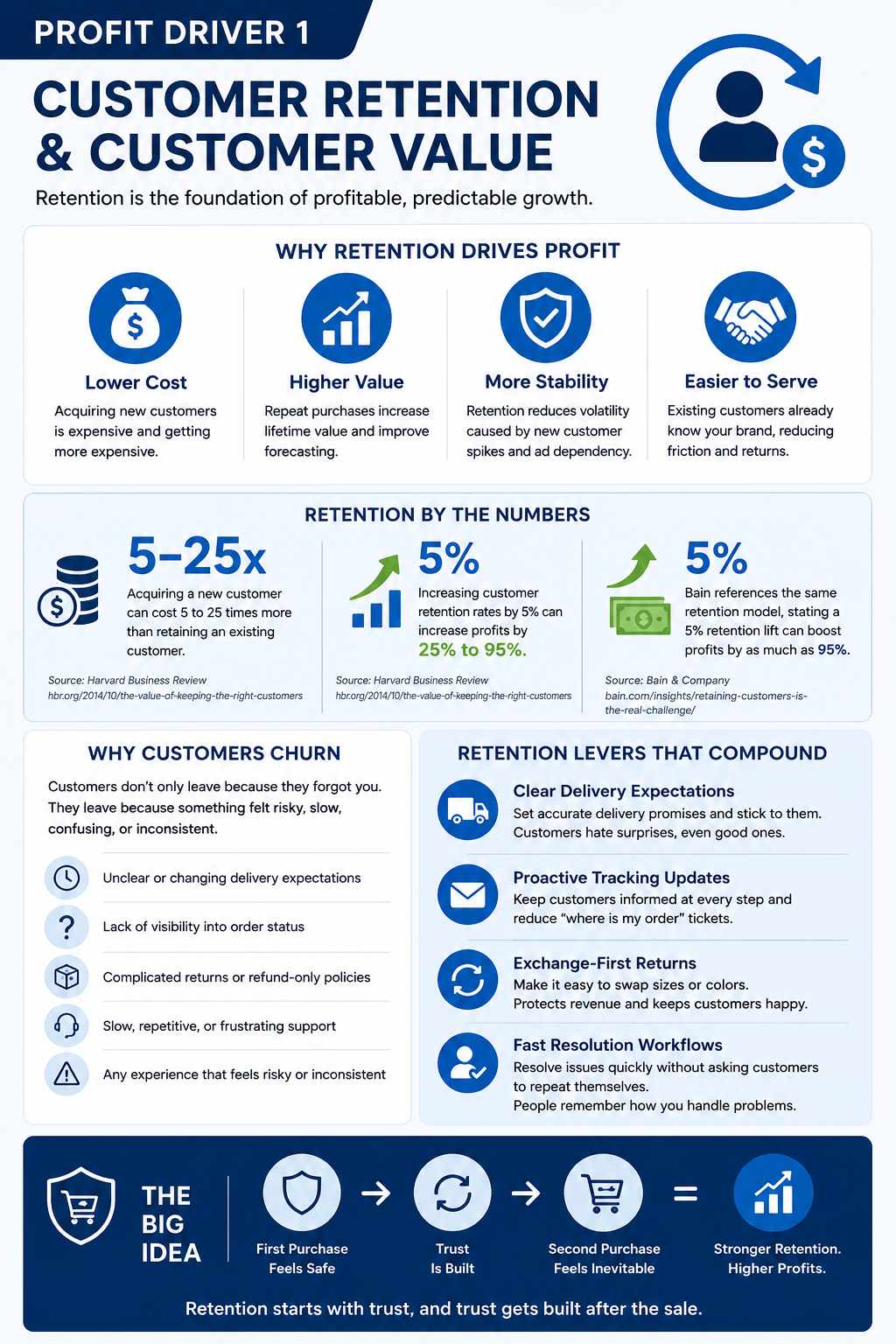
If you want a steady path to profitability, retention is the foundation. New customer acquisition is expensive, competitive, and often gets pricier every quarter. Repeat purchase is where your CAC pressure softens, your forecasting gets easier, and your best customers fund the next phase of growth.
Retention also fixes a hidden problem: volatility. Stores built entirely on new customer spikes tend to swing wildly month to month, especially if paid ads are doing the heavy lifting. In addition, repeat buyers are usually easier to serve. They already know your sizing, your shipping cadence, your packaging style, and what your brand stands for. That familiarity reduces friction and lowers the odds of refunds and chargebacks.
The catch is that retention rarely improves from email alone. If the post-purchase experience is chaotic, retention campaigns end up acting like a bandage. Customers come back when they trust the brand’s delivery promise, communication, and how issues are handled. That’s operations, not hype.
Verifiable Statistics (Customer Retention And Value)
- Acquiring a new customer can cost 5 to 25 times as much as retaining an existing customer. (HBR)
- Increasing customer retention rates by 5% can increase profits by 25% to 95%. (HBR)
- Bain references the same retention model, stating that a 5% retention lift can boost profits by up to 95%. (BAIN)
Retention usually improves when you tighten the parts of the customer journey that create anxiety. People don’t only churn because they forgot you. They churn because something felt risky, slow, confusing, or inconsistent. If a buyer had to email support twice to get tracking, they’re not excited to reorder, even if the product itself was solid.
Here are retention levers that are more operational than “marketing,” and they tend to create compounding benefits.
- Clear delivery expectations that don’t change after checkout. Customers hate surprises, even good ones.
- Proactive tracking updates that reduce “where is my order” tickets. This protects your support team and keeps the customer calm.
- An exchange first returns flow that makes it easy to swap sizes or colors. This protects revenue while still treating the customer fairly.
- Fast resolution workflows that don’t require customers to repeat themselves. People remember how you handle the issue more than the issue itself.
The big idea is simple: if the first purchase feels safe, the second purchase feels inevitable. Retention starts with trust, and trust gets built after the sale.
“Many retailers are simply not equipped to manage what’s coming. But some are. These are the brands already investing in technology, training and process optimization to turn what used to be a logistical nightmare into a competitive edge.” – Read Article on Forbes
Profit Driver 2: Traffic And Conversion (The Website Experience)
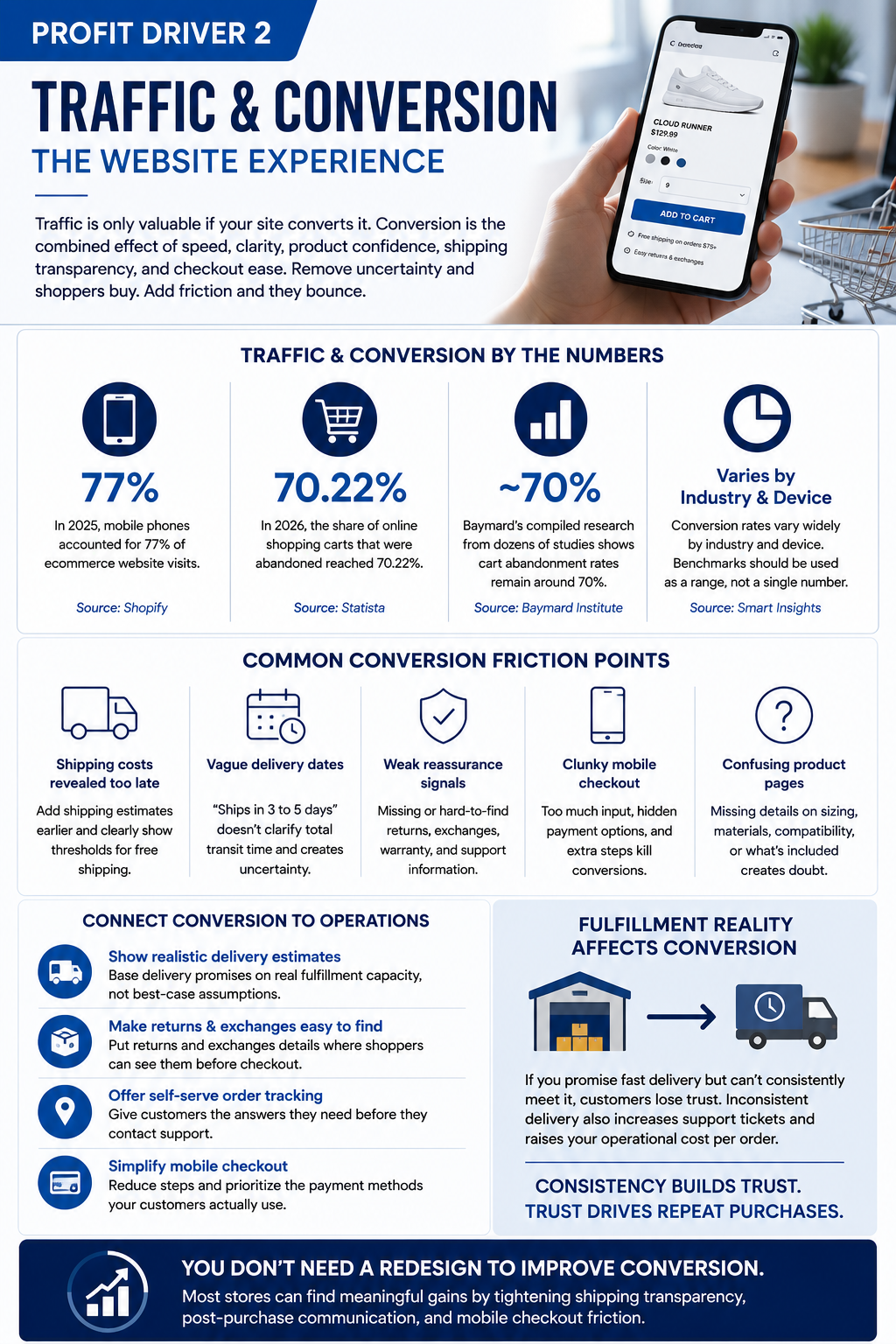
Traffic is only valuable if your site converts it, and conversion isn’t only “pretty design.” Conversion is the combined effect of speed, clarity, product confidence, shipping transparency, and checkout ease. If any one of those feels uncertain, shoppers pause, compare, and bounce.
A lot of stores chase more traffic because it feels like progress. Yet most ecommerce brands can increase revenue faster by improving their conversion experience than by buying more clicks. The math is brutal. A small conversion lift, applied across your existing sessions, can outperform a new paid campaign without increasing CAC.
Cart abandonment is the clearest signal of friction. People don’t abandon because they hate your product. They abandon because the moment they get serious, something spooks them: shipping costs, delivery-time uncertainty, forced account creation, payment friction, or a mobile checkout that feels like work.
Mobile deserves its own callout. Mobile drives the majority of ecommerce visits, but mobile shoppers are less patient and less forgiving. They’re often browsing between meetings, while watching TV, or while standing in line. If your checkout flow is clunky or your delivery promise is vague, mobile shoppers don’t “save it for later.” They vanish.
Verifiable Statistics (Traffic And Conversion)
- In 2025, mobile phones accounted for 77% of ecommerce website visits. (Shopify)
- In 2026, the share of online shopping carts that were abandoned reached 70.22%. (Statisa)
- Baymard maintains a compiled list of cart abandonment rate statistics from dozens of studies, supporting the long-standing pattern that abandonment rates remain around 70%. (Baymard)
- Smart Insights publishes ecommerce conversion rate benchmarks and notes that conversion rates vary widely by industry and device, reinforcing that benchmarks should be used as a range, not a single number. (Smart Insights)
If you want a conversion improvement plan that doesn’t rely on guesswork, focus on the steps where doubt shows up. These are the friction points we see most often.
- Shipping costs are revealed too late in checkout. Add shipping estimates earlier and clearly show thresholds for free shipping.
- Delivery dates are presented vaguely, such as “ships in 3 to 5 days,” without clarifying the total transit time.
- Weak reassurance signals around returns, exchanges, warranty, and support access.
- Mobile checkout that asks for too much input or hides payment options below the fold.
- Confusing product pages that don’t answer sizing, materials, compatibility, or “what’s included” questions.
A clean conversion experience also depends on fulfillment reality. If you offer fast delivery but your warehouse can’t consistently meet it, customers learn quickly. The store loses credibility. In addition, inconsistent delivery performance inflates support ticket volume, which increases operational cost per order.
Here’s a practical way to connect conversion to ops without turning your site into a corporate manual.
- Show realistic delivery estimates based on actual fulfillment capacity, not best-case assumptions.
- Put returns and exchanges details where shoppers can see them before checkout. You want confidence, not surprise.
- Offer self-serve order tracking that answers the obvious questions before a customer opens a ticket.
- Reduce the number of checkout steps on mobile and prioritize the payment methods your customers actually use.
You don’t need a full redesign to improve conversion. Most stores can find meaningful gains by tightening shipping transparency, post-purchase communication, and mobile checkout friction.
“Cloud-based solutions are tethered to the uptime of the service provider, whereas hybrid-cloud solutions mean you can keep shipping packages even if your SaaS provider is experiencing a disruption of service.” – Read Article on Forbes
Profit Driver 3: Social And Omnichannel Discovery
Discovery has changed. Google still plays a role, but it’s no longer the only front door for product research. Shoppers look at TikTok demos, YouTube reviews, Instagram creator posts, and social comments, then they decide whether the product feels legit.
That shift creates a new kind of growth opportunity and a new kind of operational risk. Social commerce can spike orders fast, but it also compresses the trust timeline. A buyer can go from “never heard of you” to “placed an order” in minutes. If the post-purchase experience is slow, unclear, or messy, that same buyer can go from “excited” to “chargeback” just as fast.
Omnichannel also increases complexity behind the scenes. Each channel adds another inventory sync, another order flow, another return path, and another customer expectation. That’s manageable with the right systems. Without them, it becomes chaos disguised as growth.
Verifiable Statistics (Social And Omnichannel Discovery)
- Rise at Seven reports Google accounts for 34.5% of search share in their analysis, while YouTube (24%), TikTok (16.7%), and Instagram (20.9%) collectively capture more than 60% of search discovery. (Rise Seat Seven)
- EMARKETER projects US social commerce sales will surpass $100 billion in 2026. (Emarketer)
- EMARKETER also states social commerce sales are expected to surpass $100 billion for the first time in 2026. (Emarketer)
- YouGov data cited in EMARKETER coverage indicates 51% of US consumers say reviews and ratings are the top factor influencing purchases on social media. (YouGov)
If you’re leaning into social and marketplace growth, the goal isn’t to “be everywhere.” The goal is to be consistent everywhere. Customers don’t care which channel they found you on. They only care that the order shows up on time and that the brand communicates as if it has its act together.
Here’s what keeps omnichannel growth from turning into support overload.
- Centralized order visibility so your team isn’t chasing information across platforms.
- Inventory accuracy that prevents oversells and awkward “we’re out of stock” emails.
- A unified returns and exchanges process that doesn’t punish customers for buying through a different channel.
- Post-purchase messaging that aligns with the brand voice and proactively answers common questions.
Social buyers also lean heavily on proof. Reviews, comments, and creator content act like a trust shortcut. If your product experience is solid but your post-purchase experience is weak, social proof can quickly backfire because people talk. A good system protects you from that downside and lets you scale without burning out your team.

“Post-purchase is a crucial part of the customer journey, but it often doesn’t get the attention it deserves, especially at the enterprise level. What’s interesting is how many growing e-commerce brands are outshining larger retailers when it comes to what happens after the “buy” button is clicked.” – Read Article on Forbes
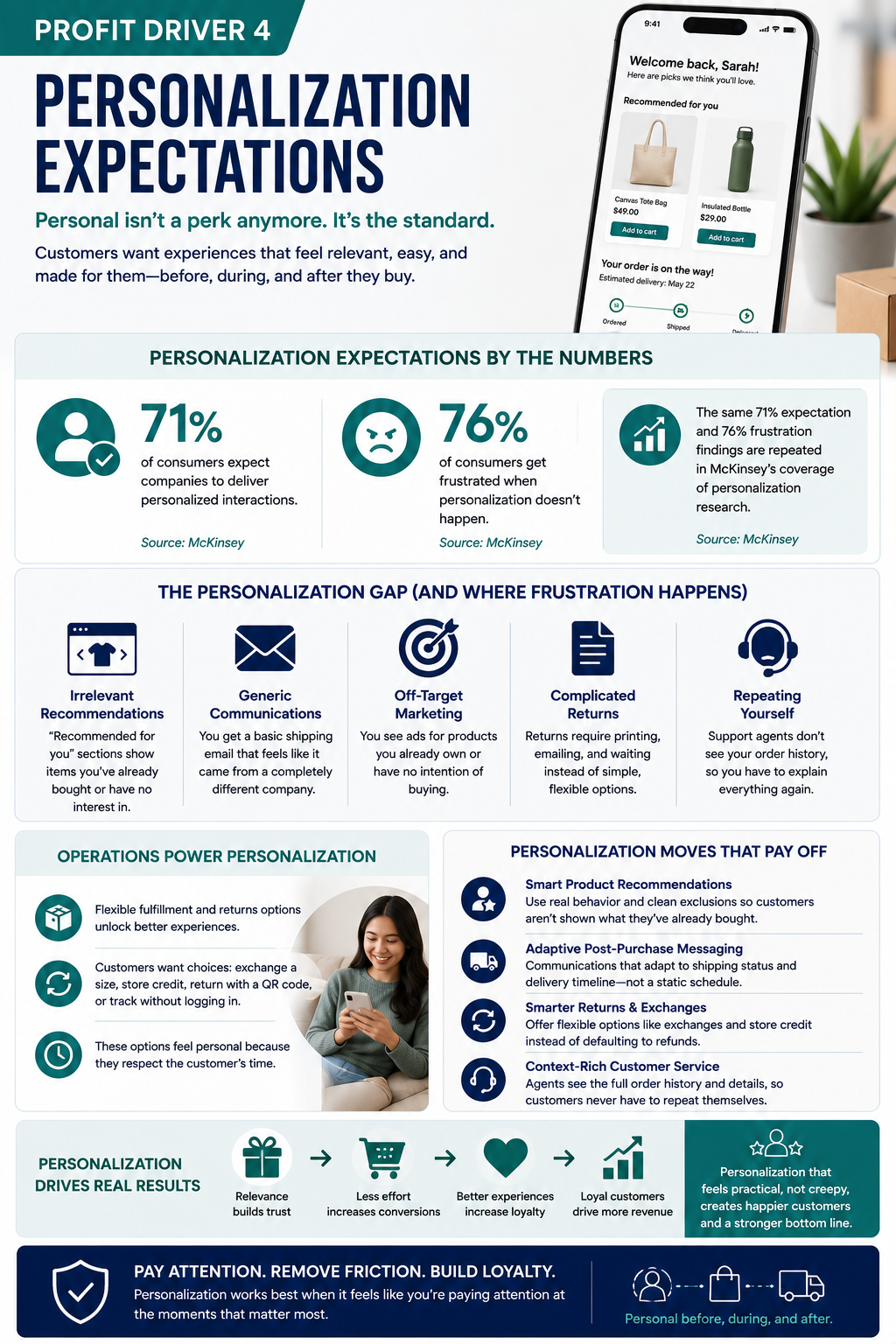
Profit Driver 4: Personalization Expectations
Personalization used to feel like a “nice extra.” Now it’s expected. Customers want the store to remember them, guide them, and make the experience feel relevant without being creepy. That includes product recommendations, but it also includes the post-purchase phase: order updates, shipping confidence, return options, and support that already knows the context.
Many brands collect data but fail to turn it into a smoother experience. That’s where frustration shows up. Shoppers see the disconnect instantly. They get a “recommended for you” carousel, then a generic shipping email that appears to be from a different company. They get targeted ads for products they already bought. They get a return process that requires printing, emailing, and waiting.
Personalization that drives revenue feels practical. It reduces effort. It gets the buyer to the right product faster, then keeps them confident after purchase.
Verifiable Statistics (Personalization Expectations)
- 71% of consumers expect companies to deliver personalized interactions, and 76% get frustrated when it doesn’t happen. (McKinsey)
- McKinsey repeats the 71% expectation and 76% frustration findings in its coverage of personalization research. (McKinsey)
Personalization also intersects with operations in ways many teams overlook. If your fulfillment and returns systems can’t support flexible options, your personalization efforts hit a ceiling. Customers want choices like “exchange for a different size,” “store credit,” “send it back with a QR code,” or “track my package without logging in.” Those features feel personal because they respect the customer’s time.
Here are personalization moves that tend to pay off without turning into an endless tech project.
- Product recommendations based on real behavior, plus clean exclusions so customers aren’t pushed by what they’ve already bought.
- Post-purchase messaging that adapts to shipping status and delivery timeline, not a static schedule.
- Returns and exchanges that offer smart options rather than defaulting to refunds.
- Customer service that immediately sees the full order context, so the customer doesn’t have to explain it all again.
Personalization works best when it feels like the brand is paying attention. It’s less about fancy AI language and more about removing friction in the moments when customers care.
“In a perfect world, you’d have the solution you needed in just a few clicks. In reality, not all software accommodates the specific needs of the individual retailer. When creating a balanced shipping strategy for your online business, it’s imperative that you ensure the feature sets you need are in place, so you can fulfill faster and go home early.” – Read Article on Forbes
A Simple Fix Order: What To Improve First
If you try to fix everything at once, you’ll end up fixing nothing. A cleaner approach is to prioritize changes that reduce friction, lower support costs, and increase repeat-purchase confidence in the same motion.
Start with conversion leaks that are easy to diagnose, then move into post-purchase experience improvements that directly impact retention.
A practical fix order looks like this.
- Check out clarity and shipping transparency first. If shoppers don’t trust the total cost and delivery promise, nothing else matters.
- Mobile experience next, since most visits happen there. Reduce input, speed up page load times, and simplify checkout.
- Post-purchase tracking and proactive communication. This reduces support load and keeps customers confident.
- Returns and exchanges optimization. Protect revenue with exchange first flows and reduce refunds where it makes sense.
- Omnichannel consistency. Add channels only when inventory and order visibility can handle the added complexity.
- Personalization layering. Use data to reduce effort and increase relevance, especially after purchase.
Small improvements compound. A tighter delivery promise reduces tickets. Fewer tickets free up your team. A calmer team resolves issues faster. Faster resolution improves reviews. Better reviews increase conversion. That cycle is how profitable ecommerce brands scale.
A Fast Store Audit Beats Guesswork
If you’re serious about improving your metrics, a short audit beats guessing. Pick three numbers and one operational reality check, then build the plan around what’s actually happening in your store.
Tell us what platforms or tools you’re using today, your current conversion rate or cart abandonment rate, and whether you sell physical products, digital goods, or subscriptions. We’ll help you identify the biggest leak and the fastest path to improvement, based on what your store is doing right now, not generic advice.
The Future of Ecommerce is Now
Staying ahead in the ecommerce industry means embracing innovation and anticipating changes before they arrive. The ecommerce trends shaping 2025 provide valuable insights into what’s next, but the future also brings exciting new possibilities. Businesses that adapt quickly and leverage the right tools will thrive in this dynamic landscape.
Ready for 2026? ReadyCloud Has You Covered!
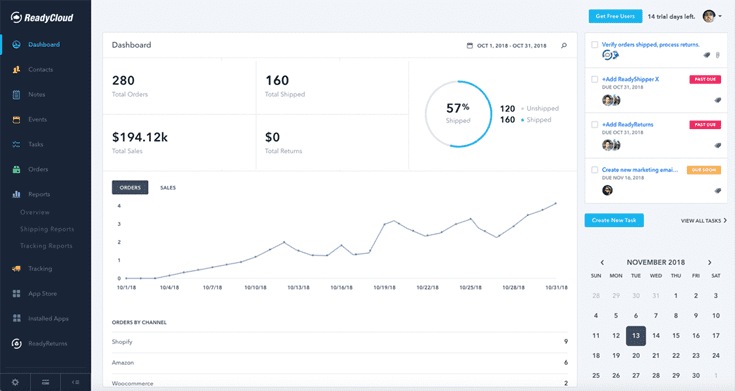
Success in 2026 starts with the right tools, and ReadyCloud’s suite of solutions is designed to propel your ecommerce business to new heights. With ReadyCloud, you’ll have all your data centralized in one place, offering insights that drive smarter decisions. Take your marketing to the next level with Action Alerts, delivering growth-focused, automated campaigns that keep your customers engaged.
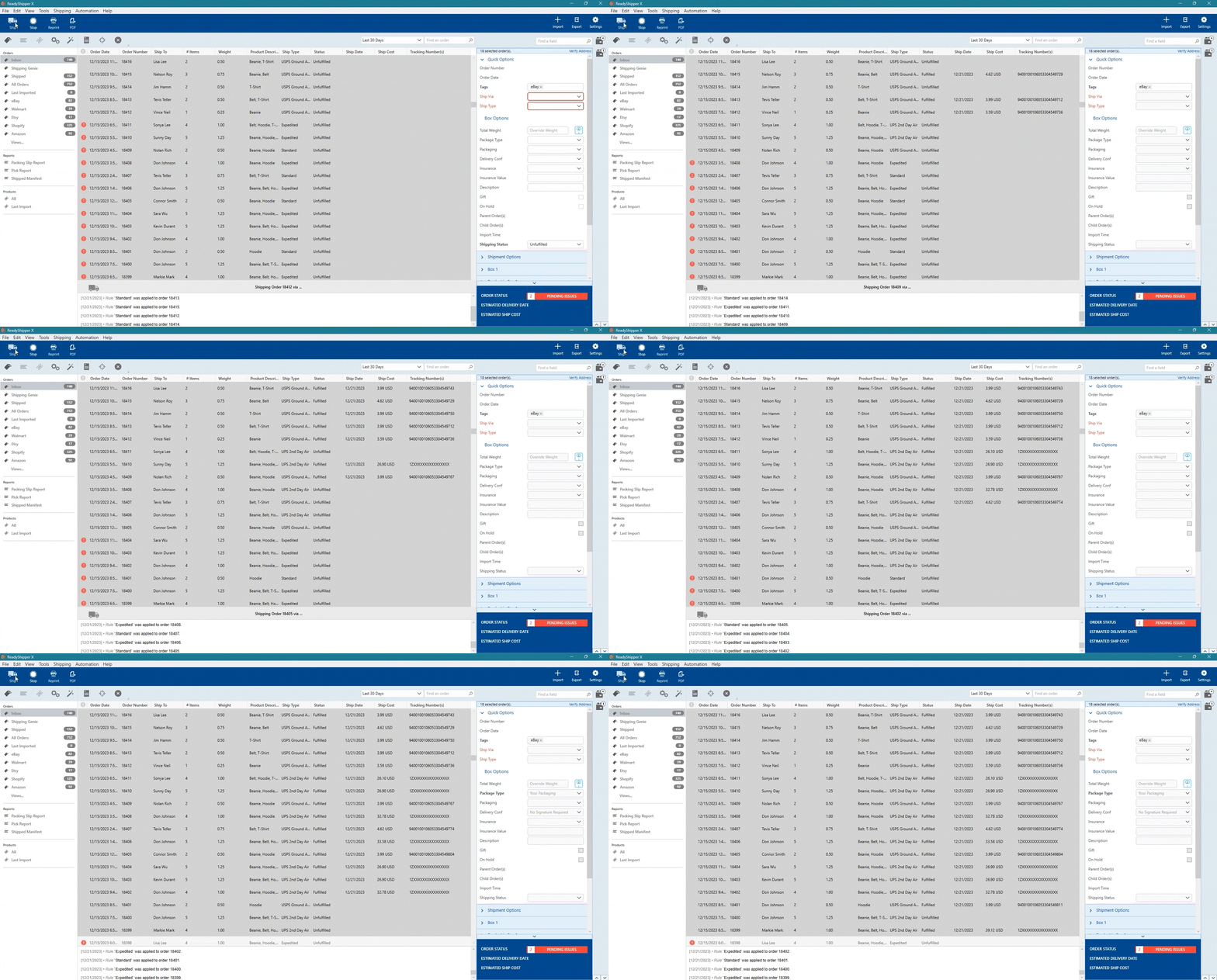
Shipping is easier than ever with ReadyShipper X, a multicarrier solution that simplifies your fulfillment process while saving time and money.
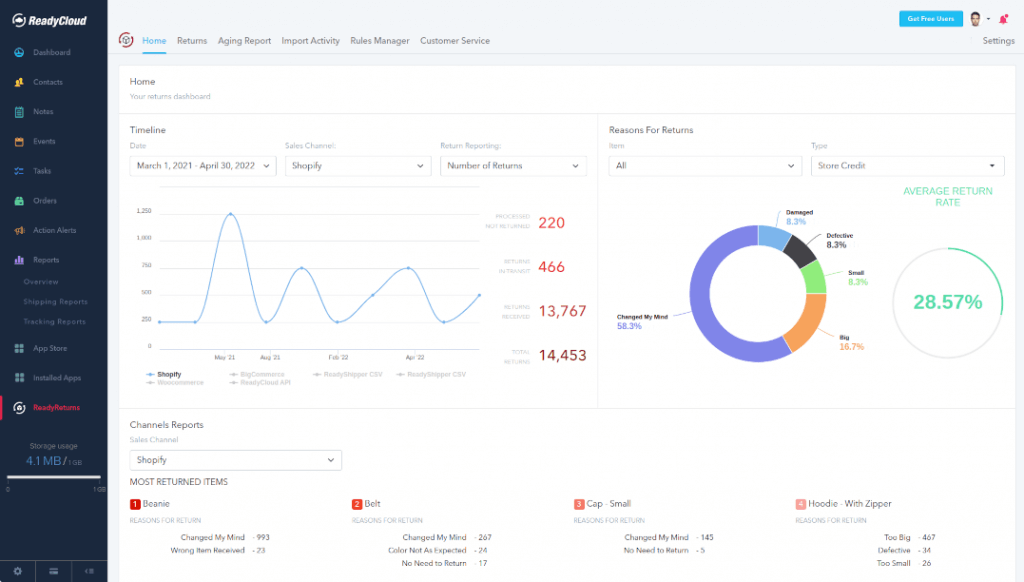
And when it comes to returns, ReadyReturns streamlines the entire process with an automated solution that boosts customer satisfaction and loyalty.

ReadyCloud is more than just a suite of systems—it’s your ticket to thriving in 2026 and beyond!
Start your journey to success today! Learn more and get started here.
Or contact our Sales Department at: 877-818-7447 ext. 1.
Frequently Asked Questions About Ecommerce Profit Drivers
What is a good e-commerce conversion rate in 2026?
A “good” conversion rate depends on your category, traffic quality, device mix, and price point. Benchmarks can help you sanity check performance, but they’re best treated as a range rather than a single target. Your next step should be to compare the conversion rate by device and by channel, so you can see where the drop-off is really happening. Once you isolate the weak segment, you can improve it without redesigning everything.
What Is The Average Cart Abandonment Rate For Online Stores?
Cart abandonment tends to stay around the 70% range across many studies and datasets. That number sounds discouraging, but it also means there’s almost always room for improvement. Focus on the most common causes, such as surprise shipping costs, unclear delivery timing, and unnecessary checkout friction. Even a small reduction in abandonment can create an outsized revenue lift because it applies to every session you already have.
How Can I Reduce Cart Abandonment Without Discounting?
Discounting can work, yet it can also train customers to wait. A stronger approach is removing the uncertainty that causes abandonment in the first place. Show shipping costs and delivery estimates earlier, simplify mobile checkout, and make returns and exchanges feel safe. Add trust signals where the buyer is deciding, not buried in the footer. This kind of cleanup increases conversion without lowering your margin.
What Are The Best Ways To Increase Customer Retention For Ecommerce Brands?
Retention rises when the first purchase feels safe, and the brand stays consistent after checkout. Proactive order tracking, clear delivery expectations, and a painless exchange process all build trust fast. Email and SMS help, but they work best when the operational experience backs them up. Customers come back when they remember the brand as reliable, not stressful.
How Does Post-Purchase Experience Affect Repeat Purchases?
The post-purchase experience is where trust is either reinforced or destroyed. If tracking is hard to find, delivery is unclear, or support feels slow, customers hesitate to reorder even if they like the product. A smooth post-purchase flow also reduces support tickets, which lowers your cost per order. That combination tends to improve reviews, reduce refunds, and lift repeat purchase rate over time.
How Important Is Mobile Optimization For Ecommerce Profitability?
Mobile drives the majority of ecommerce visits, so a weak mobile experience creates a constant leak. Mobile shoppers are less patient and more likely to abandon if checkout feels like work. Improving speed, simplifying forms, and offering convenient payment options can quickly boost mobile conversion rates. In addition, mobile improvements often reduce support tickets because customers can find order details and policies more easily.
How Do Social Platforms Influence Ecommerce Sales Today?
Social platforms influence discovery, research, and trust, especially for products that benefit from demonstrations and reviews. Many shoppers use TikTok, YouTube, and Instagram to validate a product before they buy. Social commerce can also drive direct orders, which makes operational readiness critical. If fulfillment and returns are messy, social buyers can turn into chargebacks and negative comments just as fast as they turned into customers.
What Should I Fix First If My Store Has Low Conversion And Low Repeat Purchases?
Start with the purchase friction points that create immediate doubt: shipping cost surprise, unclear delivery timing, and confusing checkout. Next, tighten post-purchase communication so customers don’t feel abandoned after they pay. Then improve returns and exchanges to protect revenue and reduce frustration. Once those foundations are stable, you can layer in personalization and expand channels with less risk.
How Do I Know If My Store’s Biggest Problem Is Marketing Or Operations?
Look at where customers drop off and what they complain about. If traffic is healthy but conversion is low, your store experience and checkout clarity are likely the issue. If conversion is decent but repeat purchases are weak, the post-purchase experience, delivery reliability, and returns flow are often the culprits. Support ticket volume, refund rate, and “where is my order” messages are strong operational signals. Those indicators help you pick the right fix instead of throwing more budget at ads.