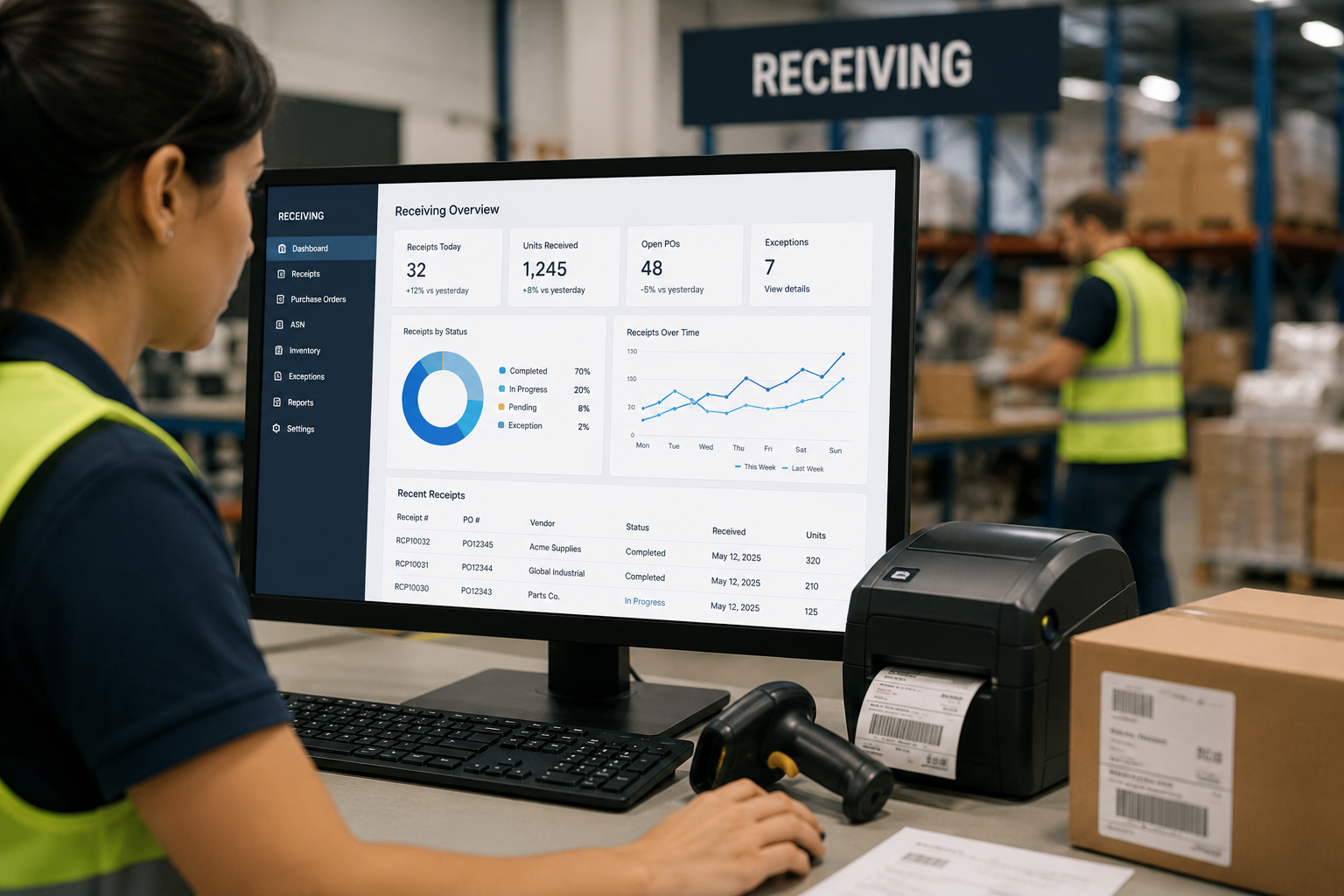
Most ecommerce teams don’t lose money because they picked the wrong marketing channel. They lose money because fulfillment costs drift upward, receiving turns into a bottleneck, and exceptions get handled in a dozen different places that never talk to each other. It starts small, then grows into a daily fight between speed, accuracy, and customer expectations.
At enterprise scale, shipping isn’t a single station at the end of the warehouse. It’s a system that touches inventory accuracy, carrier costs, customer support load, and brand trust after checkout. Receiving isn’t just counting boxes, either. If inbound processes lag or run sloppily, everything downstream gets forced into expensive workarounds.
That’s the real role of shipping receiving software. It’s the operational layer that helps teams execute consistently across carriers, locations, and systems, while keeping visibility clean enough that support and leadership aren’t guessing. This guide breaks down what that layer needs to do, what can go wrong in ERP-only workflows, and how enterprise teams tighten execution without adding more manual work.
“Growing e-commerce brands have set a new standard. They’re demonstrating that, with the right strategy in place, the post-purchase experience can be elevated. And customers are noticing it. For the larger retailers in the pond, this represents a monumental shift that swings from traditional customer acquisition to long-term retention.” Read Article on Forbes
What Shipping And Receiving Really Looks Like In Modern Operations
“Shipping and receiving” sounds simple until you’re running multiple warehouses, selling across marketplaces, managing split shipments, and dealing with inventory that changes status every hour. The work isn’t just picking and packing. It’s coordinating inbound availability, outbound service levels, and the customer experience that starts the second an order is placed.
Shipping includes the decisions that determine cost and speed, not only the printing of labels. Those decisions happen across people, shifts, and locations, which is why consistency becomes a real business issue. Receiving sets the pace for the rest of the operation. If inventory isn’t verified, located, and made available quickly, your outbound workflow becomes a chain reaction of delays and last-minute fixes.
Here are the moving parts most teams are juggling every day.
- Inbound receiving that verifies what arrived, flags shortages, and routes inventory to the right locations.
- Outbound shipping workflows that handle batch labels, carrier selection rules, and end-of-day carrier handoff steps.
- Exceptions like partial shipments, address fixes, reprints, damages, and customer-driven changes.
The big shift enterprise teams face is that shipping performance now shapes the post-purchase experience. Tracking clarity, proactive updates, and fast exception response are the difference between a smooth delivery and a week of support tickets.


Why ERP Shipping Breaks Down As Volume And Complexity Grow
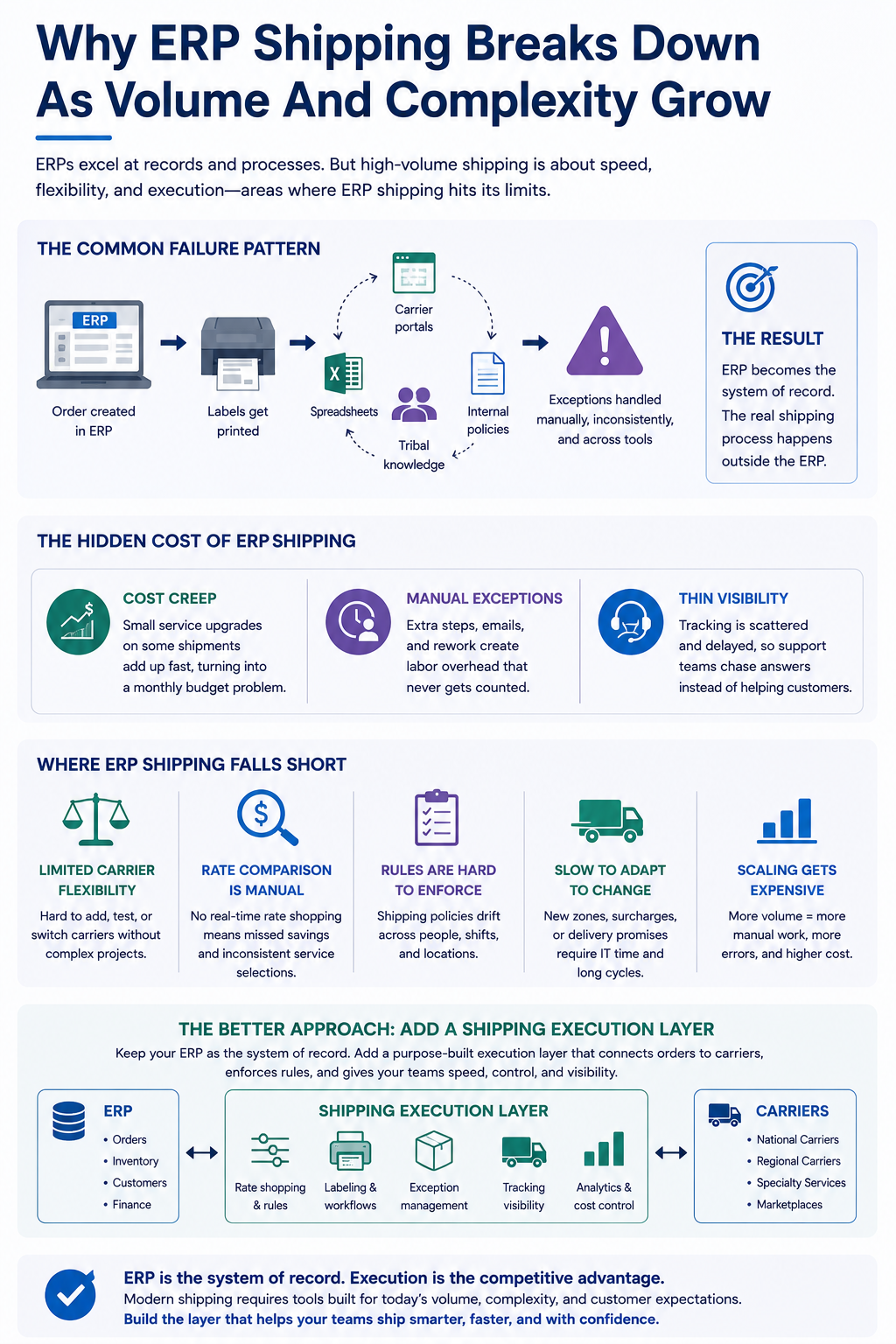
ERPs are built to manage records and processes across a business. That strength can become a weakness in high-volume parcel shipping, where execution speed and carrier flexibility matter every hour. Many teams rely on ERP shipping because it’s “already there,” only to wonder why their warehouse feels slower every quarter.
The common failure pattern looks like this. Labels get printed, but the decision-making remains manual. Teams still bounce between carrier portals, spreadsheets, internal policies, and tribal knowledge to choose services and resolve exceptions. Over time, the ERP becomes the system of record, while the real shipping process happens outside it.
This is where cost creep starts showing up in ways that are hard to spot. A few extra dollars in service upgrades on a subset of shipments turns into a monthly budget problem. Manual exceptions create labor overhead that never gets counted properly. Tracking visibility stays thin, so support teams have to chase answers from operations.
Enterprise teams also face limitations in multi-carrier execution. If your tools make it hard to compare rates, enforce rules, and flex carrier options, the business gets stuck. That’s one reason so many brands add a shipping execution layer that can work alongside an ERP, instead of trying to force the ERP to act like a modern shipping platform.
“Cloud-based solutions are tethered to the uptime of the service provider, whereas hybrid-cloud solutions mean you can keep shipping packages even if your SaaS provider is experiencing a disruption of service.” – Read Article on Forbes

What Enterprise Teams Should Expect From A Shipping And Receiving Platform
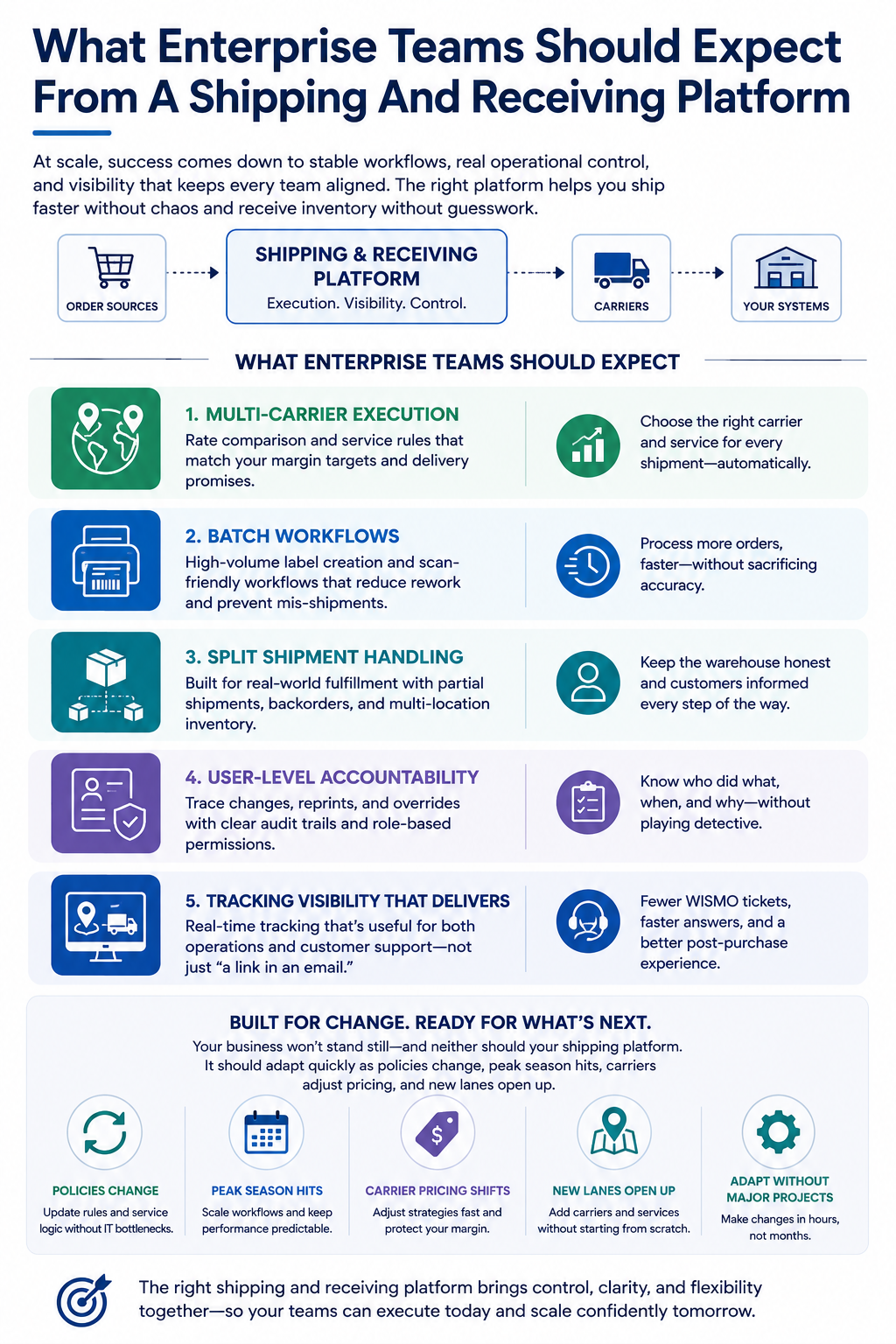
At scale, you don’t need “more features.” You need workflows that stay stable under pressure, plus visibility that keeps every team aligned. A solid platform should help you ship faster without creating chaos, and help you receive inventory without turning the warehouse into a guessing game.
The baseline expectation is multi-carrier execution that supports real operational control. That means your team can set rules for service selection, manage exceptions consistently, and keep performance predictable across locations. It also means the platform can sit cleanly between order sources and carriers, while keeping the rest of your systems updated.
Here’s what enterprise teams should expect from a serious shipping and receiving layer.
- Multi-carrier support with rate comparison and service rules that match your margin targets and delivery promises.
- Batch workflows for high-volume label creation that reduce rework and prevent mis-shipments.
- Split shipment handling that keeps the warehouse honest and keeps the customer informed.
- User-level accountability so you can trace changes, reprints, and overrides without playing detective.
- Tracking visibility that’s usable for operations and customer support, not just “a link in an email.”
Teams also need flexibility without constant reliance on IT. Shipping policies change often. Peak season adds pressure. Carriers change pricing. New lanes open up. The software layer that runs execution needs to adapt quickly without turning every adjustment into a project.
Receiving Workflows That Protect Inventory Accuracy And Speed
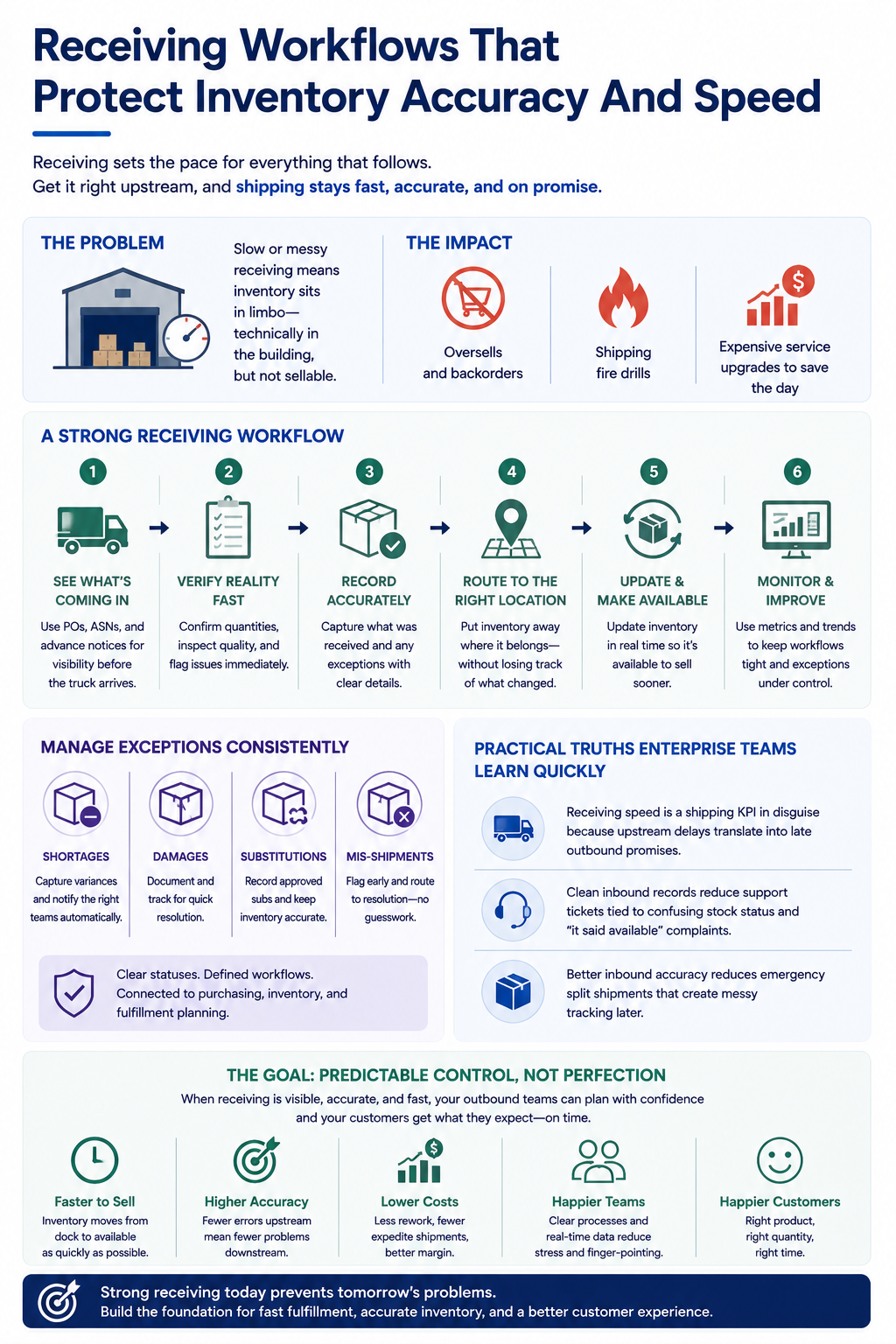
Receiving is where fulfillment either gets ahead of demand or spends the rest of the day catching up. If your receiving process is slow, inventory becomes “technically in the building” but not sellable. That creates oversells, backorders, and the kind of shipping fire drills that force expensive service upgrades.
A strong receiving workflow starts with visibility into what’s coming in, and a process that verifies reality fast. Teams need to confirm quantities, flag issues, and route inventory to locations without losing track of what has changed. If exceptions are handled loosely, accuracy degrades quickly, and downstream picking errors become the norm.
Receiving also needs consistent exception handling. Shortages, damages, substitutions, and mis-shipments should not live in someone’s memory. They need clear statuses and a workflow path that connects to purchasing, inventory, and fulfillment planning.
Here are a few practical truths enterprise teams learn quickly.
- Receiving speed is a shipping KPI in disguise because upstream delays translate into late outbound promises.
- Clean inbound records reduce support tickets tied to confusing stock status and “it said available” complaints.
- Better inbound accuracy reduces emergency split shipments that create messy tracking later.
The goal isn’t perfection. It’s predictable control, so outbound teams aren’t forced to guess what’s real every morning.
Shipping Execution That Scales Without Chaos
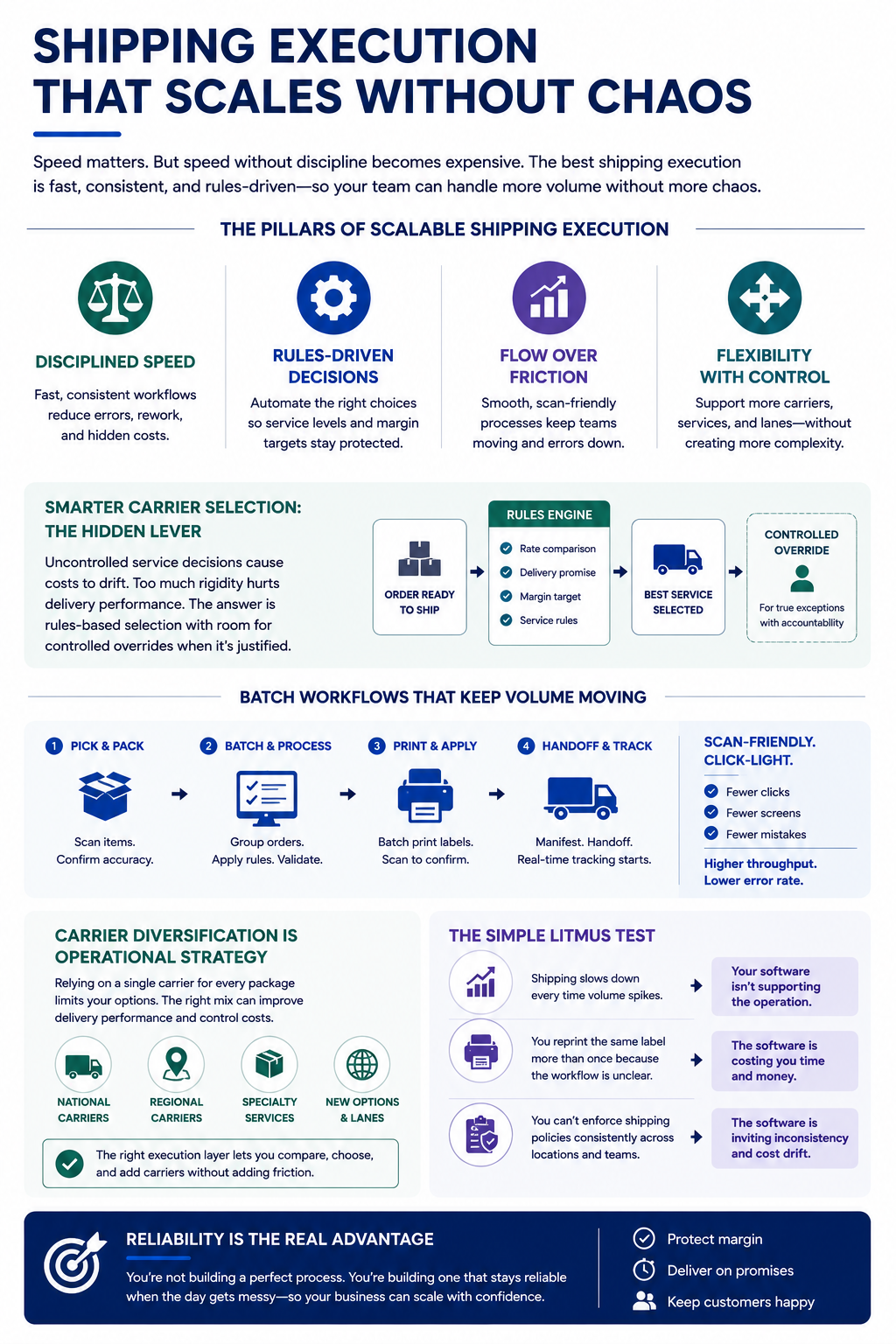
Speed matters, but speed without discipline becomes expensive. The best shipping execution setups are fast, consistent, and rules-driven. They let teams process high volume without depending on heroics, and they reduce the “small mistakes” that become expensive over time.
Carrier selection is one of the biggest hidden levers. If service decisions aren’t controlled, costs drift. If decisions are too rigid, delivery performance suffers. The right balance is rules-based selection that aligns with delivery promises and margin targets, while allowing controlled overrides for real exceptions.
Batch workflows and scan-friendly steps matter just as much. High-volume shipping is a flow problem. If your process forces too many clicks, too many screens, or too much manual checking, throughput drops. Then teams compensate with shortcuts, and shortcuts create errors.
This is also where carrier diversification becomes an operational strategy. Many enterprise teams can’t rely on a single carrier network for every package. Regional carriers, specialty services, and new options can improve delivery performance or reduce costs, but only if the execution layer supports them without adding friction.
There’s a simple litmus test. If your shipping process slows down every time volume spikes, the software isn’t supporting the operation. The second time you reprint the same label because the workflow is unclear, the software is costing you time. If your team can’t enforce shipping policies across locations, the software is inviting inconsistency.
You’re not trying to build a “perfect” shipping process. You’re trying to build one that stays reliable when the day gets messy.
“In a perfect world, you’d have the solution you needed in just a few clicks. In reality, not all software accommodates the specific needs of the individual retailer. When creating a balanced shipping strategy for your online business, it’s imperative that you ensure the feature sets you need are in place, so you can fulfill faster and go home early.” – Read Article on Forbes
“Post-purchase is a crucial part of the customer journey, but it often doesn’t get the attention it deserves, especially at the enterprise level. What’s interesting is how many growing e-commerce brands are outshining larger retailers when it comes to what happens after the “buy” button is clicked.” – Read Article on Forbes
Tracking Clarity And Post-Purchase Visibility
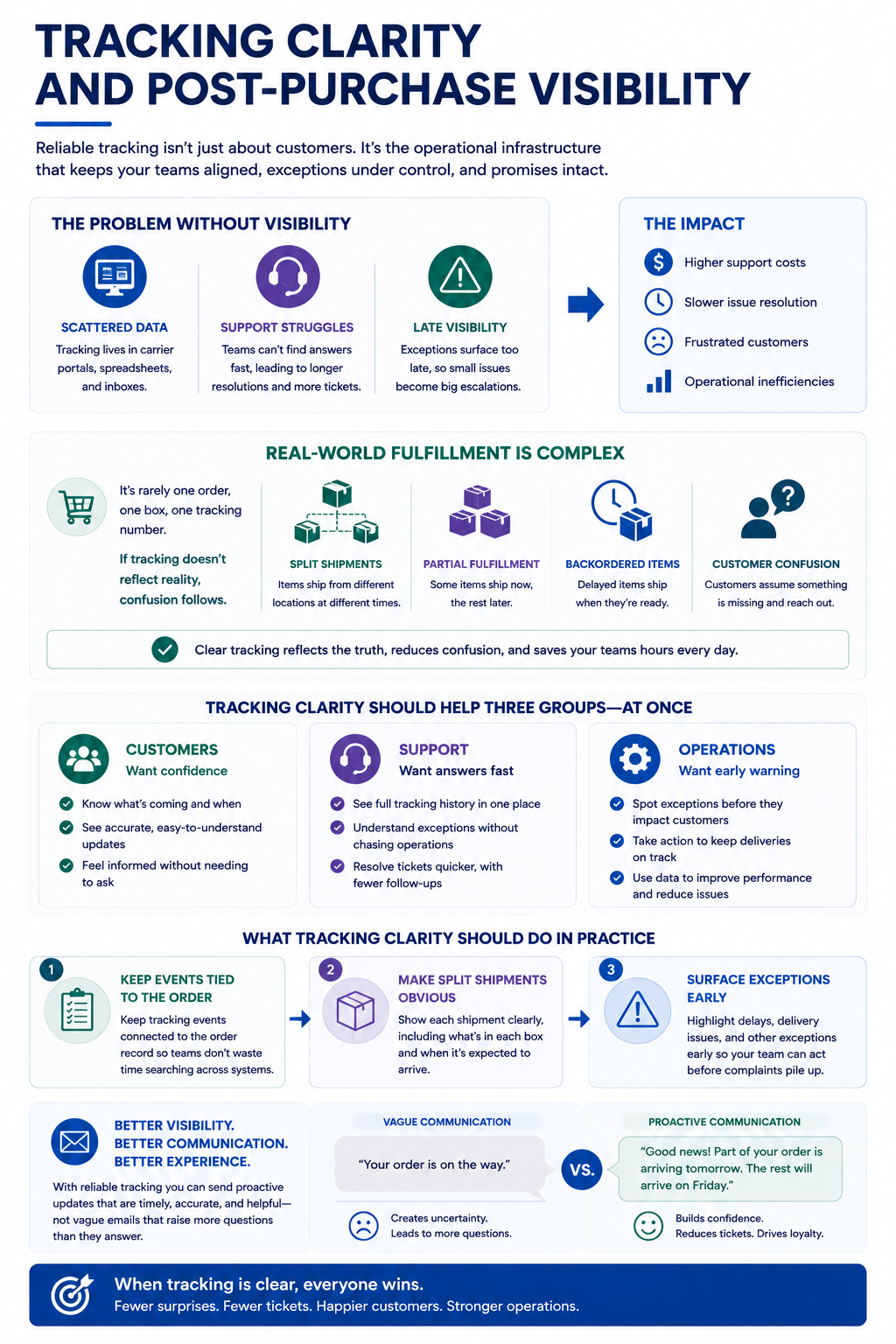
Tracking is not a customer-only feature. It’s operational infrastructure. If tracking data is scattered across carrier portals, support teams can’t answer questions quickly, and operations teams can’t see exceptions early enough to respond. That delay turns minor issues into escalations.
Order clarity matters because real-world fulfillment isn’t always one order, one box, one tracking number. Split shipments happen. Partial fulfillment happens. Backordered items ship later. If tracking doesn’t reflect that reality, customers assume something is missing, and your support team gets stuck explaining the same situation over and over.
Better tracking visibility should help three groups at once: customers, support, and operations. Customers want confidence. Support wants answers without chasing the warehouse. Operations want early warning when a delivery is drifting into problem territory.
Here’s what tracking clarity should do in practice.
- Keep tracking events tied to the order record so teams don’t waste time searching across systems.
- Make split shipments obvious, so customers understand what’s arriving and when.
- Surface exceptions early enough that your team can act before complaints pile up.
This is also where communication gets easier. If your tracking view is reliable, you can send proactive updates that feel confident and accurate, rather than vague emails that raise more questions than they answer.
“Many retailers are simply not equipped to manage what’s coming. But some are. These are the brands already investing in technology, training and process optimization to turn what used to be a logistical nightmare into a competitive edge.” – Read Article on Forbes
WISMO Costs More Than Most Teams Budget For
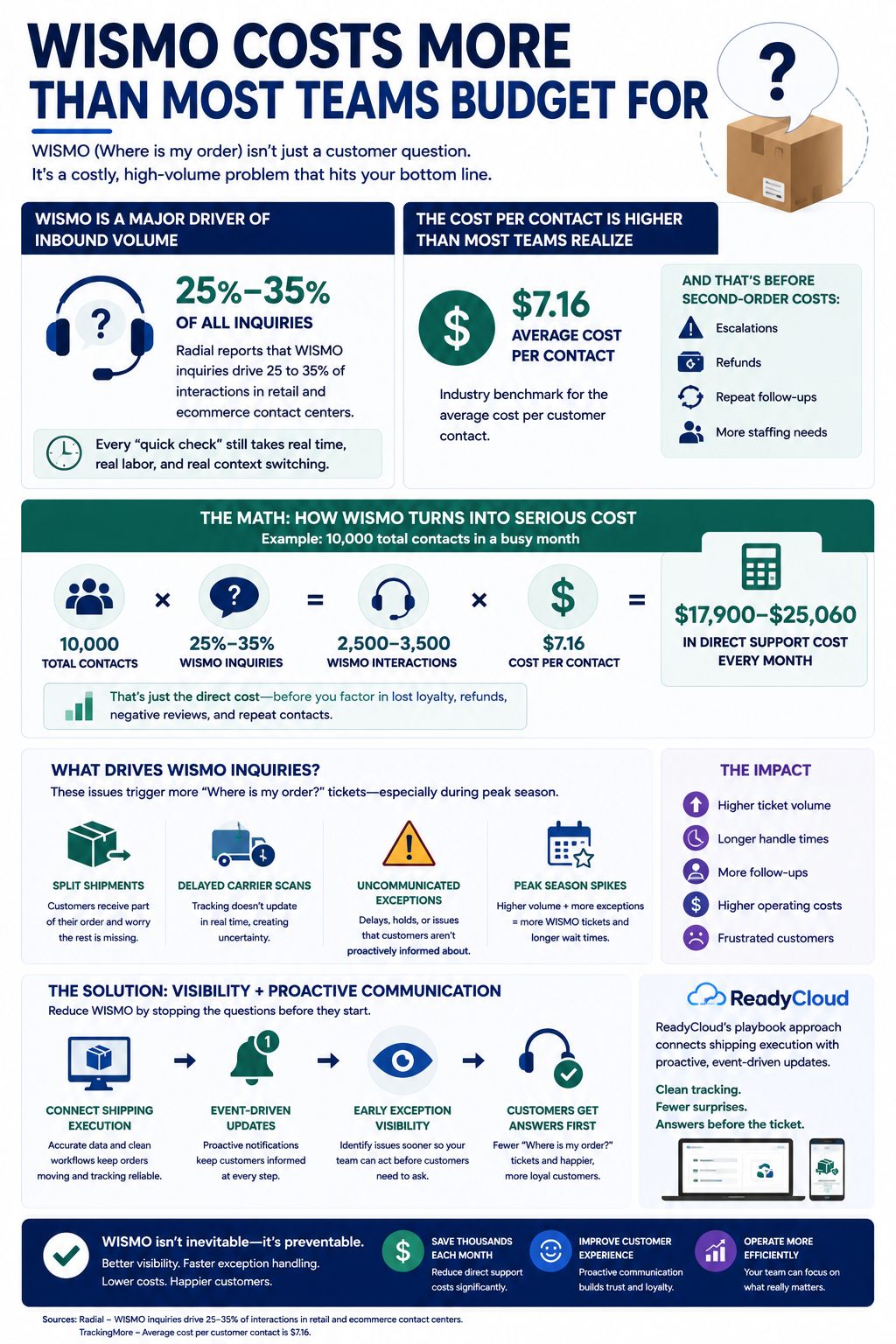
WISMO, short for “Where is my order,” is one of those support costs that quietly balloons until it’s impossible to ignore. In retail and ecommerce contact centers, Radial reports that WISMO inquiries drive 25 to 35 percent of interactions, which is a massive share of your inbound volume for a single category of question. That volume gets expensive fast because every “quick check” still takes real time, real labor, and real context switching.
What’s more, the cost per customer contact is not trivial. One industry benchmark pegs the average cost per contact at about $7.16, and that’s before you factor in the second-order costs like escalations, refunds triggered by slow responses, and the compounding effect of repeat follow-ups.
Put those two stats together, and the math gets ugly in a hurry. If your team handles 10,000 contacts in a busy month, WISMO at 25 to 35 percent means 2,500 to 3,500 WISMO interactions, or roughly $17,900 to $25,060 in direct support cost using that $7.16 benchmark.
This is why reducing WISMO isn’t about telling support to “work faster.” It’s about tightening visibility and exception response so customers don’t feel forced to ask in the first place. Split shipments, delayed carrier scans, and uncommunicated exceptions are the classic triggers, and they spike hardest during peak season.
“Modern consumers expect transparency. They don’t want to chase tracking links across different carriers or dig through their inbox to figure out when a package is supposed to arrive. They want real-time updates and branded communication that feels consistent with the rest of their shopping experience.
Brands that offer detailed order tracking, SMS updates or branded tracking pages are already ahead of the curve. These shipping intelligence touchpoints show customers that the brand is still involved … even after the sale is complete.” Read Article on Forbes
Carrier Strategy And Rate Pressure In 2026
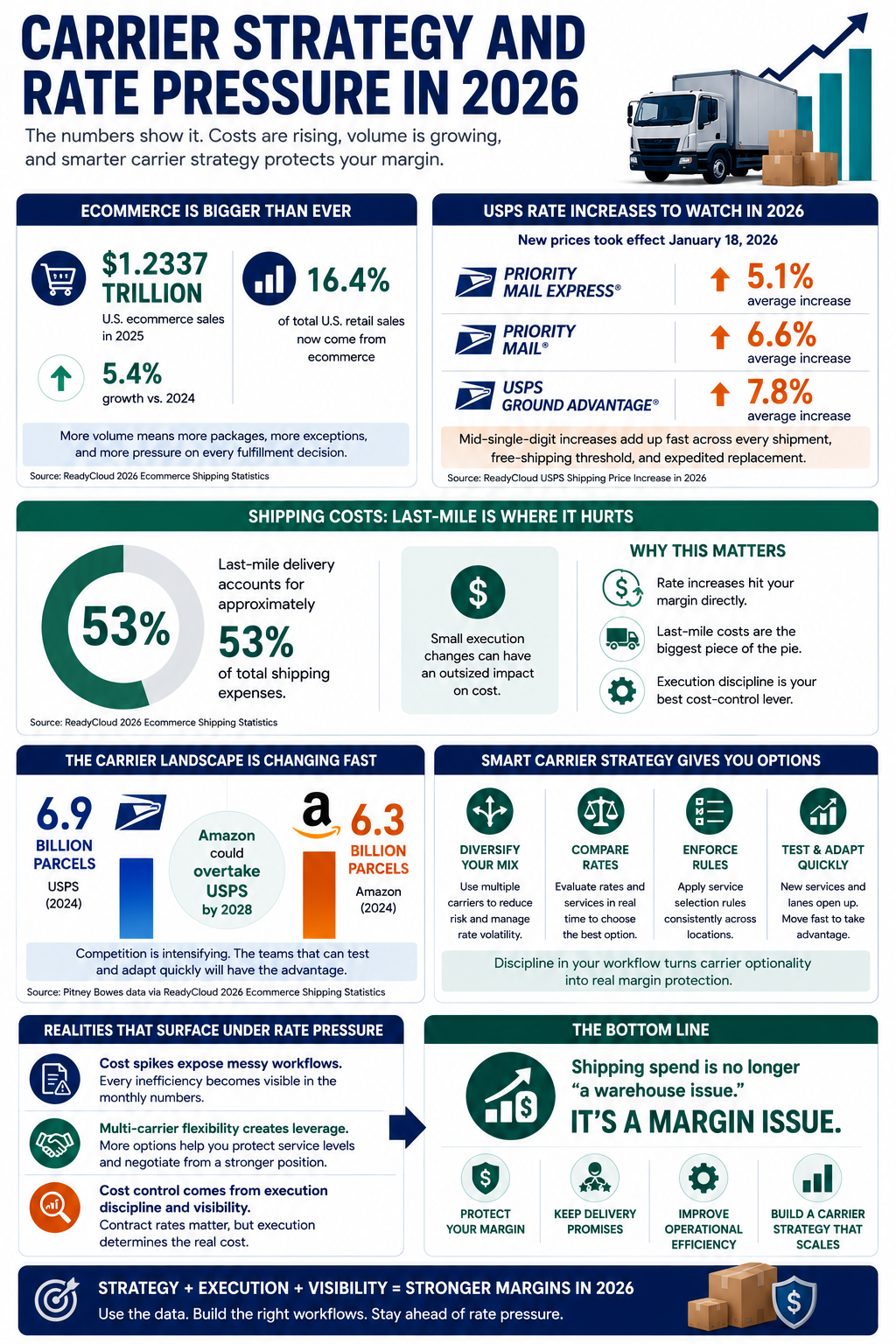
Shipping costs don’t stay still, and the numbers going into 2026 make it clear that “set it and forget it” carrier strategy is gone. U.S. ecommerce sales hit $1.2337 trillion in 2025, up 5.4% year over year, and ecommerce now represents 16.4% of total U.S. retail sales. More volume means more packages, more exceptions, and more pressure on every fulfillment decision you make.
Rate pressure is real, and USPS is a perfect example. The USPS price updates that took effect January 18, 2026, include average retail increases of 5.1% for Priority Mail Express, 6.6% for Priority Mail, and 7.8% for USPS Ground Advantage. A mid-single-digit increase can look manageable on a rate sheet, then become a margin problem once it applies to every daily shipment, every free-shipping threshold, and every expedited replacement you send.
Carrier optionality matters because it gives the business room to move when lanes get expensive or service levels shift. If last-mile delivery accounts for about 53% of total shipping expenses, small execution changes can have an outsized impact on cost. That’s where disciplined service rules, rate comparison, and consistent enforcement across locations stop being “nice to have” and become margin protection.
The carrier landscape is also changing fast. Amazon handled 6.3 billion parcels in 2024, just behind USPS at 6.9 billion, with a projection that Amazon’s new shipping option could overtake USPS by 2028. That’s a signal for ecommerce teams: carrier mix is getting more competitive, and you want workflows that let you test options quickly without blowing up daily operations.
A few realities tend to surface quickly under rate pressure.
- Cost increases expose messy workflows faster than almost anything else, because inefficiencies show up immediately in monthly spend.
- Multi-carrier flexibility creates leverage, giving teams more options to protect service levels and manage cost spikes.
- Cost control comes from execution discipline and visibility, not only from negotiated rates.
This is also the point where leadership starts paying attention, because shipping spend is no longer “a warehouse issue.” It’s a margin issue, and the numbers are big enough that small decisions add up fast.
Checkout Promises, Delivery Expectations, And Cart Abandonment
Customers don’t separate shipping from the product. Shipping is part of the buying decision, and the 2026 data makes that impossible to ignore. An average cart abandonment rate of 70.22% was found across 50 studies, which means roughly 7 out of 10 carts still don’t convert. If delivery feels uncertain, slow, or expensive, shoppers hesitate, and that hesitation shows up right at checkout.
The connection between fulfillment and conversion is tighter than most teams want to admit. In fact, 39% of U.S. online shoppers abandon their cart because extra costs are too high, including shipping, tax, or fees. If your checkout promise doesn’t match what your fulfillment operation can reliably deliver, customers feel the gap fast. Late deliveries, unclear tracking, and inconsistent service levels don’t just create support noise; they chip away at conversion and repeat purchase confidence.
There’s also a cost side to this. If you try to “save” the experience after a late fulfillment cycle with service upgrades, spend climbs fast. If you absorb those costs, the margin shrinks. If you push them to the customer, conversion drops, especially when totals change late in the checkout flow. Last year, there were nearly $260 billion in recoverable lost orders across the U.S. and EU, plus a potential 35.26% lift in conversion from improving the checkout experience and reducing friction. That’s a strong signal that tightening shipping clarity and delivery expectations is a revenue move, not just an ops project.
The strongest brands treat shipping performance as part of the product experience. They align delivery promises with what the warehouse can execute and keep communication clear so shoppers don’t feel they’re taking a risk at the last step. In 2026, “faster” isn’t the only goal. “Predictable and clearly communicated” is what keeps carts from turning into drop-offs.
Checkout Promises, Delivery Expectations, And Cart Abandonment
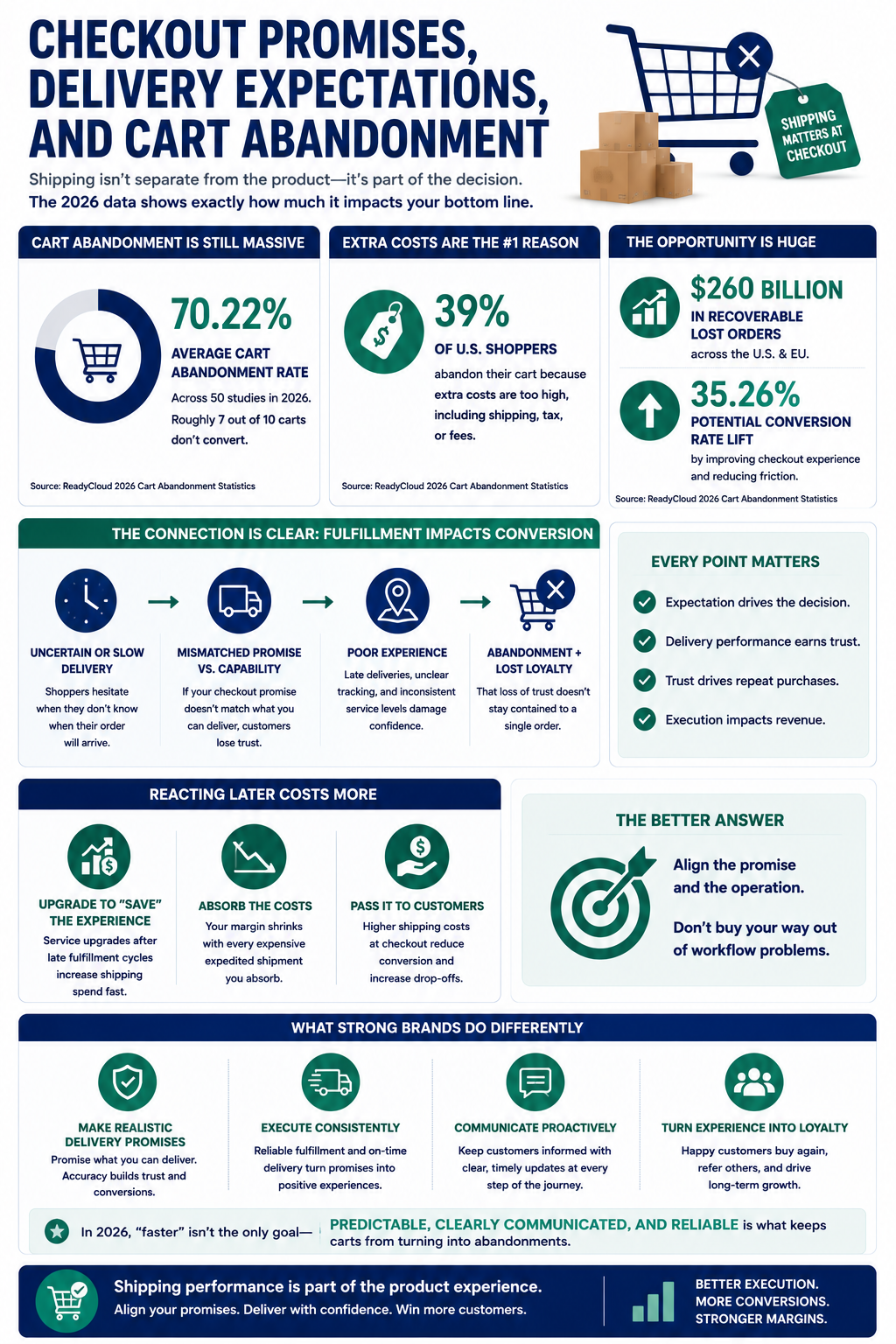
Customers don’t separate shipping from the product. Shipping is part of the buying decision, and the 2026 data makes that impossible to ignore. An average cart abandonment rate of 70.22% was found across 50 studies, which means roughly 7 out of 10 carts still don’t convert. If delivery feels uncertain, slow, or expensive, shoppers hesitate, and that hesitation shows up right at checkout.
The connection between fulfillment and conversion is tighter than most teams want to admit. In fact, 39% of U.S. online shoppers abandon their cart because extra costs are too high, including shipping, tax, or fees. If your checkout promise doesn’t match what your fulfillment operation can reliably deliver, customers feel the gap fast. Late deliveries, unclear tracking, and inconsistent service levels don’t just create support noise; they chip away at conversion and repeat purchase confidence.
There’s also a cost side to this. If you try to “save” the experience after a late fulfillment cycle with service upgrades, spend climbs fast. If you absorb those costs, the margin shrinks. If you push them to the customer, conversion drops, especially when totals change late in the checkout flow. Last year, there were nearly $260 billion in recoverable lost orders across the U.S. and EU, plus a potential 35.26% lift in conversion from improving the checkout experience and reducing friction. That’s a strong signal that tightening shipping clarity and delivery expectations is a revenue move, not just an ops project.
The strongest brands treat shipping performance as part of the product experience. They align delivery promises with what the warehouse can execute and keep communication clear so shoppers don’t feel they’re taking a risk at the last step. In 2026, “faster” isn’t the only goal. “Predictable and clearly communicated” is what keeps carts from turning into drop-offs.
Implementation Plan That Won’t Disrupt Daily Fulfillment
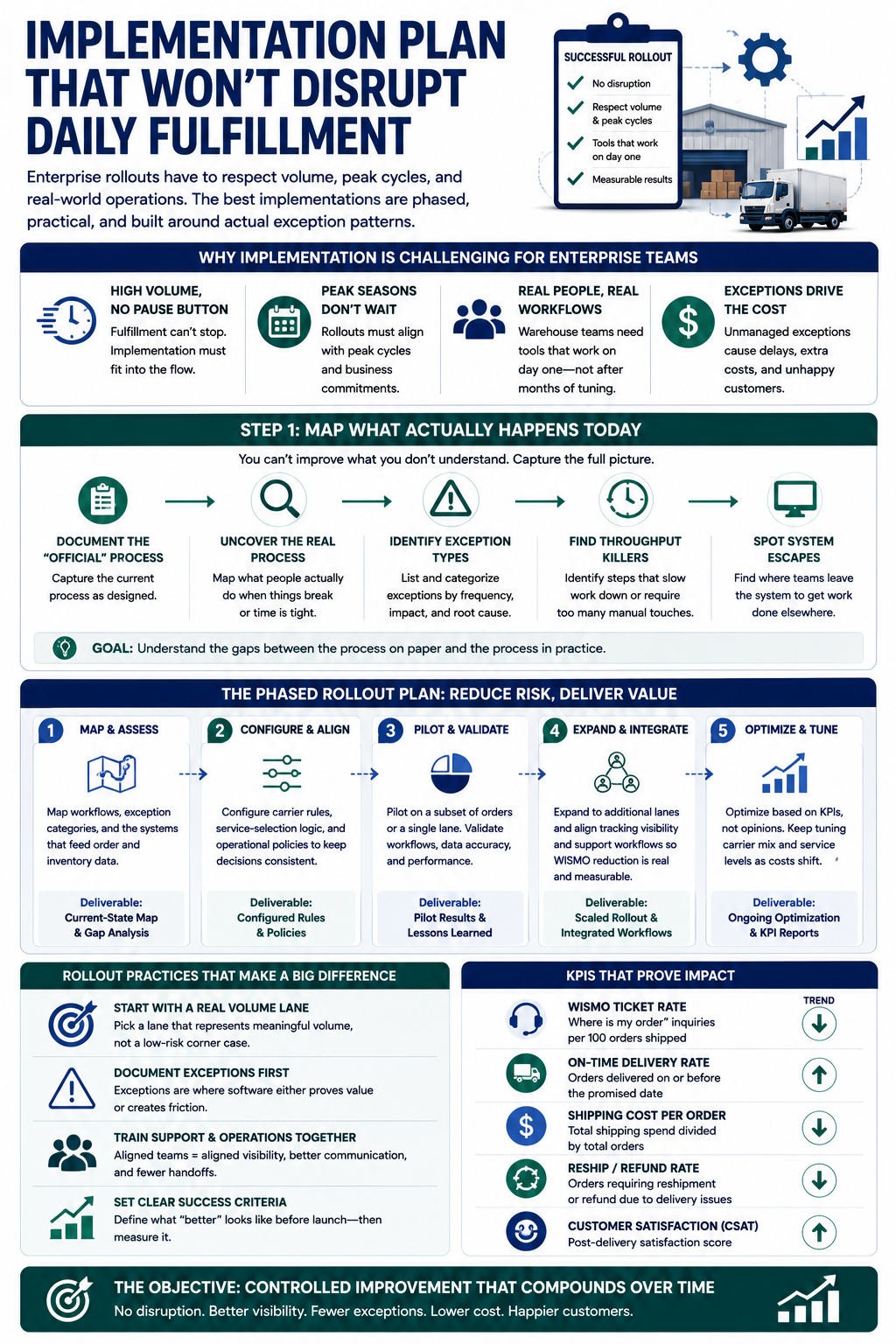
Enterprise teams don’t have the luxury of pausing fulfillment to roll out new systems. Implementation has to respect volume, peak cycles, and the reality that warehouse teams need tools that work on day one. The best rollouts are phased, practical, and built around real exception patterns.
Start with mapping what actually happens today. That includes the “official” process and the real process people follow when things break. Document exception types, identify steps that slow throughput, and identify points where people leave the system to get work done.
A phased rollout plan keeps risk manageable.
- Phase 1: Map workflows, exception categories, and the systems that feed order and inventory data.
- Phase 2: Configure carrier rules, service-selection logic, and operational policies to ensure consistent decisions.
- Phase 3: Pilot on a subset of orders or a single lane, then expand after the workflow proves stable.
- Phase 4: Align tracking visibility and support workflows, so WISMO reduction becomes real and measurable.
- Phase 5: Optimize based on KPIs, not opinions, and keep tuning carrier mix as costs shift.
A few rollout practices make a big difference.
- Start with a lane that represents real volume, not a low-risk corner case that won’t expose problems.
- Document exceptions first, because exceptions are where software either proves value or creates friction.
- Train support and operations together to keep visibility and communication aligned.
The objective is not disruption. It’s a controlled improvement that compounds over time.
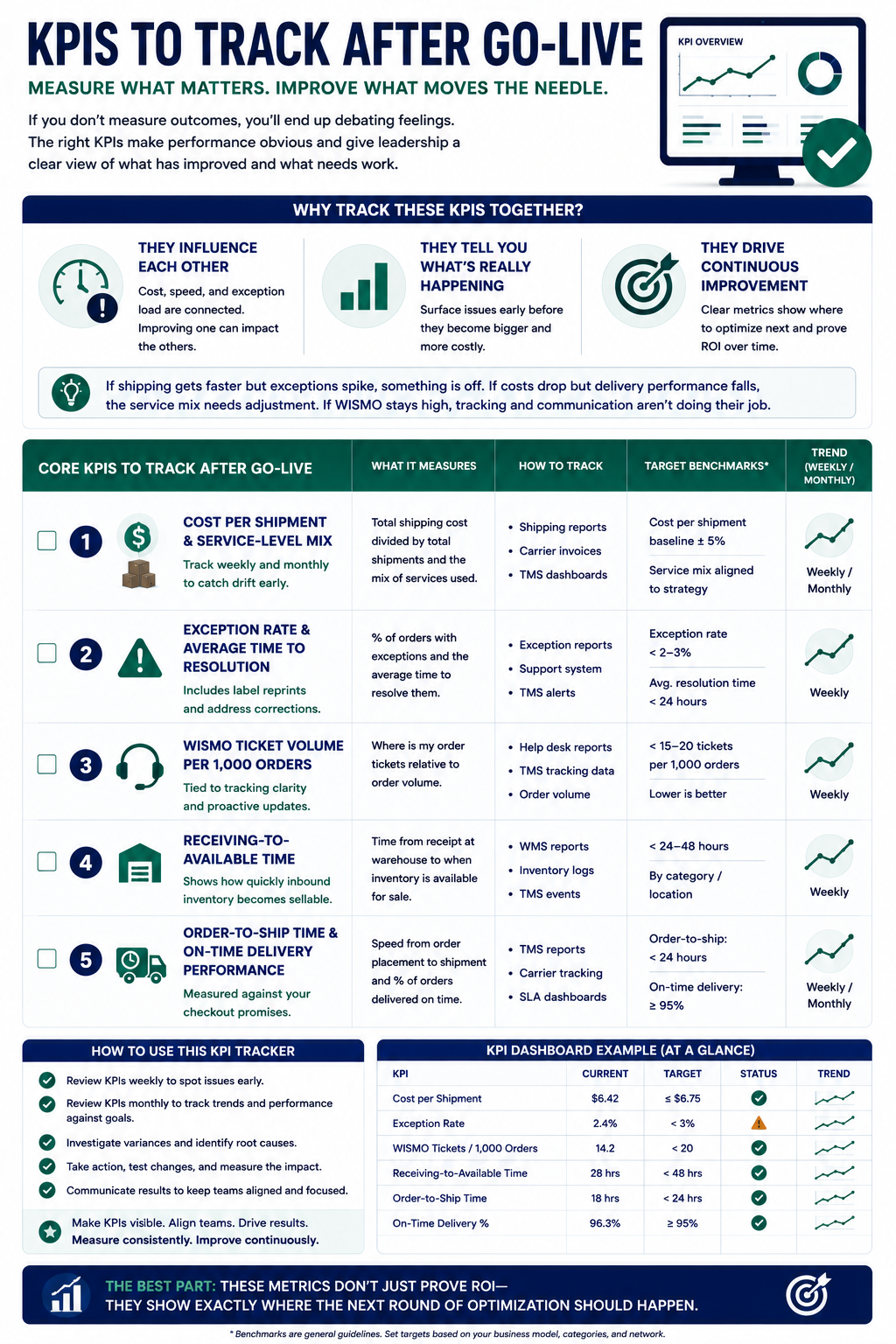
KPIs To Track After Go-Live
If you don’t measure outcomes, you’ll end up debating feelings. The right KPIs make performance obvious and give leadership a clear view of what has improved and what needs work.
Track cost, speed, and exception load together, because they influence each other. If shipping gets faster but exceptions spike, something is off. If costs drop but delivery performance falls, the service mix needs adjustment. If WISMO stays high, tracking and communication aren’t doing their job.
Here are the KPIs enterprise teams typically track after implementation.
- Cost per shipment and service-level mix, tracked weekly and monthly to catch drift early.
- Exception rate and average time to resolution, including label reprints and address corrections.
- WISMO ticket volume per 1,000 orders, tied to tracking clarity and proactive updates.
- Receiving-to-available time, which shows how quickly inbound inventory becomes sellable.
- Order-to-ship time and on-time delivery performance, measured against your checkout promises.
The best part is that these metrics don’t just prove ROI. They show exactly where the next round of optimization should happen.
See How ReadyCloud Supports Shipping And Receiving At Scale
If your team is shipping at volume, managing multiple systems, and fighting exceptions that never seem to stop, it’s a sign the execution layer needs an upgrade. ReadyCloud is built to support enterprise shipping operations that need speed, control, and visibility without turning the warehouse into a manual decision factory.
If you want to tighten receiving accuracy, improve outbound throughput, reduce support load, and keep tracking clarity consistent across split shipments and exceptions, let’s talk. We’ll walk through your current workflow, identify where costs and delays arise, and show how ReadyCloud supports shipping and receiving at scale.
The Future of Ecommerce is Now
Staying ahead in the ecommerce industry means embracing innovation and anticipating changes before they arrive. The ecommerce trends shaping 2025 provide valuable insights into what’s next, but the future also brings exciting new possibilities. Businesses that adapt quickly and leverage the right tools will thrive in this dynamic landscape.
Ready for 2026? ReadyCloud Has You Covered!
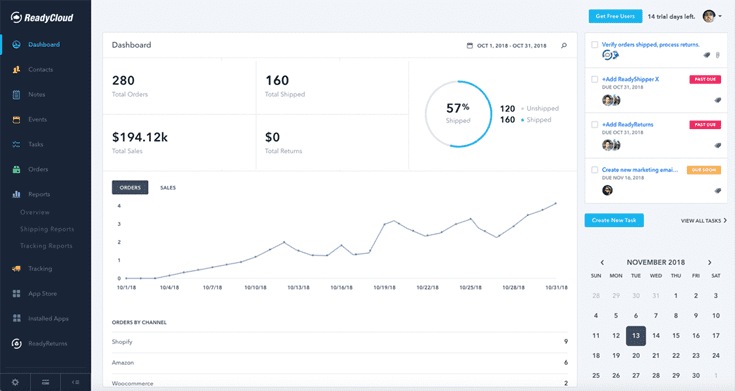
Success in 2026 starts with the right tools, and ReadyCloud’s suite of solutions is designed to propel your ecommerce business to new heights. With ReadyCloud, you’ll have all your data centralized in one place, offering insights that drive smarter decisions. Take your marketing to the next level with Action Alerts, delivering growth-focused, automated campaigns that keep your customers engaged.
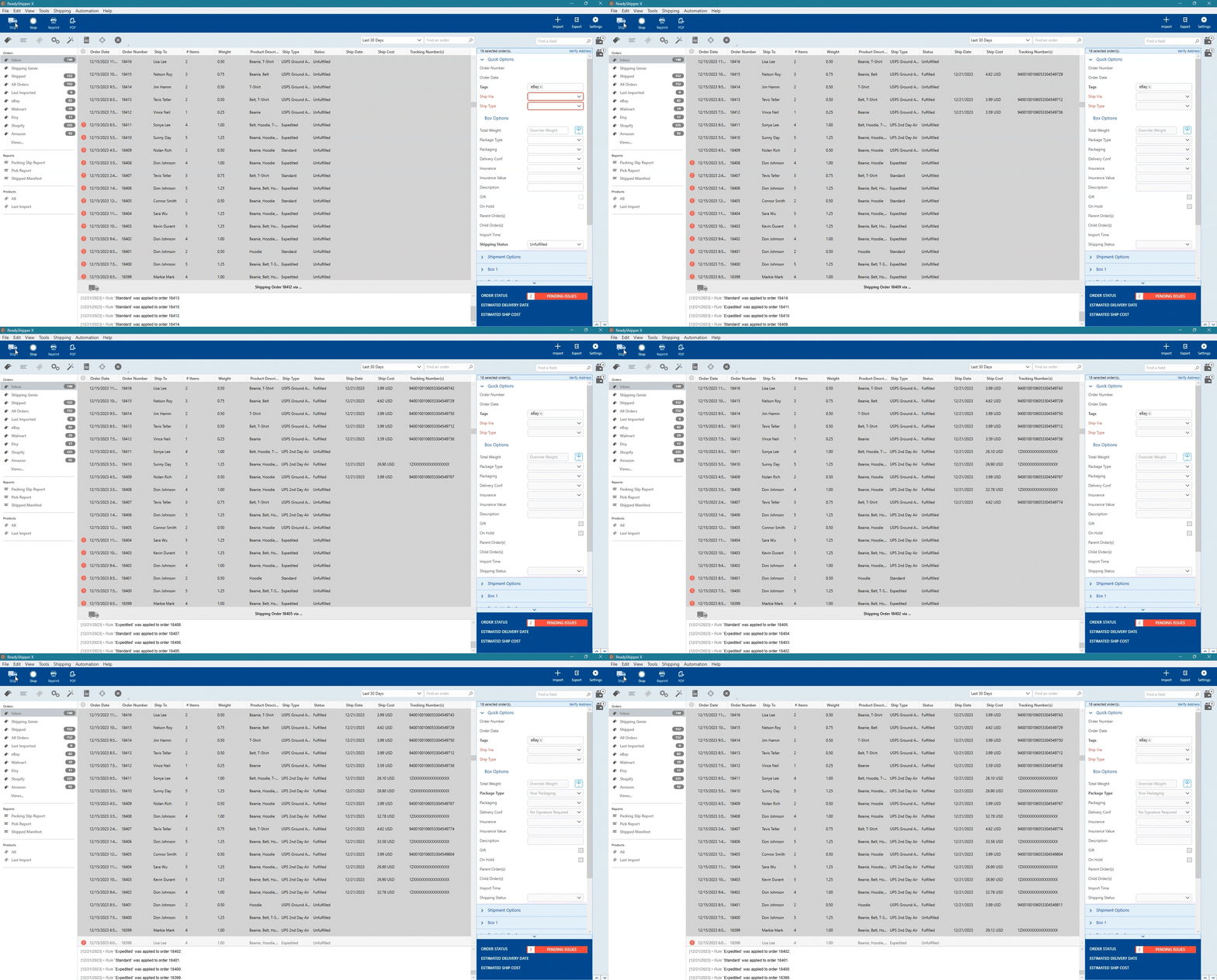
Shipping is easier than ever with ReadyShipper X, a multicarrier solution that simplifies your fulfillment process while saving time and money.
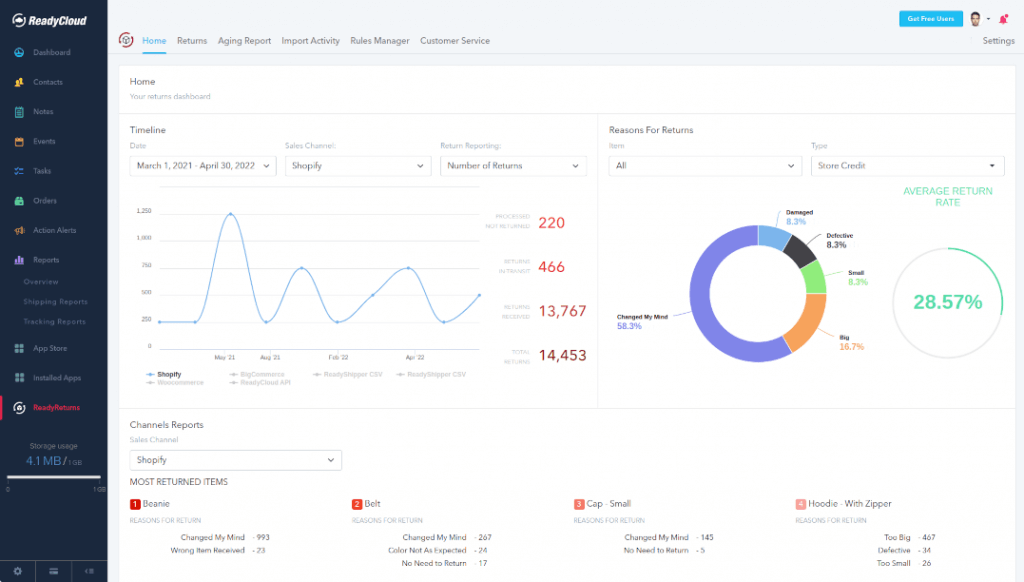
And when it comes to returns, ReadyReturns streamlines the entire process with an automated solution that boosts customer satisfaction and loyalty.
ReadyCloud is more than just a suite of systems—it’s your ticket to thriving in 2026 and beyond!
Start your journey to success today! Learn more and get started here.
Or contact our Sales Department at: 877-818-7447 ext. 1.
Frequently Asked Questions About Shipping and Receiving Software
What Is Shipping Receiving Software?
Shipping receiving software is the operational layer that helps teams manage inbound receiving and outbound shipping in a consistent, trackable workflow. It supports the real work that happens between systems of record and the physical warehouse floor, including verification, exception handling, carrier selection, label creation, and tracking visibility. Instead of relying on a mix of portals, spreadsheets, and tribal knowledge, teams use one system to keep execution predictable. It also helps connect operations and support, so customer questions don’t turn into internal scavenger hunts.
What Features Should Shipping and Receiving Software Include for Ecommerce?
Ecommerce teams need more than label printing, especially as volume rises and orders get more complex. Look for multi-carrier execution, rate comparison, rules-driven service selection, batch workflows, and clean handling for split shipments and partial fulfillment. Receiving capabilities matter too, including fast verification, clear exception processes, and the ability to make inventory available quickly without losing accuracy. The goal is fewer manual steps, fewer shipping mistakes, and a workflow that stays stable under pressure.
Can Shipping Receiving Software Work With An ERP Like SAP Or NetSuite?
Yes, and that’s often the best approach for enterprise teams. The ERP can stay the system of record for finance, inventory, and operational reporting, while a shipping execution layer handles carrier decisions and high-speed workflows. This setup avoids forcing the ERP into tasks it wasn’t designed to handle at scale. It also helps teams improve workflow quality without rebuilding their entire backend. The key is clean integration and consistent data flow, paired with execution tools that warehouse teams actually want to use.
How Does Shipping Receiving Software Reduce Shipping Costs?
Cost reduction usually comes from operational discipline, not from a single magic setting. Rules-based service selection reduces random upgrades and keeps shipping policies consistent across people and locations. Rate comparison helps teams pick smarter services for each shipment, especially when costs shift across zones and carriers. Better workflows also reduce labor waste tied to rework, label reprints, and exception chasing. Over time, these small gains add up to meaningful monthly savings.
How Does Better Tracking Reduce WISMO Tickets?
WISMO grows when customers don’t feel confident about what’s happening after checkout. Better tracking reduces that uncertainty because updates are accurate, tied to the right order, and clear about split shipments or partial deliveries. Support teams benefit too, because they can see what’s happening without asking the warehouse to investigate. Faster answers reduce back-and-forth messages and repeat tickets. The result is fewer escalations and a smoother, more reliable post-purchase experience.
What’s The Difference Between Shipping Software And Shipment Tracking Software?
Shipping software focuses on execution, including carrier selection, label creation, workflows, and handoff steps that get packages out the door. Shipment tracking software focuses on visibility after the package ships, including tracking events, exception status, and customer-facing updates. Enterprise operations need both working together, because shipping without visibility creates support problems, and tracking without execution control doesn’t fix cost and workflow issues. The best setups connect execution and visibility so teams can act quickly when something goes off track. That combined view is what drives real order clarity.
Is Amazon A Real Shipping Option For Businesses Outside Amazon?
Amazon has expanded shipping services in ways that can be useful for certain businesses, depending on lanes, delivery expectations, and cost comparisons. For some brands, it can become another option alongside traditional carriers and regional services. The operational advantage comes from having the infrastructure to test and compare options without disrupting daily workflows. Teams also need consistent rules, so adding a new shipping option doesn’t turn into inconsistent decisions across shifts. If you’re evaluating it, the right question is how it fits into your carrier mix and execution controls.
How Long Does It Take To Implement Shipping and Receiving Software?
Timelines vary based on complexity, the number of locations, system integrations, and the number of workflows that need to be standardized. Many enterprise teams take a phased approach, starting with a pilot lane or a subset of orders, then expanding after the workflow proves stable. The biggest time drivers are usually exception mapping, policy decisions, and training alignment across operations and support. A careful rollout reduces risk and prevents disruption during peak cycles. The goal is steady improvement without slowing fulfillment.
What Problems Show Up First When Scaling Shipping Operations?
The first problems usually involve inconsistency and visibility. Service selection starts to drift across people and locations, driving unpredictable costs and delivery outcomes. Manual steps become throughput bottlenecks, especially during peaks, and exceptions start piling up faster than teams can resolve them. Tracking confusion becomes a support issue, especially with split shipments and delayed carrier scans. These problems are signals that the operation needs a stronger execution layer, along with tracking clarity that keeps support and customers informed.